
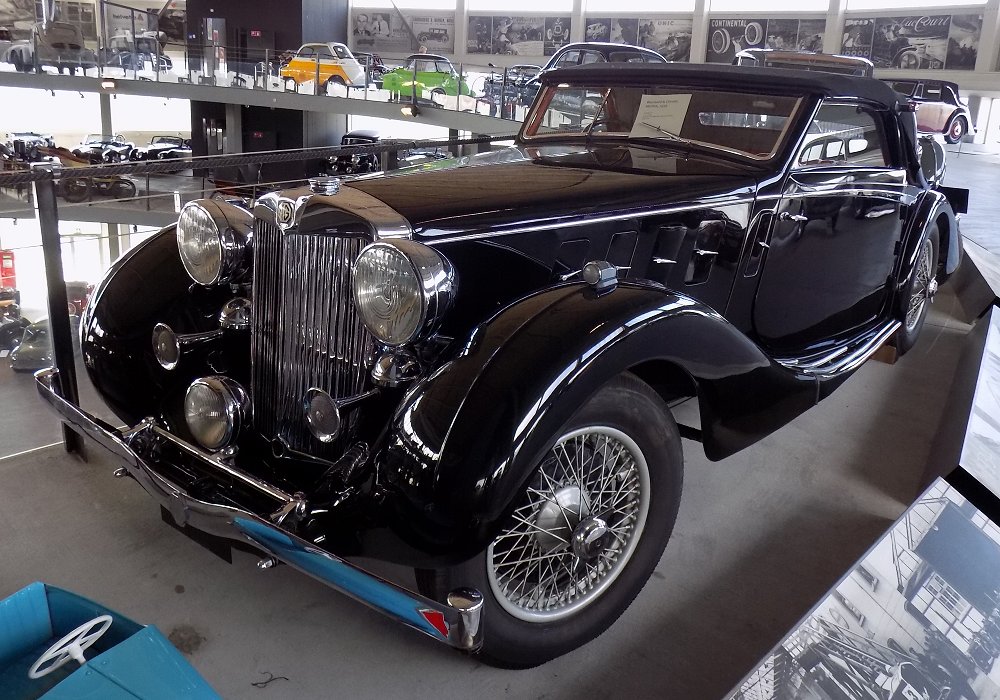
The MG WA Reinbolt & Christé was a rare coachbuilt interpretation of MG’s largest pre-war passenger car, combining the substantial engineering of the WA chassis with distinctive European coachbuilding craftsmanship. Based on the MG WA introduced in 1938, the vehicle is associated with the French coachbuilding firm Reinbolt & Christé, which specialised in creating individual bodies for customers seeking something more exclusive than standard production coachwork. The result represents an unusual meeting of British sporting-car engineering and continental coachbuilding traditions during the final years before the Second World War.
The MG WA was introduced in 1938 as the flagship of the MG range, positioned above the smaller VA and SA models. It represented the company’s most ambitious attempt to enter the market for large, luxurious sporting cars, competing with established British manufacturers such as Alvis, Lagonda and SS Cars. While MG was internationally recognised for its lightweight sports cars, the WA demonstrated that the company could also produce a substantial six-cylinder vehicle offering comfort, refinement and respectable performance.
The WA was developed from the earlier SA, incorporating a larger engine, a strengthened chassis and more generous passenger accommodation. Its considerable dimensions made it particularly suitable for specialist coachwork, allowing independent bodybuilders to create distinctive designs without the restrictions imposed by smaller sports-car chassis. The WA Reinbolt & Christé illustrates the appeal of this approach, in which an established mechanical platform could be combined with individually commissioned bodywork.
Power was supplied by a 2,561 cc inline six-cylinder engine featuring overhead valves operated by pushrods. Developed from the engine used in the SA range, the larger unit was equipped with twin SU carburettors and produced approximately 100 horsepower. This represented a substantial increase over the earlier SA and provided the WA with improved torque and acceleration. The six-cylinder configuration delivered smooth and flexible performance, making the car well suited to long-distance touring.
The engine was coupled to a four-speed manual gearbox transmitting power to the rear wheels. The transmission allowed the driver to make effective use of the engine’s relatively broad torque characteristics, providing relaxed cruising as well as sufficient acceleration for overtaking. Depending on body style, weight and mechanical condition, the WA was capable of reaching approximately 85 mph (137 km/h), an impressive figure for a large British sporting car of the late 1930s.
The chassis employed substantial ladder-frame construction, designed to accommodate the increased weight and dimensions of the WA range. Suspension consisted of rigid front and rear axles supported by semi-elliptic leaf springs, with hydraulic shock absorbers controlling movement. Hydraulically operated drum brakes provided stopping power, while the long wheelbase contributed to stable road behaviour and a comfortable ride.
The WA’s substantial chassis was particularly appropriate for specialist coachbuilders, providing a strong foundation for individually designed bodies. Reinbolt & Christé could therefore apply its own approach to exterior styling and passenger accommodation while retaining the established MG mechanical components. As with other coachbuilt vehicles of the period, the final appearance and equipment would have reflected the requirements of the original customer.
Reinbolt & Christé was based in Strasbourg, France, and was associated with the tradition of bespoke European automotive coachbuilding. During the interwar years, specialist firms offered customers the opportunity to commission distinctive bodies for chassis supplied by established manufacturers. These bodies often incorporated individually designed wings, rooflines, passenger compartments and interior fittings, allowing wealthy motorists to obtain vehicles that differed considerably from standard factory offerings.
The MG WA Reinbolt & Christé is distinguished by its association with this tradition of individual coachwork. Rather than following the conventional appearance of the standard WA saloon or Tickford Drophead Coupé, the coachbuilt vehicle reflected the styling preferences of its builder and original customer. Its British mechanical foundations were combined with continental design influences, giving it a distinctive place within MG’s pre-war history.
The WA’s long bonnet and prominent upright radiator provided an imposing starting point for the coachbuilder. These features were characteristic of MG’s larger sporting cars and helped establish the vehicle’s visual identity. The substantial wheelbase allowed considerable freedom in the arrangement of the passenger compartment and rear bodywork, while separate headlamps, flowing wings and traditional wire-spoked wheels contributed to its period appearance.
Because the Reinbolt & Christé designation refers to specialist coachwork rather than a standardised factory body style, details of the individual car’s construction should be established from surviving photographs and historical documentation. Coachbuilt vehicles were frequently produced as one-off commissions, and their specifications could differ substantially from those of regular production models.
Inside, a Reinbolt & Christé-bodied WA would have offered the opportunity for a highly individual interior specification. The standard WA already provided luxurious accommodation, with leather upholstery, polished wood trim and comprehensive instrumentation. Specialist coachwork could incorporate alternative seating arrangements, distinctive interior materials and individually designed fittings, reflecting the preferences of the commissioning customer.
The driving experience remained fundamentally that of the MG WA, combining smooth six-cylinder performance with the stable road behaviour of a substantial touring chassis. The engine’s generous torque made the car suitable for relaxed long-distance travel, while the manual gearbox and conventional suspension retained the mechanical character of a pre-war British sporting car. The weight and configuration of the coachbuilt body would have influenced acceleration, handling and overall refinement.
The MG WA was produced during a particularly difficult period for European luxury-car manufacturers. Introduced in 1938, it entered a market already affected by political uncertainty and the approaching threat of war. The outbreak of the Second World War in September 1939 brought civilian vehicle production at MG to a halt, ending the company’s ambitious programme of large sporting saloons and touring cars.
Only approximately 369 MG WA cars were manufactured during the model’s short production life. This limited total makes the WA one of MG’s rarest regular production models, while individually coachbuilt examples are considerably more unusual. The Reinbolt & Christé-bodied car therefore occupies a particularly distinctive position within the history of the range.
Following the war, MG concentrated increasingly on smaller sports cars and more conventional saloons. The company did not return to the production of large luxury vehicles comparable with the WA, making the model an important reminder of its broader ambitions during the late 1930s. The combination of a powerful six-cylinder engine and substantial chassis represented the culmination of MG’s pre-war development of prestigious sporting cars.
Today, the MG WA Reinbolt & Christé is of considerable interest to historians and collectors of rare coachbuilt automobiles. Its appeal lies not only in the scarcity of the WA chassis but also in the association with specialist French craftsmanship. Vehicles of this kind are particularly valued when their original bodywork, mechanical components and historical documentation have survived.
Restoration of an individually coachbuilt WA can present significant challenges. Mechanical components specific to the WA are relatively scarce, while unique body panels, structural framework and interior fittings may require specialist fabrication. Preserving the original coachbuilder’s design and construction methods is especially important, as these features form an essential part of the vehicle’s historical identity.
The MG WA Reinbolt & Christé represents an intriguing combination of British automotive engineering and French coachbuilding artistry. By pairing MG’s most substantial pre-war chassis with individually commissioned European bodywork, it illustrates the diversity of the luxury-car market during the 1930s. Its rarity, distinctive origins and association with the final generation of large pre-war MGs make it a fascinating example of the craftsmanship and individuality that characterised specialist motoring before the Second World War.