
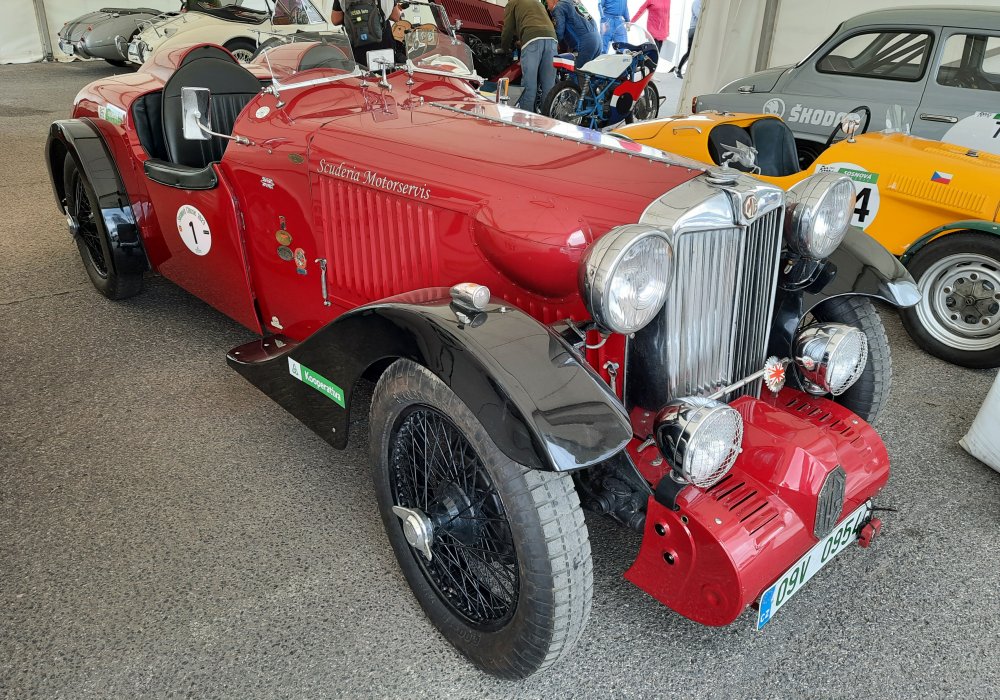
The MG VA Supercharged Special represents an unusual and highly individual interpretation of MG’s pre-war VA range, combining the mechanical foundations of the company’s 1½-litre sporting car with the enhanced performance offered by forced induction. Based on the MG VA introduced in 1937, the Supercharged Special reflects the British tradition of modifying production vehicles for greater performance, often through the installation of lightweight bodywork and specialist mechanical components. Rather than being a regular factory-produced model, the designation describes a VA-based special fitted with a supercharged engine, with its precise specification dependent upon the individual vehicle and its development history.
The MG VA was introduced in February 1937 as the smallest member of MG’s new range of larger sporting cars, positioned below the six-cylinder SA. It was designed to provide a combination of respectable performance, comfortable accommodation and the distinctive sporting character associated with the MG marque. Available in saloon, tourer and Tickford Drophead Coupé forms, the VA offered a more practical alternative to MG’s smaller two-seat sports cars while retaining sufficient performance to appeal to enthusiastic motorists.
The standard VA was powered by a 1,548 cc inline four-cylinder engine featuring overhead valves operated by pushrods. Derived from Wolseley engineering and adapted for MG applications, the engine was equipped with twin SU carburettors and produced approximately 55 horsepower. Although designed primarily for sporting saloon and touring applications, the engine provided a useful foundation for performance modifications, particularly when combined with reductions in vehicle weight.
Supercharging offered a means of increasing the engine’s output without requiring a substantial increase in displacement. A mechanically driven compressor forced additional air into the cylinders, allowing a greater quantity of fuel to be burned and producing more power. Roots-type superchargers were widely associated with British sporting and competition cars during the 1930s, although the precise type of supercharger fitted to an individual VA Special would depend upon its construction and subsequent modifications.
The installation of a supercharger generally required changes to the engine’s induction system, including revised carburation and additional pipework. Depending on the intended boost pressure, modifications could also include changes to the compression ratio, ignition timing, lubrication and cooling arrangements. These alterations were particularly important when adapting an engine originally designed for naturally aspirated operation, as forced induction increased both mechanical and thermal loads.
The performance of an MG VA Supercharged Special would depend upon its particular engine specification, supercharger installation and overall vehicle weight. A carefully prepared conversion could provide considerably stronger acceleration and improved flexibility compared with the standard VA. However, there was no universally established factory specification for a supercharged VA Special, and precise horsepower or maximum-speed figures cannot be reliably attributed to the designation without documentation of the individual car.
Power was normally transmitted to the rear wheels through a four-speed manual gearbox, following the general mechanical arrangement of the standard VA. The original transmission was designed for the relatively modest torque output of the naturally aspirated engine, so a substantial increase in performance could place additional demands on the clutch, gearbox and rear axle. Competition-oriented conversions sometimes incorporated stronger components or revised gearing to improve durability and acceleration.
The MG VA chassis employed a substantial steel frame with independent front suspension using torsion bars, while the rear axle was supported by semi-elliptic leaf springs. Hydraulic shock absorbers controlled suspension movement, and hydraulically operated drum brakes provided stopping power. This arrangement was relatively advanced for a British sporting car of the period, particularly when compared with the rigid front axles used on MG’s smaller T-type Midgets.
For a sporting special, the VA chassis offered several advantages. Its independent front suspension provided improved wheel control over uneven road surfaces, while the substantial frame offered a strong foundation for mechanical development. However, the standard VA was designed to accommodate relatively heavy saloon and touring bodies, making weight reduction an important consideration for builders seeking greater performance.
The appearance of an MG VA Supercharged Special could differ considerably from that of the standard production models. Some conversions retained much of the original bodywork, while others incorporated lightweight aluminium panels and simplified sporting bodies. Competition-inspired examples might feature a long bonnet, low windscreen, compact passenger compartment and narrow cycle wings, creating a more purposeful profile than the conventional VA saloon or tourer.
The supercharger installation could also influence the external appearance of the car. Depending on the position of the compressor and associated induction components, modifications to the bonnet or engine compartment might be necessary. Additional ventilation, exposed pipework or revised exhaust arrangements could distinguish a supercharged special from an otherwise standard vehicle. These features, however, varied according to the individual conversion and should not be considered universal characteristics.
Inside, a VA Supercharged Special would generally provide a more functional environment than the standard production car, particularly if prepared for competition. The original VA featured comfortable seating, traditional instrumentation and relatively refined interior trim. A special-bodied conversion might instead incorporate lightweight seats, simplified panels and additional gauges to monitor engine performance. Oil pressure, engine temperature and, where fitted, boost pressure instrumentation could be particularly important for a supercharged engine.
The driving experience of a supercharged VA special would be influenced by the increased engine output and any reduction in overall weight. Forced induction could provide stronger acceleration and more immediate response under load, while lightweight bodywork could improve braking and cornering performance. The combination of a substantial pre-war chassis and enhanced power nevertheless required careful driving, particularly on narrow tyres and uneven road surfaces.
The construction of supercharged specials formed part of a broader tradition of British sporting engineering during the interwar and post-war periods. Enthusiasts frequently modified existing production cars to compete in trials, hill climbs, sprints and club racing. MG vehicles were particularly attractive for such projects because of the marque’s sporting reputation and its earlier success with supercharged competition models, including the C-type Midget, J4 Midget and K3 Magnette.
Although the standard VA was not designed as a dedicated racing car, its mechanical layout offered opportunities for development. The installation of a supercharger could transform its performance characteristics, particularly when combined with lighter bodywork and revised suspension settings. Such conversions reflected the ingenuity of private builders and specialist workshops rather than a formal MG factory development programme.
Production of the standard MG VA continued from 1937 until 1939, with approximately 2,407 examples manufactured across the various body styles. The outbreak of the Second World War brought civilian car production to a halt, ending the development of MG’s pre-war larger sporting-car range. Because supercharged VA specials were individually modified rather than produced as a separate factory model, no definitive production figure exists for this configuration.
Today, an MG VA Supercharged Special is of particular interest to collectors of unusual pre-war British sports cars and historic competition machinery. Its appeal lies in the combination of MG’s established engineering, the additional performance of forced induction and the individuality of specialist construction. Examples with documented period conversions, recognised competition histories or distinctive original coachwork can be especially desirable.
Restoration and maintenance require careful attention to both the original VA mechanical components and the modifications introduced during the conversion. Supercharging increases the demands placed upon the engine, making correct lubrication, cooling, ignition settings and fuel delivery particularly important. The condition of the clutch, gearbox, brakes and chassis must also be considered when assessing a vehicle with substantially increased performance.
The MG VA Supercharged Special represents a fascinating aspect of MG’s pre-war heritage and the wider British tradition of individually developed sporting cars. By combining the relatively sophisticated VA chassis with forced-induction technology and potentially lightweight bodywork, specialist builders could create a distinctive machine with performance beyond that of the standard production model. Although not a regular factory offering, the Supercharged Special demonstrates the adaptability of MG engineering and the enthusiasm of motorists who sought to develop their cars beyond their original specifications.