
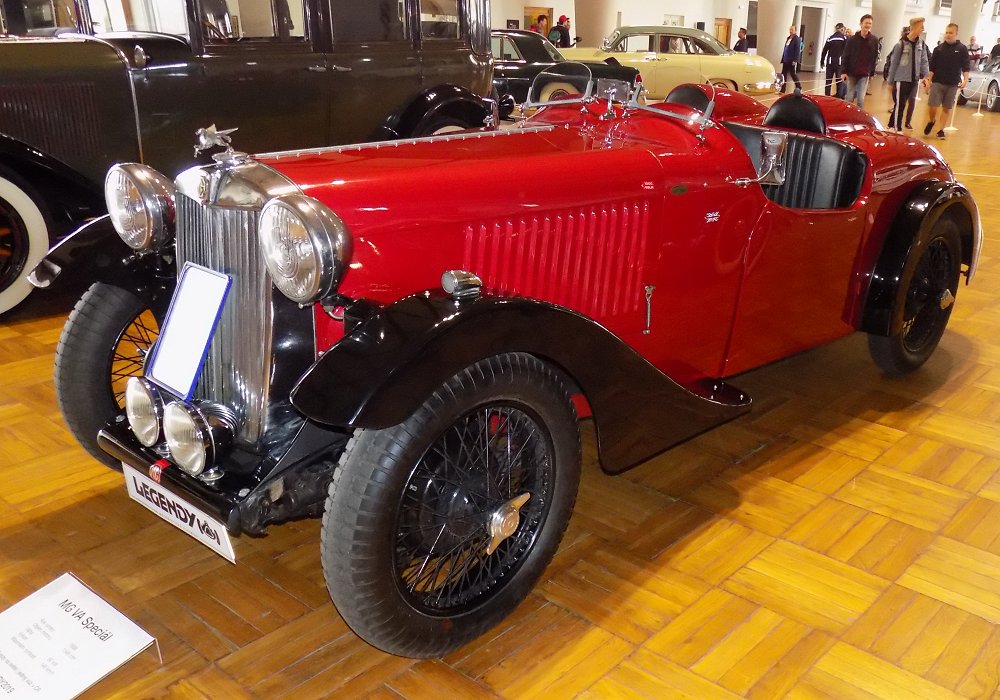
The MG VA Real Demon Special is an unusual example of a specially modified MG VA, combining the engineering foundations of MG’s pre-war 1½-litre range with the individual character of a sporting special. Based on the MG VA introduced in 1937, the Real Demon Special belongs to the tradition of British enthusiasts transforming production cars into more distinctive and performance-oriented machines. Rather than representing a regular factory-produced MG model, the Real Demon Special is best understood as an individually developed vehicle whose precise specification and history depend upon its documented construction and subsequent modifications.
The MG VA was introduced in 1937 as the smallest member of MG’s new range of larger sporting cars, positioned below the six-cylinder SA. It was intended to provide a balance between the practicality of a family car and the responsive performance associated with the MG marque. Available in saloon, tourer and drophead coupé forms, the VA featured a relatively sophisticated chassis and a four-cylinder engine that provided useful performance for its class. Its mechanical layout also offered a suitable foundation for specialist conversions.
The standard MG VA was powered by a 1,548 cc inline four-cylinder engine featuring overhead valves operated by pushrods. Derived from the Morris/Wolseley engine family and developed for MG use, the unit produced approximately 55 horsepower. Although designed primarily for sporting saloon and touring applications, the engine offered sufficient flexibility for enthusiastic driving and could be modified to improve its performance. In a special-bodied car, reductions in overall weight could also provide a noticeable improvement in acceleration and responsiveness.
The precise engine specification of the Real Demon Special should be distinguished from that of the standard VA. Individually constructed specials frequently incorporated mechanical changes during their development, including revised carburation, modified cylinder heads, alternative exhaust arrangements or replacement engines. Without verified records for the Real Demon Special itself, it would be misleading to attribute a particular horsepower output, engine capacity or induction system to the car.
The original VA employed a four-speed manual gearbox transmitting power to the rear wheels. Its chassis featured a substantial steel frame, independent front suspension with torsion bars and a conventional live rear axle supported by semi-elliptic leaf springs. Hydraulic drum brakes provided stopping power. These features gave the VA more advanced road manners than many smaller MG sports cars of the period, particularly in terms of ride comfort and front-wheel control.
For a sporting special, the VA chassis offered both opportunities and challenges. Its relatively substantial construction was intended to support comfortable touring bodies rather than an exceptionally lightweight racing machine. However, removing heavy production coachwork and replacing it with a lighter body could significantly alter the vehicle’s performance and handling characteristics. Depending on the builder’s objectives, additional changes might be made to suspension settings, steering components, wheel equipment and braking arrangements.
The appearance of the MG VA Real Demon Special is one of the characteristics that distinguishes it from the standard VA range. Special-bodied British cars of this period frequently adopted a more purposeful sporting profile, with a long bonnet, compact passenger compartment and simplified bodywork. Lightweight aluminium panels, low windscreens, exposed wheels and shortened rear sections were common features of competition-inspired specials, although the exact configuration of the Real Demon Special must be established from photographs and historical documentation of the individual car.
The name Real Demon Special suggests a deliberately individual identity rather than a conventional MG model designation. Such names were frequently associated with privately constructed or extensively modified British sports cars, reflecting the personality of their builders and the sporting ambitions behind their construction. The designation does not, by itself, establish a particular factory connection, competition history or technical specification.
Inside, a VA-based special could provide a considerably different driving environment from the standard saloon or tourer. Whereas the production VA offered comfortable seating, traditional instruments and relatively generous passenger accommodation, a sporting conversion might employ lightweight seats, reduced interior trim and a simplified dashboard. Additional instruments could be fitted to monitor engine temperature, oil pressure and other mechanical functions during demanding driving.
The driving characteristics of a lightweight VA special would depend heavily on the extent of its modifications. Reducing body weight could improve acceleration and braking while giving the car a more immediate response to steering inputs. The relatively long wheelbase and substantial chassis of the original VA would nevertheless influence its behaviour, producing a different character from that of the smaller MG Midget sports cars.
The wider historical context of the Real Demon Special is closely connected with Britain’s tradition of constructing sporting specials from existing production vehicles. During the 1930s and particularly after the Second World War, enthusiasts frequently adapted older cars for trials, hill climbs, sprints and club racing. MG chassis were popular for such projects because of their sporting reputation, accessible engineering and the availability of specialist knowledge.
The MG VA itself remained in production until 1939, when the outbreak of the Second World War brought civilian car manufacturing to a halt. Approximately 2,407 examples were produced across the standard body styles. Although the VA was less numerous than many of MG’s smaller sports cars, it established an important place in the company’s pre-war range as a capable sporting family car.
Today, the MG VA Real Demon Special is of interest as an individual expression of British specialist car construction. Its historical significance depends not simply on its MG origins but on the circumstances of its conversion, the identity of its builder, its mechanical development and any documented sporting achievements. Establishing these details is particularly important when distinguishing an authentic period special from a vehicle modified or reconstructed many years later.
Restoration and preservation of such a car can present unusual challenges. Unlike a standard production MG, an individually constructed special may contain unique body panels, modified chassis components and mechanical parts sourced from several different vehicles. Maintaining its historical character may therefore require careful research and specialist fabrication rather than simply returning it to standard MG VA specification.
The MG VA Real Demon Special illustrates the adaptability of pre-war British engineering and the enthusiasm of individuals who sought to create distinctive sporting vehicles from established production machinery. While its precise technical details and historical development require individual documentation, its identity as a VA-based special places it within a long tradition of independent automotive craftsmanship. It represents an intriguing and uncommon interpretation of MG’s pre-war sporting heritage, demonstrating how the company’s larger touring-car chassis could provide the foundation for a unique and highly individual motor car.