
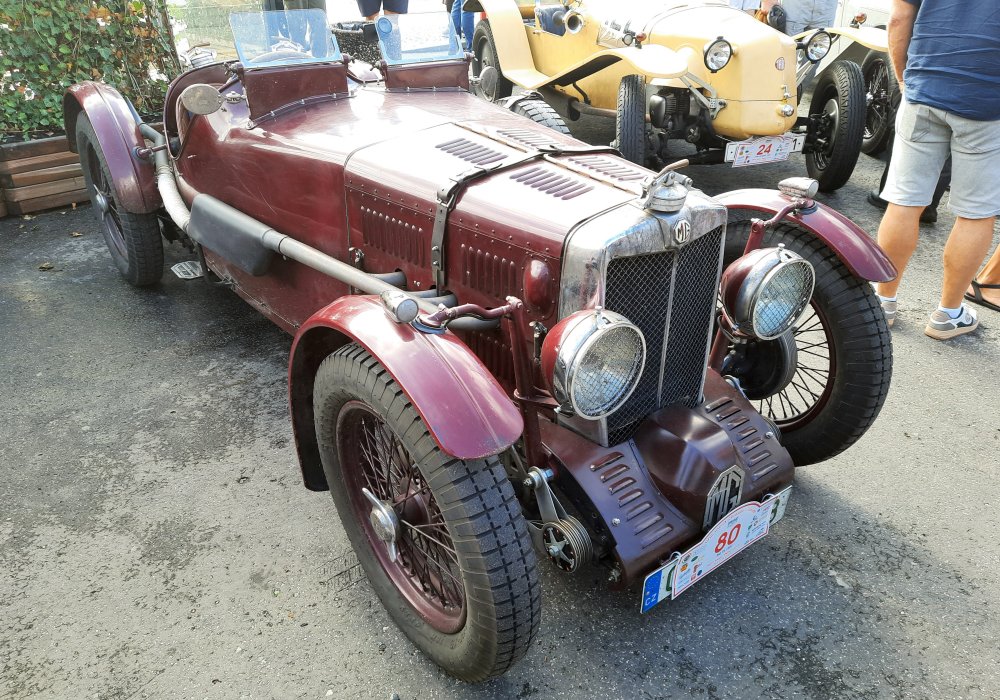
The MG TA Special 1350 was a modified version of the pre-war MG TA Midget, developed to provide improved performance through engine enlargement, mechanical tuning and, in some cases, lightweight competition bodywork. Based on the MG TA introduced in 1936, the Special 1350 represented the tradition of privately developed British sports cars, in which enthusiasts and specialist engineers adapted existing production vehicles for more demanding sporting use. Rather than being a separately catalogued factory model, the designation generally describes an individual TA-based special fitted with an engine of approximately 1,350 cc.
The MG TA Midget provided a suitable foundation for such conversions. Introduced as the successor to the PB Midget, it marked the beginning of MG’s successful T-type series and incorporated a larger chassis, improved passenger accommodation and more conventional mechanical components than its predecessors. The TA’s relatively straightforward construction made it particularly attractive to owners interested in modifying their cars for competition, while the availability of Morris-derived mechanical components offered opportunities for engine development.
The standard TA was powered by a 1,292 cc inline four-cylinder engine derived from the Morris Ten. Featuring overhead valves operated by pushrods and twin SU carburettors, the engine developed approximately 50 horsepower at 4,500 rpm. Although the engine lacked the overhead-camshaft arrangement of earlier MG Midgets, it offered useful torque and a relatively robust mechanical design. These characteristics made it a practical starting point for performance modifications.
The 1350 designation indicates an engine capacity of approximately 1.35 litres, although the precise displacement and internal specification would depend upon the individual conversion. An increase in capacity could be achieved through alterations to the cylinder bore, crankshaft stroke or a combination of both. Such modifications were intended to improve torque and acceleration, particularly when combined with changes to the induction, exhaust and ignition systems.
Engine tuning could also include higher-compression pistons, modified cylinder heads, revised camshaft profiles and improved carburation. These changes were commonly employed in the preparation of small-capacity British competition engines, although they should not be assumed to have been fitted to every TA Special 1350. Without the build records of a particular vehicle, it is not possible to establish a definitive engine specification or reliable horsepower figure for the designation.
Power was normally transmitted to the rear wheels through a four-speed manual gearbox. The original TA transmission incorporated synchromesh on the upper three ratios, making it relatively convenient for road use. Competition-prepared specials sometimes received modified gear ratios or alternative transmission components to suit their increased engine performance. The final specification depended upon whether the vehicle was intended for road driving, hill climbs, trials or circuit racing.
The chassis retained the basic ladder-frame construction of the MG TA, with rigid front and rear axles supported by semi-elliptic leaf springs. Hydraulic shock absorbers controlled suspension movement, while hydraulically operated drum brakes provided stopping power. Although conventional by modern standards, this arrangement was typical of British sports cars during the late 1930s and offered a durable foundation for sporting development.
Competition modifications could include changes to spring rates, shock absorber settings, steering geometry and braking components. Reducing overall weight was another important consideration, particularly for cars intended for hill climbs and short-distance racing. A lighter body could improve acceleration, braking and cornering performance without requiring substantial increases in engine output.
The appearance of an MG TA Special 1350 could differ considerably from that of the standard roadster. Some conversions retained the original two-seat body, with its upright MG radiator grille, long bonnet, separate headlamps and sweeping wings. Others adopted lightweight aluminium coachwork, narrow cycle wings, reduced-height windscreens and simplified rear body sections. These alterations reflected the individual requirements of the builder and the intended purpose of the vehicle.
The traditional MG radiator grille and wire-spoked wheels were frequently retained on TA-based specials, preserving a visual connection with the original T-type design. Competition examples could incorporate additional bonnet ventilation, external exhaust arrangements or modified engine covers to accommodate altered mechanical components. The resulting cars often possessed a purposeful appearance that distinguished them from standard production MGs.
Inside, the Special 1350 would typically retain a simple and functional driving environment. Road-going examples might preserve much of the original TA interior, including leather seating, traditional instrumentation and the large steering wheel. Competition-oriented vehicles could feature lightweight seats, reduced trim and additional gauges for monitoring engine performance. The emphasis was generally placed on driver control and mechanical accessibility rather than luxury.
The driving characteristics of a TA Special 1350 would depend upon the extent of its modifications. An enlarged and carefully tuned engine could provide stronger acceleration and improved flexibility compared with the standard 1,292 cc unit. Combined with reduced body weight, these improvements could produce a noticeably more responsive sports car. However, the traditional chassis, narrow tyres and relatively simple suspension demanded considerable driver involvement, particularly during enthusiastic cornering or driving on uneven roads.
The development of special-bodied MGs formed an important part of British motorsport culture before and after the Second World War. Private owners frequently modified older MGs to compete in trials, hill climbs, sprints and club racing, where relatively inexpensive machinery could remain competitive through careful preparation. The TA was particularly suitable for this activity because its chassis and mechanical components were familiar to enthusiasts and specialist workshops.
The 1,350 cc capacity also placed such a vehicle within the broader tradition of small-displacement competition cars, although eligibility for particular events depended upon the regulations in force at the time. Engine capacity, induction type, vehicle weight and permitted modifications could all influence the class in which a special competed. Consequently, the sporting history of any individual TA Special 1350 needs to be considered in relation to its documented specification and competition record.
The standard MG TA Midget was manufactured between 1936 and 1939, with approximately 3,003 examples produced before its replacement by the MG TB. The later TB introduced the 1,250 cc XPAG engine, which subsequently became central to MG’s post-war sports car development. TA-based specials continued to be constructed and modified after the original model had ceased production, extending the sporting life of the pre-war chassis.
There is no established separate factory production figure for the MG TA Special 1350, and the designation should not be interpreted as identifying a standard MG production variant. Individual vehicles may have undergone substantial alterations over several decades, making documented provenance particularly important when establishing their original configuration and historical significance.
Today, an MG TA Special 1350 is of interest to enthusiasts of pre-war British sports cars and historic competition machinery. Examples with documented period modifications, recognised competition histories or distinctive specialist bodywork can be particularly desirable. Their value and historical importance depend upon the authenticity of the individual vehicle, the quality of its construction and the preservation of significant original components.
Maintenance and restoration require an understanding of both the original MG TA engineering and the modifications incorporated into the special. Enlarged engines may use non-standard pistons, crankshafts or other internal components, while individual bodywork and chassis alterations can complicate restoration. Accurate mechanical records and careful identification of fitted components are therefore especially valuable.
The MG TA Special 1350 represents the ingenuity and enthusiasm associated with Britain’s long tradition of privately developed sports cars. By combining the established TA chassis with an enlarged engine and potentially lighter bodywork, builders could create a more individual and competitive machine while retaining the essential character of the original MG. Although not a distinct factory model, the Special 1350 illustrates the adaptability of the early T-type design and the enduring appeal of modifying modest British sports cars for improved performance.
Create image