
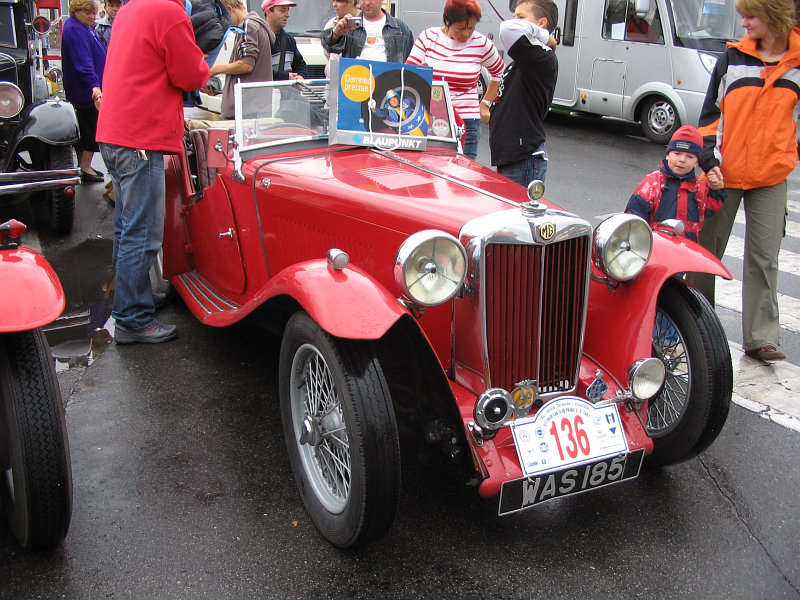
The MG TB Midget was introduced in May 1939 as the successor to the successful MG TA Midget, representing an important development in MG’s celebrated T-type sports car series. Although externally similar to its predecessor, the TB incorporated significant mechanical improvements, most notably the introduction of the new XPAG engine. Produced at the MG factory in Abingdon, Oxfordshire, the TB combined traditional British sports car styling with improved performance and greater mechanical sophistication. Its production life was cut short by the outbreak of the Second World War, making it one of the rarest and most historically significant models in the T-type family.
The introduction of the TB followed the success of the TA, which had established a new direction for MG’s small sports cars. While the TA had adopted a larger, Morris-derived engine and more spacious bodywork, the TB was designed to improve performance and refinement without fundamentally altering the established T-type formula. The most important change was the replacement of the TA’s 1,292 cc engine with a newly developed 1,250 cc four-cylinder unit, which would subsequently become one of the most successful engines in MG’s history.
The TB was powered by the 1,250 cc XPAG inline four-cylinder engine, featuring overhead valves operated by pushrods and twin SU carburettors. Despite its slightly smaller displacement than the TA engine, the XPAG produced approximately 54 horsepower at 5,200 rpm, representing an improvement in both power output and engine efficiency. The engine incorporated a more modern design with improved breathing characteristics and a stronger bottom end, allowing it to operate reliably at higher engine speeds.
One of the most significant advantages of the XPAG engine was its greater potential for further development. Its robust construction and relatively efficient cylinder head made it particularly suitable for performance tuning, a characteristic that would prove valuable in subsequent MG sports cars. The engine’s combination of smooth operation, flexibility and lively response helped establish the mechanical character of the T-type series during the following decade.
Power was transmitted to the rear wheels through a four-speed manual gearbox, which featured synchromesh on the upper three ratios. The transmission was revised to suit the characteristics of the new engine, providing improved gear selection and a more responsive driving experience. The TB was capable of reaching approximately 80 mph (129 km/h), depending on road conditions and vehicle specification. Its relatively low weight and improved engine performance contributed to lively acceleration, making it a capable small sports car by the standards of the late 1930s.
The chassis retained the traditional ladder-frame construction of the TA, with rigid front and rear axles supported by semi-elliptic leaf springs. Hydraulic shock absorbers controlled suspension movement, while hydraulically operated drum brakes provided stopping power. Although the basic suspension arrangement remained unchanged, the TB benefited from refinements intended to improve handling and road behaviour. The combination of compact dimensions, relatively low weight and direct steering gave the car the responsive character associated with MG sports cars.
The TB retained the familiar appearance of the TA Midget, featuring a long bonnet, upright MG radiator grille, separate chrome headlamps and sweeping wings. The open two-seat body incorporated cut-down doors, a folding fabric hood and detachable side screens, providing basic protection from the elements. Wire-spoked wheels, running boards and a rear-mounted spare wheel completed the traditional styling, giving the TB an appearance that was immediately recognisable as an MG.
Although the external differences between the TA and TB were relatively subtle, the later model incorporated changes to accommodate its revised mechanical components. The overall proportions remained similar, with a wheelbase of approximately 94 inches (2,388 mm). The compact body and narrow track contributed to the car’s agility, while the traditional styling preserved the visual character that had made the T-type series popular among British sporting motorists.
Inside, the TB offered a simple but attractive cockpit, with leather-trimmed seating and a traditional dashboard. Instrumentation included a speedometer, tachometer, oil-pressure gauge and other essential controls. The large steering wheel, floor-mounted gear lever and upright driving position reflected contemporary sports car design. Although the cabin remained compact, it provided sufficient accommodation for two occupants and was more spacious than the earlier P-type Midgets.
The driving experience was characterised by direct steering, a relatively firm ride and the distinctive sound of the XPAG engine. The improved power delivery made the TB more responsive than the TA, particularly when driven enthusiastically through the gears. With minimal insulation from wind, road noise and mechanical vibration, the car offered a level of driver involvement that became central to the appeal of traditional MG sports cars.
The TB was also available with alternative coachwork, most notably the Tickford Drophead Coupé, which featured a more luxurious enclosed body produced by Salmons & Sons. This version offered improved weather protection and greater refinement while retaining the mechanical specification of the standard sports car. Such variations demonstrated the adaptability of the T-type chassis and appealed to buyers seeking a more comfortable alternative to the open roadster.
The outbreak of the Second World War in September 1939 brought civilian car production at MG to an abrupt halt. As a result, the TB remained in production for only a few months, with approximately 379 examples manufactured. This exceptionally short production run makes it one of the rarest standard-production MG T-type models and contributes significantly to its desirability among collectors.
Despite its limited production, the TB had a lasting influence on MG’s subsequent development. The XPAG engine introduced in the TB was retained and further developed for the post-war MG TC, which entered production in 1945. The same basic engine design subsequently powered the MG TD and early MG TF, becoming closely associated with the international success of British sports cars during the late 1940s and early 1950s.
The TB therefore occupies an important position in MG history as the link between the pre-war TA and the highly successful post-war TC. Although its production was interrupted by wartime circumstances, the model introduced the mechanical foundation that would support MG’s sports car range for many years. Its combination of traditional styling and improved engineering helped establish the characteristics that made the later T-type models so successful.
Today, the MG TB Midget is highly regarded among collectors and enthusiasts of pre-war British sports cars. Its rarity, historical significance and association with the introduction of the XPAG engine make it particularly desirable. Surviving examples are often carefully restored or preserved, with considerable attention given to maintaining original mechanical components, bodywork and period-correct details.
Restoration can present challenges because of the model’s limited production and the availability of certain TB-specific components. Although many mechanical parts share similarities with later T-type models, differences in the chassis, bodywork and early XPAG installation require careful consideration. Originality and documented provenance are particularly important when assessing surviving examples, especially given the close visual resemblance between the TA, TB and early TC.
The MG TB Midget represents a significant milestone in the evolution of MG’s small sports cars. By introducing the XPAG engine while retaining the attractive styling and engaging character of the TA, it successfully combined traditional British sports car design with improved mechanical performance. Although only a small number were manufactured before the outbreak of war, the TB’s influence extended throughout the post-war T-type series. Its rarity, engineering importance and classic appearance ensure that it remains one of the most fascinating models in MG’s pre-war history.