
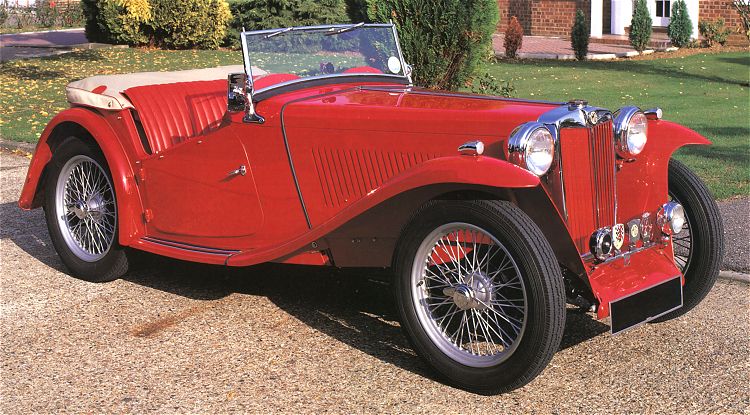
The MG TC Midget was introduced in September 1945 as the first new MG sports car to enter production following the Second World War. Developed from the pre-war MG TB, the TC retained the traditional appearance and mechanical simplicity of its predecessor while incorporating improvements to passenger accommodation and everyday usability. Produced at the MG factory in Abingdon, Oxfordshire, between 1945 and 1949, the TC became one of the most influential British sports cars of the immediate post-war period. Its popularity among overseas buyers, particularly in the United States, helped establish the international reputation of MG and played an important role in the growing enthusiasm for British sports cars.
The introduction of the TC came at a time when the British motor industry was recovering from the disruption of wartime production. MG had ceased civilian car manufacturing in 1939, and the company faced significant challenges in obtaining materials and restarting production. Rather than developing an entirely new sports car, MG chose to update the existing TB design, allowing manufacturing to resume relatively quickly. The resulting TC retained the familiar T-type styling and mechanical layout while offering a slightly wider body and improved interior accommodation.
Power was supplied by the established 1,250 cc XPAG inline four-cylinder engine, first introduced in the MG TB. Featuring overhead valves operated by pushrods and twin SU carburettors, the engine developed approximately 54.5 horsepower at 5,200 rpm. Although modest by later standards, the XPAG was a responsive and relatively durable unit that suited the lightweight character of the TC. Its willingness to operate at higher engine speeds and its potential for tuning made it particularly popular among sporting motorists.
The engine incorporated a cast-iron cylinder block and cylinder head, with a conventional overhead-valve arrangement and a relatively robust bottom end. Its design allowed straightforward maintenance, while the twin carburettors contributed to responsive throttle characteristics. The XPAG would subsequently become one of MG’s most successful engines, continuing in developed form through the TD and early TF models.
Power was transmitted to the rear wheels through a four-speed manual gearbox, with synchromesh on the upper three ratios. The transmission was closely related to that of the pre-war TB and provided a direct, mechanical driving experience. Gear changes required a deliberate technique, particularly when selecting first gear, but the gearbox allowed drivers to make effective use of the engine’s available performance.
The MG TC was capable of reaching approximately 78 mph (126 km/h), depending on road conditions and vehicle specification. Acceleration from 0 to 60 mph took approximately 22 seconds, reflecting the relatively modest output of its small-capacity engine. Nevertheless, the TC’s appeal lay less in outright speed than in its responsive handling, lightweight construction and engaging driving characteristics.
The chassis retained the traditional ladder-frame construction of the earlier T-type models, with rigid front and rear axles supported by semi-elliptic leaf springs. Hydraulic shock absorbers controlled suspension movement, while hydraulically operated drum brakes provided stopping power. Although the suspension arrangement was already becoming outdated compared with more modern independent systems, it offered predictable handling and relatively simple maintenance.
The TC’s steering was particularly direct, requiring active driver involvement and careful attention on uneven road surfaces. Its narrow tyres, relatively high centre of gravity and firm suspension contributed to a distinctive driving experience that differed considerably from that of later sports cars. The combination of compact dimensions and responsive controls nevertheless made the TC enjoyable on winding country roads, where its modest weight and lively engine could be fully appreciated.
Externally, the MG TC Midget retained the unmistakable appearance of a traditional pre-war British sports car. Its long bonnet, upright radiator grille, separate chrome headlamps and sweeping wings created an elegant and purposeful profile. Wire-spoked wheels, running boards and a rear-mounted spare wheel completed the classic styling, while the open two-seat body emphasised the car’s sporting character.
The TC was wider than the preceding TB, providing improved passenger accommodation without substantially altering the overall appearance. The body incorporated cut-down doors, a folding fabric hood and detachable side screens, offering basic weather protection while preserving the traditional open-air driving experience. The relatively narrow cockpit and upright windscreen remained characteristic of the T-type design.
One of the TC’s most distinctive features was its use of large 19-inch wire-spoked wheels. These contributed significantly to the car’s traditional appearance and influenced its handling characteristics. The narrow tyres and relatively tall wheels were typical of earlier British sports cars, although they contrasted with the smaller wheels and wider tyres increasingly adopted by more modern vehicles.
Inside, the TC featured a simple but attractive cockpit with leather-trimmed seating and a traditional dashboard. The instruments included a speedometer, tachometer, oil-pressure gauge and other essential controls, arranged within a distinctive fascia. The large steering wheel, floor-mounted gear lever and relatively upright seating position reflected the car’s pre-war origins.
The interior offered little in the way of luxury or insulation from the outside environment. Wind noise, engine sounds and road vibration were all prominent, particularly when driving with the hood lowered. However, these characteristics formed an important part of the TC’s appeal, providing a direct connection between the driver, the mechanical components and the road.
The MG TC became particularly significant because of its success in overseas markets. British servicemen and American personnel stationed in Britain during and after the war had developed an interest in lightweight European sports cars, and the TC offered an attractive alternative to the larger and more powerful vehicles commonly available in the United States. Its compact dimensions, traditional styling and engaging driving experience appealed to American enthusiasts seeking something different from conventional domestic cars.
Although the TC was manufactured exclusively in right-hand-drive configuration, substantial numbers were exported to the United States. Approximately 2,000 examples were sold to American buyers, helping establish MG as a recognised sports car manufacturer in that market. The TC’s success encouraged the development of later models specifically intended to appeal to overseas customers, particularly the MG TD, which introduced left-hand-drive availability and more modern chassis engineering.
The TC also developed a strong reputation in motorsport. Its lightweight construction, responsive engine and relatively straightforward mechanical layout made it popular in club racing, hill climbs, trials and rallies. Private owners frequently modified their cars with improved carburation, higher-compression pistons, revised camshafts and other performance equipment. The XPAG engine’s tuning potential allowed enthusiasts to extract considerably more power than the standard factory specification.
In the United States, the TC played an important role in the early development of organised sports car racing. Enthusiasts competed in road races and other sporting events, helping establish the foundations of the American sports car movement during the late 1940s and early 1950s. The TC’s influence extended beyond its own competition achievements, introducing many drivers to the characteristics of lightweight European sports cars.
Production of the MG TC continued until November 1949, when it was replaced by the MG TD Midget. A total of 10,001 examples were manufactured, making the TC substantially more successful than its pre-war predecessors. The TD introduced significant mechanical improvements, including independent front suspension, rack-and-pinion steering and smaller road wheels, while retaining the general appearance and sporting philosophy established by the earlier T-type models.
The TC’s importance in MG history extends far beyond its production figures. It was the model that helped transform MG from a predominantly British sports car manufacturer into an internationally recognised marque. Its popularity in the United States created a valuable export market that would support the company’s subsequent development and contributed to the wider success of British sports cars throughout the 1950s.
Today, the MG TC Midget is regarded as one of the most historically significant British sports cars of the post-war period. Its traditional styling, relatively simple mechanical construction and close association with the growth of international sports car enthusiasm make it highly desirable among collectors. Surviving examples are regularly seen at historic motoring events, classic car rallies and MG club gatherings around the world.
Restoration requires careful attention to the condition of the chassis, ash-framed body structure, steel panels and mechanical components. The XPAG engine is generally well understood by specialists, and the strong international MG enthusiast community provides valuable support for maintenance and restoration. Originality, documented history and the quality of previous restoration work are important considerations when assessing surviving vehicles.
The MG TC Midget represents a pivotal chapter in the history of British sports motoring. By combining pre-war styling and traditional mechanical engineering with the renewed optimism of the post-war period, MG created a sports car that captured the imagination of enthusiasts on both sides of the Atlantic. Although its performance and suspension design were already becoming outdated by the late 1940s, the TC’s character, simplicity and engaging driving experience ensured its lasting appeal. Its contribution to the international success of MG and the development of the modern sports car market makes it one of the most influential models ever produced by the company.