
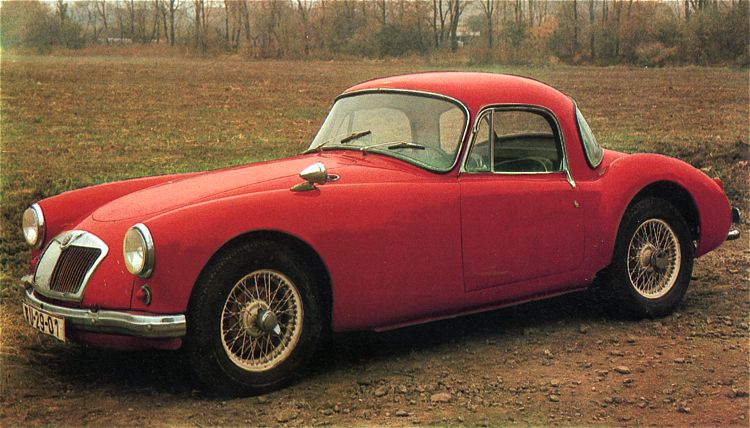
The MG MGA Coupé was an elegant fixed-head version of MG’s successful MGA sports car, introduced in 1956 as a more refined and weatherproof alternative to the open Roadster. Combining the streamlined styling of the original MGA with a permanent roof, wind-up side windows and improved interior comfort, the Coupé offered greater practicality for everyday driving and long-distance touring while retaining the sporting character of the MG marque. Produced until 1962, the MGA Coupé was available with several engine specifications, including the original 1500, the improved 1600 and the final 1600 Mk II. Although considerably less numerous than the Roadster, the Coupé has become one of the most distinctive and desirable variations of the MGA family.
The origins of the MGA Coupé can be traced to the development of the original MGA, which was introduced at the Frankfurt Motor Show in September 1955. The new sports car represented a dramatic departure from the traditional MG T-type models, replacing their upright radiator grilles, separate wings and relatively tall bodywork with a low, streamlined design. Developed under the direction of MG designer Syd Enever, the MGA was intended to provide a more modern and competitive sports car capable of maintaining MG’s established reputation in the important export markets.
Although the open Roadster was initially the principal model, MG recognised that some buyers wanted the performance and styling of the MGA combined with the greater comfort and security of an enclosed body. The resulting fixed-head Coupé was introduced in 1956, offering a more sophisticated alternative without requiring major changes to the underlying mechanical design.
The Coupé retained the MGA’s substantial separate chassis, longitudinally mounted engine and rear-wheel-drive layout. However, the body incorporated a permanent steel roof, fixed rear window and conventional wind-up door windows, creating a more weatherproof and refined passenger compartment than the open Roadster.
The fixed-head body was one of the MGA Coupé’s most distinctive features. Its gently curved roofline flowed smoothly into the rear deck, creating an elegant fastback profile that complemented the car’s low bonnet and rounded wings. The design retained the essential proportions of the Roadster while giving the Coupé a more enclosed and purposeful appearance.
The roof was carefully integrated into the original MGA body shape, with relatively slender pillars and a large rear window contributing to good visibility. The result was a balanced and attractive design that appeared to have been conceived as a complete sports car rather than simply a Roadster fitted with a permanent roof.
The Coupé retained the traditional MG radiator grille, recessed headlamps and flowing front wings of the open model. The long bonnet and short rear deck continued to define its sporting proportions, while the fixed roof gave the car a distinctive silhouette that differed considerably from the more familiar Roadster.
The body was constructed primarily from steel panels mounted on a separate box-section chassis. The fixed roof contributed to structural rigidity, although the Coupé was slightly heavier than the Roadster because of its additional bodywork, glass and interior fittings.
The original MGA 1500 Coupé was powered by a 1,489 cc BMC B-series inline four-cylinder engine, featuring overhead valves operated by pushrods. The engine employed a cast-iron cylinder block and cylinder head, with twin SU carburettors providing fuel delivery. Early examples developed approximately 68 horsepower at 5,500 rpm, while later versions received improvements that increased output to around 72 horsepower.
The B-series engine was a relatively modern and robust unit that offered improved torque and flexibility compared with the smaller XPAG and XPEG engines used in earlier MG sports cars. Its straightforward overhead-valve construction made it suitable for everyday use, while the twin-carburettor arrangement provided responsive throttle characteristics and respectable performance for a small-capacity sports car.
Power was transmitted to the rear wheels through a four-speed manual gearbox incorporating synchromesh on second, third and fourth gears. First gear remained unsynchronised, requiring careful selection when the vehicle was moving. The transmission provided a direct mechanical feel, while the relatively close ratios allowed drivers to make effective use of the engine’s available power.
The MGA 1500 Coupé was capable of reaching approximately 95 mph (153 km/h), depending on vehicle condition and road conditions. Acceleration from 0 to 60 mph generally required around 16 to 17 seconds. Although the Coupé was slightly heavier than the Roadster, its improved aerodynamics helped compensate for the additional weight at higher speeds.
The MGA Coupé retained the same fundamental suspension arrangement as the Roadster. At the front, independent suspension employed coil springs and wishbones, with lever-arm hydraulic shock absorbers forming part of the upper suspension arrangement. This provided relatively precise wheel control and contributed to the car’s responsive handling.
At the rear, a conventional live axle was supported by semi-elliptic leaf springs, with lever-arm hydraulic shock absorbers controlling suspension movement. Although the system was relatively simple, it provided predictable handling and reasonable ride comfort, particularly on the road surfaces of the period.
Rack-and-pinion steering provided direct and responsive control, allowing the driver to place the car accurately through corners. The combination of a low seating position, relatively wide track and balanced chassis gave the MGA Coupé an engaging driving character that appealed to enthusiasts.
The original MGA 1500 Coupé was equipped with hydraulically operated drum brakes on all four wheels. These were adequate for normal road use, although repeated heavy braking could produce fade. Later 1600 models introduced front disc brakes, improving stopping performance and resistance to overheating.
The MGA Coupé was available with steel disc wheels as standard, while traditional centre-lock wire wheels were offered as an option. The wire wheels were particularly popular among enthusiasts because of their classic sporting appearance and association with earlier MG models.
Inside, the MGA Coupé offered a more refined environment than the open Roadster. The permanent roof, wind-up side windows and improved weather sealing provided greater protection from wind, rain and road noise, making the car better suited to everyday driving and long-distance touring.
The cockpit retained the MGA’s simple and purposeful layout, with two individual seats, a large steering wheel and a dashboard incorporating a speedometer, tachometer and supplementary instruments. The instrument panel was finished in painted metal, reflecting the car’s emphasis on straightforward sporting motoring rather than luxury.
The Coupé’s enclosed body allowed improved interior trim and greater protection from the elements. The wind-up windows were particularly significant, as the Roadster retained removable side screens throughout its production life. This made the Coupé more convenient in poor weather and provided greater security when parked.
The seating position remained low, with the driver seated close to the road and surrounded by a relatively compact cockpit. Although interior space was limited, the Coupé offered sufficient accommodation for two occupants and was well suited to touring journeys.
The fixed roof also provided improved protection from wind buffeting at higher speeds, while the enclosed passenger compartment reduced some of the noise associated with open-air motoring. However, the MGA remained a traditional sports car, and the Coupé was not as quiet or refined as more expensive grand touring models.
In 1959, MG introduced the MGA 1600, replacing the original 1500 engine with an enlarged 1,588 cc B-series unit. The new engine developed approximately 79 horsepower, providing improved acceleration and greater flexibility during everyday driving.
The MGA 1600 Coupé also benefited from the introduction of front disc brakes, which improved stopping performance and resistance to fade. Revised exterior lighting and minor trim changes distinguished the new model from its predecessor, although the basic body design remained unchanged.
The larger engine made the Coupé more capable on open roads and improved its suitability for longer-distance touring. The additional torque reduced the need for frequent gear changes, while the improved braking system provided greater confidence during enthusiastic driving.
In 1961, MG introduced the MGA 1600 Mk II, representing the final major development of the range. The Mk II employed a further enlarged 1,622 cc B-series engine producing approximately 90 horsepower, providing the strongest performance of the conventional pushrod-engined MGA models.
The Mk II also incorporated revised gearing and minor styling changes, including a recessed radiator grille and revised rear lighting. These modifications gave the Coupé a slightly more modern appearance while retaining the elegant proportions that had made the original design so successful.
The MGA 1600 Mk II Coupé was capable of reaching approximately 100 mph (161 km/h), depending on vehicle condition and road conditions. Acceleration was improved compared with the earlier 1500 and 1600 versions, making the final Coupé a more capable touring car.
In addition to the conventional pushrod-engined models, MG also produced a limited number of MGA Twin Cam Coupés. Introduced in 1958, the Twin Cam featured a sophisticated 1,588 cc double-overhead-camshaft engine producing approximately 108 horsepower, together with four-wheel disc brakes and other mechanical improvements. Although mechanically distinct from the standard Coupé, it demonstrated the performance potential of the MGA platform.
The MGA Coupé’s driving experience was characterised by balanced handling, responsive steering and a more refined touring environment than the Roadster. The permanent roof and improved weather protection made it particularly suitable for longer journeys, while the low seating position and direct controls preserved the engaging character of a traditional British sports car.
The Coupé was especially enjoyable on winding roads, where its relatively low centre of gravity and predictable suspension allowed drivers to maintain momentum through corners. Although the additional body weight slightly affected acceleration, the improved aerodynamics and enclosed cockpit made it comfortable at sustained cruising speeds.
The MGA Coupé was sold in several international markets, with North America remaining particularly important to MG’s commercial success. American buyers appreciated its elegant styling and traditional British sporting character, although the open Roadster remained considerably more popular.
The Coupé’s relatively limited sales reflected the strong demand for open sports cars during the late 1950s. Many buyers associated MG ownership with open-air motoring and therefore preferred the Roadster, while those seeking a fully enclosed car often considered more conventional saloons or larger grand touring models.
Nevertheless, the Coupé developed a loyal following among motorists who valued its distinctive appearance and greater practicality. Its combination of sports car performance and enclosed accommodation made it particularly attractive to buyers who intended to use their cars regularly rather than exclusively for recreational driving.
The MGA Coupé also appeared in competition, particularly in club racing and endurance events. Its relatively aerodynamic body and rigid construction offered advantages in certain forms of motorsport, while the robust B-series engine provided a dependable foundation for performance modifications.
Production of the MGA Coupé continued until 1962, when the entire MGA range was replaced by the MGB. The new model introduced unitary body construction, improved passenger accommodation and more modern mechanical engineering, reflecting changing customer expectations.
A total of 101,081 MGAs were manufactured across all body styles and engine specifications, with the Coupé accounting for approximately 9,900 examples of the conventional pushrod-engined models. This relatively small production total makes the Coupé considerably less common than the Roadster and contributes to its appeal among collectors.
Today, the MG MGA Coupé is regarded as one of the most elegant and distinctive British fixed-head sports cars of the 1950s and early 1960s. Its flowing roofline, compact proportions and traditional MG styling make it particularly attractive to enthusiasts seeking a less familiar alternative to the open MGA Roadster.
Restoration requires careful inspection of the separate chassis, body panels, structural sills and mechanical components. Corrosion can affect the chassis and lower body structure, while deterioration of the timber floorboards and body mounting areas may require extensive repairs.
The fixed-head body introduces additional restoration considerations, particularly concerning the roof structure, door alignment, window mechanisms and weather seals. Coupé-specific glass, trim and interior fittings can be more difficult to obtain than equivalent Roadster components, making completeness and originality important considerations when purchasing a restoration project.
The B-series engine is generally robust and benefits from extensive specialist knowledge and good parts availability. The gearbox, rear axle, suspension and braking system are also relatively straightforward to maintain, although careful inspection is essential when assessing a vehicle that has been unused for an extended period.
The MG MGA Coupé represents an important and distinctive chapter in MG’s post-war history. By combining the successful MGA chassis and mechanical engineering with an elegant fixed-head body, MG created a sports car that offered improved comfort and practicality without sacrificing the marque’s traditional sporting character. Although produced in considerably smaller numbers than the Roadster, the Coupé remains a celebrated example of British sports car design, valued for its graceful proportions, engaging driving experience and historical significance within the MGA family.