
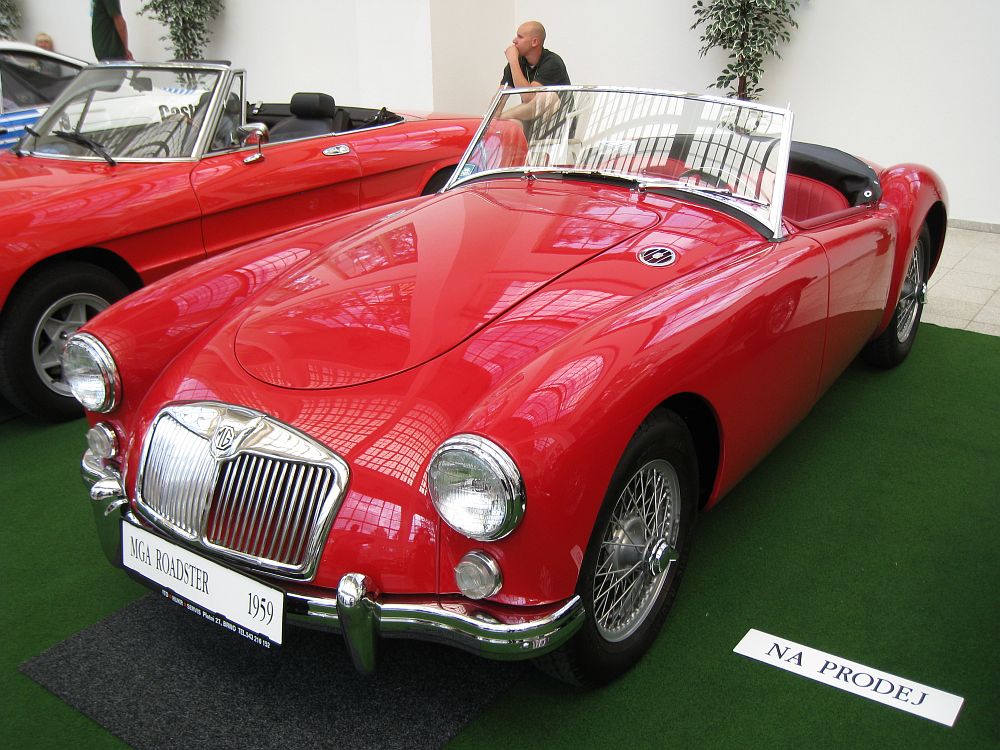
The MG MGA 1500 was a landmark British sports car produced between 1955 and 1959, representing one of the most important developments in the history of the MG marque. Introduced as the successor to the traditional MG TF Midget, the MGA 1500 marked a dramatic departure from the upright styling and pre-war engineering philosophy of the earlier T-type models. With its low, streamlined bodywork, 1,489 cc four-cylinder engine, improved chassis and responsive handling, the MGA established a new identity for MG during the second half of the 1950s. Its combination of attractive styling, dependable mechanical engineering and affordable sporting performance made it an international success, particularly in North America, where British sports cars enjoyed considerable popularity.
The origins of the MGA 1500 can be traced to the early 1950s, when MG recognised that its traditional T-type sports cars were becoming increasingly outdated. Although the MG TC, TD and TF had achieved substantial commercial success, their separate wings, upright radiator grilles and relatively tall bodywork reflected design principles established before the Second World War. Competition from more modern sports cars demonstrated the need for a completely new model capable of maintaining MG’s established reputation while appealing to a younger generation of buyers.
The development of the MGA was strongly influenced by MG designer Syd Enever, who had been responsible for several important projects within the company. During the early 1950s, Enever developed a streamlined body for a competition car associated with privateer racer George Phillips. The resulting design demonstrated the aerodynamic advantages of lower bodywork and more integrated styling, providing an important foundation for the production MGA.
The new sports car was developed under the internal project designation EX175. Its design required substantial changes to the traditional MG chassis arrangement, particularly to allow the occupants to sit lower within the body. Rather than retaining the high seating position and upright appearance of the T-type models, the MGA employed a wider chassis with longitudinal members positioned to accommodate a low cockpit and streamlined body.
The production MGA was officially introduced at the Frankfurt Motor Show in September 1955. Its appearance represented a dramatic departure from earlier MG sports cars, and the company deliberately adopted the MGA name to emphasise the beginning of a new generation. The new model was initially available as an open two-seat roadster, with a fixed-head coupé following in 1956.
The MGA 1500’s styling was one of its greatest attractions. The low bonnet, flowing front wings, recessed headlamps and gently curved body panels created an elegant and purposeful appearance. The traditional MG radiator grille was retained but incorporated into a more streamlined front end, providing a visual connection with earlier models while establishing a distinctly modern identity.
The long bonnet and short rear deck gave the car classic sports car proportions, while the low windscreen and open cockpit reinforced its sporting character. Unlike the earlier T-type models, the MGA featured fully integrated wings rather than separate flowing mudguards, contributing to improved aerodynamics and a cleaner overall appearance.
The body was constructed primarily from steel panels mounted on a substantial separate chassis, with aluminium used for certain components, including the bonnet, boot lid and doors. The chassis employed a strong box-section structure designed to provide adequate rigidity while allowing the low seating position that distinguished the MGA from its predecessors.
Power was supplied by a 1,489 cc BMC B-series inline four-cylinder engine, featuring overhead valves operated by pushrods. The engine employed a cast-iron cylinder block and cylinder head, with twin SU carburettors providing fuel delivery. Early examples developed approximately 68 horsepower at 5,500 rpm, while later versions received improvements that increased output to around 72 horsepower.
The B-series engine represented a significant departure from the smaller XPAG and XPEG engines used in earlier MG sports cars. Its larger displacement and more modern design provided improved torque and greater flexibility, making the MGA better suited to contemporary road conditions and longer-distance touring.
The engine was mounted longitudinally at the front of the car, driving the rear wheels through a four-speed manual gearbox. The transmission incorporated synchromesh on second, third and fourth gears, while first gear remained unsynchronised. The gearbox offered relatively close ratios, allowing drivers to make effective use of the engine’s available power.
The MGA 1500 was capable of reaching approximately 95 to 100 mph (153 to 161 km/h), depending on specification and road conditions. Acceleration from 0 to 60 mph generally required around 16 seconds. These figures represented a useful improvement over the outgoing MG TF and placed the MGA among the more capable affordable British sports cars of the mid-1950s.
One of the MGA 1500’s principal attractions was its balanced handling. The low seating position and relatively low centre of gravity contributed to improved stability, while the wide chassis and carefully developed suspension provided predictable road holding.
At the front, the MGA employed independent suspension using coil springs and wishbones, with lever-arm hydraulic shock absorbers forming part of the upper suspension arrangement. This system was developed from engineering principles already established on the MG Y-type saloon and TD sports car, providing effective wheel control and a relatively comfortable ride.
At the rear, the MGA retained a conventional live axle supported by semi-elliptic leaf springs, with lever-arm hydraulic shock absorbers controlling suspension movement. Although the arrangement was relatively simple, it provided dependable handling and was well suited to the car’s modest weight and performance.
Rack-and-pinion steering was retained, providing direct and responsive control. Combined with the relatively low seating position and balanced chassis, this gave the MGA an engaging driving character that appealed to enthusiasts. The car responded predictably to steering inputs and was particularly enjoyable on winding country roads.
The original MGA 1500 was equipped with hydraulically operated drum brakes on all four wheels. These were adequate for normal road use, although repeated heavy braking could produce fade. The later MGA 1600 introduced front disc brakes, improving stopping performance and resistance to overheating.
The MGA 1500 was initially offered with steel disc wheels as standard, while traditional centre-lock wire wheels were available as an option. The wire wheels were particularly popular among enthusiasts because of their classic sporting appearance and association with earlier MG models.
Inside, the MGA 1500 featured a simple and purposeful two-seat cockpit. The low seating position placed the occupants close to the road, while the dashboard incorporated a large speedometer, tachometer and supplementary instruments. The instrument panel was finished in painted metal, reflecting the car’s emphasis on straightforward sporting motoring rather than luxury.
The seats provided reasonable comfort for a compact sports car, although interior space was limited. The low windscreen and relatively narrow cockpit contributed to the car’s intimate driving environment, while the large steering wheel and floor-mounted gear lever reinforced its traditional sporting character.
The MGA 1500 Roadster employed removable side screens rather than conventional wind-up windows, and weather protection was provided by a folding fabric hood. Although this arrangement was less convenient than the fully enclosed windows used on more modern cars, it helped preserve the MGA’s lightweight construction and traditional open-air character.
In 1956, MG introduced the MGA 1500 Coupé, offering a fixed-head alternative to the open Roadster. The Coupé featured a permanent roof, wind-up side windows and improved weather protection, making it more suitable for everyday driving and longer-distance touring. Although mechanically similar to the Roadster, the Coupé was slightly heavier because of its additional bodywork and interior fittings.
The fixed-head Coupé retained the MGA’s elegant proportions, with a gently curved roofline flowing smoothly into the rear deck. Its distinctive appearance made it one of the most attractive British sports coupés of the period, although the open Roadster remained considerably more popular.
The MGA 1500’s driving experience was characterised by smooth engine performance, responsive steering and predictable handling. Although its acceleration was modest compared with larger sports cars, the combination of a low seating position, relatively light weight and direct controls made it enjoyable to drive. The car encouraged drivers to maintain momentum through corners, rewarding smooth steering and careful use of the gearbox.
The MGA 1500 was particularly successful in North America, where British sports cars had developed a strong following during the post-war years. American buyers appreciated its elegant styling, compact dimensions and engaging driving characteristics, while its relatively affordable purchase price made it accessible to a broad range of enthusiasts.
Export sales accounted for the overwhelming majority of MGA production, with approximately 80 per cent of cars sold overseas. The United States became the model’s most important market, and the MGA played a major role in establishing MG’s international reputation during the late 1950s.
The MGA 1500 also enjoyed a notable competition history. MG entered specially prepared MGA prototypes in the 1955 24 Hours of Le Mans, demonstrating the potential of the new design before its official public introduction. These competition cars provided valuable experience and helped reinforce the sporting credentials of the new model.
Following its introduction, the MGA became popular in club racing, rallies, hill climbs and other sporting events, particularly in Britain and North America. Its relatively robust mechanical construction, balanced handling and extensive tuning potential made it attractive to private competitors.
The B-series engine offered considerable scope for performance modifications, including improved carburation, revised camshafts, cylinder-head work and exhaust systems. The availability of competition components and specialist knowledge encouraged enthusiasts to develop the MGA for a wide range of sporting activities.
During its production life, the MGA 1500 received several mechanical improvements, including revisions to the engine and transmission. The increase in engine output from approximately 68 to 72 horsepower improved performance, while ongoing development helped maintain reliability and refinement.
Production of the MGA 1500 continued until 1959, when it was replaced by the MGA 1600. The new model featured an enlarged 1,588 cc B-series engine producing approximately 79 horsepower, together with front disc brakes and revised exterior lighting. These changes improved acceleration, braking and general usability while retaining the MGA’s established styling.
Approximately 58,750 MGA 1500 models were manufactured across both Roadster and Coupé body styles, making it the most numerous early version of the MGA family. Its commercial success established the foundations for the subsequent 1600, Twin Cam and Mk II models, which continued production until 1962.
Today, the MG MGA 1500 is regarded as one of the most attractive and historically significant British sports cars of the 1950s. Its flowing bodywork, low driving position and responsive handling continue to appeal to collectors and enthusiasts, while its relatively simple mechanical engineering makes it a practical classic for regular use.
Restoration requires careful attention to the separate chassis, body panels, structural sills and mechanical components. Corrosion can affect the chassis and lower body structure, while deterioration of the timber floorboards and body mounting areas may require extensive repairs. The B-series engine is generally robust and benefits from good specialist support, although the condition of the gearbox, rear axle, suspension and braking system should also be assessed.
The availability of replacement parts and specialist knowledge remains one of the MGA’s greatest advantages. Numerous suppliers continue to provide mechanical components, body panels, interior trim and weather equipment, allowing surviving cars to be maintained and restored to a high standard.
The MG MGA 1500 represents a defining moment in the history of the MG marque. By replacing the traditional T-type design with a low, streamlined body and more modern mechanical engineering, MG created a sports car that successfully combined elegance, performance and affordability. Its international commercial success, extensive competition history and enduring popularity helped establish MG as one of the world’s most recognisable sports car manufacturers. More than six decades after its introduction, the MGA 1500 remains a celebrated example of classic British sports car design and one of the most important models ever produced by MG.