
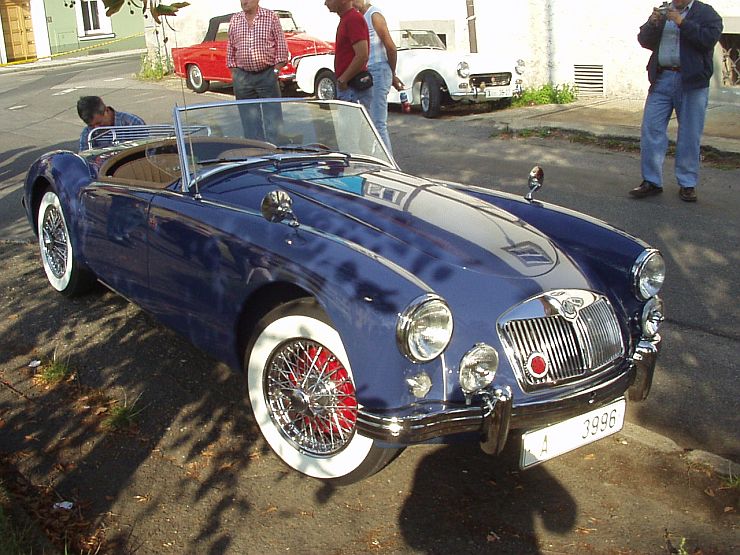
The MG MGA 1600 Mk I was an improved version of MG’s successful MGA sports car, produced between 1959 and 1961. Introduced as the successor to the original MGA 1500, the new model featured an enlarged 1,588 cc four-cylinder engine, front disc brakes and revised exterior lighting, providing improved performance and greater everyday usability while retaining the elegant styling and responsive handling that had made the MGA an international success. Available in both open Roadster and fixed-head Coupé body styles, the MGA 1600 Mk I represented an important stage in the development of MG’s modern sports car range and helped consolidate the company’s reputation for producing attractive, dependable and affordable British sports cars.
The origins of the MGA 1600 Mk I can be traced to the introduction of the original MGA at the Frankfurt Motor Show in September 1955. Developed under the direction of MG designer Syd Enever, the MGA represented a dramatic departure from the traditional T-type sports cars that had established MG’s international reputation during the immediate post-war years. Its low, streamlined bodywork, integrated wings and relatively modern chassis provided a more contemporary alternative to the upright styling of the MG TC, TD and TF.
The original MGA 1500 had proved particularly successful in North America, where British sports cars enjoyed considerable popularity. Its combination of attractive styling, responsive handling and relatively affordable purchase price made it appealing to a broad range of enthusiasts. However, by the late 1950s, increasing competition from more powerful sports cars highlighted the need for improved engine performance and braking capability.
MG responded in May 1959 with the introduction of the MGA 1600, subsequently known as the Mk I to distinguish it from the later 1600 Mk II. The new model retained the fundamental body and chassis design of the original MGA but incorporated a number of mechanical improvements intended to enhance performance, safety and driving enjoyment.
The most significant change was the introduction of an enlarged version of the BMC B-series engine. Displacement increased from 1,489 cc to 1,588 cc, providing greater torque and improved acceleration. The new engine retained the established overhead-valve configuration, with four cylinders arranged in line and valves operated by pushrods.
The engine employed a cast-iron cylinder block and cylinder head, with twin SU carburettors providing fuel delivery. In standard MGA 1600 Mk I specification, it developed approximately 79.5 horsepower at 5,600 rpm, with maximum torque of around 87 lb ft (118 Nm) at 3,800 rpm.
The increase in displacement was achieved through changes to the cylinder bore, while the engine retained the basic architecture of the earlier B-series unit. This allowed MG to improve performance without introducing a completely new engine design, helping maintain reliability and control manufacturing costs.
The B-series engine was already well established within the British Motor Corporation and had earned a reputation for durability, straightforward maintenance and relatively economical operation. Its robust construction and conventional overhead-valve arrangement made it particularly suitable for a sports car intended for both enthusiastic driving and everyday use.
The twin SU carburettors contributed to responsive throttle characteristics and helped distinguish the sporting MGA engine from more modest versions used in conventional passenger cars. The engine was also well suited to performance tuning, and enthusiasts frequently experimented with improved carburation, revised camshafts, cylinder-head modifications and exhaust systems.
Power was transmitted to the rear wheels through a four-speed manual gearbox incorporating synchromesh on second, third and fourth gears. First gear remained unsynchronised, requiring careful selection when the vehicle was moving. The gearbox retained the direct mechanical feel of the earlier MGA 1500, while the increased engine torque made the car more flexible during normal driving.
The MGA 1600 Mk I was capable of reaching approximately 100 mph (161 km/h), depending on vehicle condition, body style and road conditions. Acceleration from 0 to 60 mph generally required around 13 to 14 seconds, representing a noticeable improvement over the original 1500 model. These figures made the MGA 1600 a competitive affordable sports car during the late 1950s and early 1960s.
The additional engine performance was particularly noticeable during overtaking and motorway driving, where the greater torque reduced the need for frequent gear changes. Although the MGA remained a relatively modest sports car compared with larger and more expensive models, the 1600 offered a useful improvement in flexibility and cruising ability.
The MGA 1600 Mk I retained the substantial separate chassis introduced with the original MGA. The chassis employed box-section longitudinal members and cross-bracing designed to provide adequate rigidity while allowing the occupants to sit relatively low within the body. This arrangement was an important departure from the traditional high chassis layout used on earlier MG sports cars.
The body was constructed primarily from steel panels mounted on the separate chassis, with aluminium used for certain components, including the bonnet, boot lid and doors on standard production cars. The relatively low body and wide chassis contributed to a low centre of gravity, improving stability and handling.
At the front, the MGA 1600 Mk I employed independent suspension using coil springs and wishbones, with lever-arm hydraulic shock absorbers forming part of the upper suspension arrangement. This system provided effective wheel control and contributed to the car’s responsive handling, particularly on winding roads.
At the rear, the car retained a conventional live axle supported by semi-elliptic leaf springs, with lever-arm hydraulic shock absorbers controlling suspension movement. Although the arrangement was relatively simple, it provided predictable handling and reasonable ride comfort for a lightweight sports car of the period.
Rack-and-pinion steering was retained, providing direct and responsive control. Combined with the low seating position and relatively balanced chassis, this gave the MGA 1600 Mk I an engaging driving character that appealed to enthusiasts. The car responded predictably to steering inputs and encouraged smooth, precise driving.
One of the most important mechanical improvements introduced with the MGA 1600 Mk I was the adoption of front disc brakes. The original MGA 1500 had been equipped with drum brakes on all four wheels, which were adequate for normal road use but could suffer from reduced effectiveness during repeated heavy braking.
The new front disc brakes provided improved stopping performance and greater resistance to brake fade, particularly during enthusiastic driving or prolonged descents. Conventional drum brakes were retained at the rear, providing a balanced and effective braking system suited to the car’s increased performance.
The adoption of front disc brakes brought the standard MGA closer to the braking standards established by the more specialised MGA Twin Cam, which had been introduced in 1958 with four-wheel disc brakes. Although the standard 1600 did not receive the Twin Cam’s sophisticated engine or rear disc brakes, the improvements made it a more capable and confidence-inspiring road car.
Externally, the MGA 1600 Mk I retained the elegant styling of the original MGA 1500. The low bonnet, flowing front wings, recessed headlamps and gently curved body panels continued to define the car’s appearance. The traditional MG radiator grille remained integrated into the streamlined front end, providing a visual connection with earlier MG models.
The most noticeable exterior changes were associated with the lighting arrangements. The MGA 1600 introduced revised front side lamps and indicators, together with larger rear lamp units incorporating separate functions for braking and direction indication. These changes improved visibility and helped distinguish the 1600 from the earlier 1500.
The MGA 1600 Mk I was available in both Roadster and Coupé body styles. The open Roadster retained the low windscreen, folding fabric hood and removable side screens associated with traditional British sports cars. Its lightweight construction and open-air character made it particularly popular among enthusiasts.
The fixed-head Coupé offered a more refined alternative, featuring a permanent roof, wind-up side windows and improved weather protection. The Coupé’s gently curved roofline flowed smoothly into the rear deck, creating an elegant profile that complemented the MGA’s low bonnet and rounded wings.
Although the Coupé was slightly heavier than the Roadster, its improved aerodynamics and enclosed passenger compartment made it particularly suitable for longer-distance touring. The additional weather protection also made it more practical for everyday use, especially in colder or wetter climates.
Inside, the MGA 1600 Mk I retained the simple and purposeful cockpit arrangement of its predecessor. Two individual seats provided accommodation for the driver and passenger, while the dashboard incorporated a large speedometer, tachometer and supplementary instruments.
The instrument panel was finished in painted metal, reflecting the car’s emphasis on straightforward sporting motoring rather than luxury. The large steering wheel and floor-mounted gear lever reinforced the traditional MG driving environment, while the low seating position placed the occupants close to the road.
The Roadster’s removable side screens and folding hood provided basic weather protection, although fitting the equipment required more effort than the conventional windows and roof arrangements used on more modern cars. The Coupé offered greater convenience through its permanent roof and wind-up windows.
The MGA 1600 Mk I’s driving experience was characterised by improved engine performance, responsive steering and predictable handling. The additional torque of the 1,588 cc engine made the car more flexible during everyday driving, while the front disc brakes provided greater confidence during enthusiastic motoring.
The car was particularly enjoyable on winding country roads, where its relatively low centre of gravity and balanced suspension allowed drivers to maintain momentum through corners. Although the live rear axle could become unsettled on rough surfaces, the MGA generally offered stable and predictable handling when driven within its limits.
The MGA 1600 Mk I competed in a growing market for affordable British sports cars, alongside models such as the Triumph TR3A, Austin-Healey 3000 and various smaller European sports cars. Although some competitors offered greater engine capacity or outright performance, the MGA distinguished itself through its elegant styling, responsive handling and relatively economical operation.
North America remained the model’s most important export market. American buyers appreciated the MGA’s traditional British sporting character, attractive bodywork and engaging driving experience. The improved performance and braking of the 1600 helped maintain its appeal in an increasingly competitive market.
The MGA 1600 Mk I also enjoyed popularity in amateur motorsport. Its relatively robust mechanical construction, balanced handling and extensive tuning potential made it suitable for club racing, rallies, hill climbs and other sporting events. The B-series engine provided a dependable foundation for performance modifications, while the improved front disc brakes offered advantages during competition use.
The model also benefited from the competition experience gained through MG’s earlier MGA racing programmes. Specially prepared MGA prototypes had competed at Le Mans in 1955, while subsequent production-based cars appeared in numerous national and international events. These activities helped reinforce MG’s reputation for producing affordable sports cars with genuine sporting capabilities.
Production of the MGA 1600 Mk I continued until 1961, when it was replaced by the MGA 1600 Mk II. The new model introduced a further enlarged 1,622 cc B-series engine producing approximately 90 horsepower, together with revised gearing and minor styling changes.
Approximately 31,500 MGA 1600 Mk I models were manufactured across Roadster and Coupé body styles, making it one of the more numerous versions of the MGA family. Its commercial success helped sustain MG’s international reputation during the period immediately preceding the introduction of the MGB.
Today, the MG MGA 1600 Mk I is regarded as one of the most desirable versions of the MGA range. Its combination of the elegant original body design, improved 1,588 cc engine and front disc brakes provides an attractive balance between traditional styling and practical performance.
Restoration requires careful attention to the separate chassis, body panels, structural sills and mechanical components. Corrosion can affect the chassis and lower body structure, while deterioration of the timber floorboards and body mounting areas may require extensive repairs.
The B-series engine is generally robust and benefits from extensive specialist knowledge and good parts availability. The gearbox, rear axle, suspension and braking system are also relatively straightforward to maintain, although careful inspection is essential when assessing a vehicle that has been unused for an extended period.
The availability of replacement parts and specialist support remains one of the MGA’s greatest advantages. Numerous suppliers continue to provide mechanical components, body panels, interior trim and weather equipment, allowing surviving cars to be maintained and restored to a high standard.
The MG MGA 1600 Mk I represents an important stage in the evolution of MG’s modern sports car range. By combining the successful MGA chassis and streamlined bodywork with a larger engine, improved braking and revised equipment, MG created a more capable and enjoyable sports car without sacrificing the elegant styling and traditional driving character that had made the original MGA so successful. Its international popularity, competition heritage and enduring appeal ensure its place among the most significant British sports cars of the late 1950s and early 1960s.