
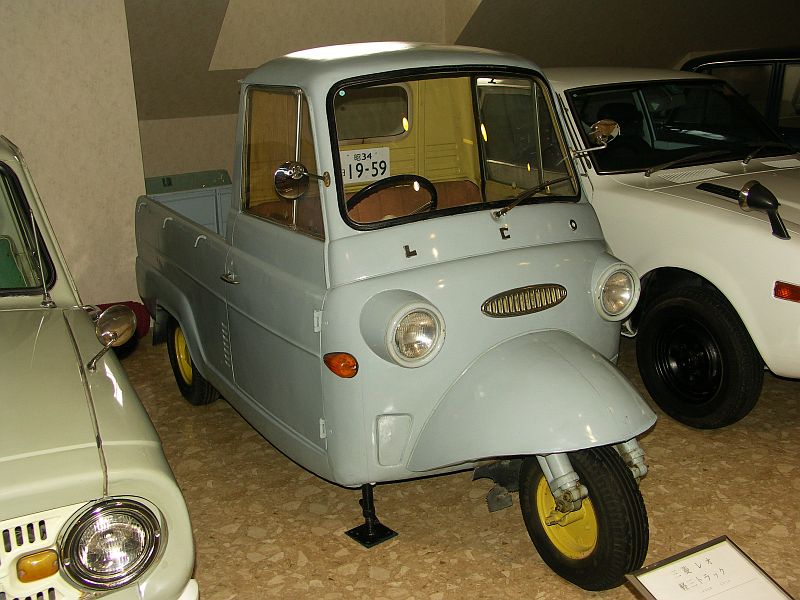
The Mitsubishi Pet Leo LT10 was a compact three-wheeled commercial vehicle produced in Japan during the early post-war period, when small, economical utility vehicles played an important role in the country’s industrial and economic recovery. Developed by Mitsubishi’s automotive manufacturing operations, the Pet Leo belonged to a generation of lightweight three-wheelers designed to provide affordable transport for small businesses, tradespeople and delivery operators. Its simple mechanical construction, compact dimensions and modest running costs reflected the practical requirements of Japanese motorists during the 1950s, when conventional four-wheeled commercial vehicles remained relatively expensive. Although considerably less well known than Mitsubishi’s later passenger cars and commercial vehicles, the Pet Leo LT10 formed part of the company’s early experience in producing economical road transport.
The origins of the Mitsubishi Pet Leo LT10 can be traced to the development of Japan’s motor industry during the first half of the twentieth century. Mitsubishi had been involved in vehicle manufacturing since the introduction of the Mitsubishi Model A in 1917, one of Japan’s earliest attempts at producing a series-manufactured passenger car.
The Model A was an ambitious project for its time, but the Japanese market for private automobiles was extremely limited. Production ended in 1921 after only a small number had been completed, and Mitsubishi subsequently concentrated much of its automotive engineering activity on commercial vehicles, buses and industrial machinery.
During the 1930s, Mitsubishi developed a variety of commercial and specialist vehicles, including buses, trucks and experimental military transport. This work helped establish the engineering and manufacturing experience that would support the company’s later expansion into the automotive industry.
Following the Second World War, Japan faced severe shortages of raw materials, fuel and affordable transport. Much of the country’s industrial infrastructure had been damaged, while economic conditions made the purchase of conventional motor vehicles difficult for many individuals and businesses.
Small motorcycles, motorised bicycles and three-wheeled commercial vehicles consequently became important forms of transport. Their relatively simple construction and low fuel consumption made them suitable for a country rebuilding its economy.
Three-wheeled vehicles were particularly attractive to small businesses because they offered greater carrying capacity than motorcycles while remaining less expensive to manufacture and operate than conventional four-wheeled trucks.
The Japanese market supported numerous manufacturers of lightweight three-wheelers during the post-war years. Companies such as Mazda, Daihatsu and Mitsubishi developed vehicles intended to meet the needs of local businesses, agricultural operators and delivery services.
Mitsubishi’s involvement in this sector formed part of its broader effort to re-establish civilian vehicle production. The company also developed the Mitsubishi Silver Pigeon motor scooter, introduced in 1946, which became an important product during the early years of Japan’s economic recovery.
The Silver Pigeon demonstrated Mitsubishi’s ability to produce relatively simple, affordable motorised transport for civilian customers. Its success helped strengthen the company’s position in the developing Japanese vehicle market.
The Mitsubishi Pet Leo LT10 emerged from this environment, when demand for small commercial vehicles was increasing as Japanese industry and retail activity recovered.
The Pet Leo was conceived as a practical working vehicle rather than a passenger car. Its principal purpose was to provide an economical means of transporting goods over relatively short distances, particularly in towns and urban areas where narrow streets and limited parking space favoured compact vehicles.
The LT10 designation identified a particular version within the Pet Leo family. Detailed surviving technical documentation is limited, and specifications attributed to the model are not always consistent across historical references. Consequently, precise production dates, engine output and dimensions should be treated cautiously unless supported by contemporary Mitsubishi literature.
The Pet Leo LT10 employed a three-wheeled layout, reflecting the popularity of this configuration among Japanese commercial vehicles during the period.
Three-wheeled utility vehicles offered several advantages over conventional four-wheeled trucks. Their mechanical layouts could be relatively simple, manufacturing costs were lower, and their compact dimensions made them well suited to crowded urban environments.
The arrangement also allowed manufacturers to develop lightweight vehicles with useful load-carrying capacity while keeping engine size and fuel consumption modest.
The Pet Leo’s design reflected these practical priorities. Its bodywork was functional, with relatively little emphasis on decorative styling or passenger comfort.
The vehicle was intended to be inexpensive to purchase, straightforward to maintain and capable of performing everyday commercial duties.
Its compact proportions made it suitable for deliveries, local transport and other applications where manoeuvrability was more important than high-speed performance.
The three-wheeled configuration was particularly useful in Japanese towns, where narrow streets and small commercial premises often restricted access for larger vehicles.
The Pet Leo LT10 was associated with Mitsubishi’s early lightweight commercial-vehicle development, a field that would eventually be overtaken by the growing popularity of four-wheeled kei trucks.
The vehicle’s construction followed the general principles of the period, favouring a lightweight chassis and uncomplicated mechanical components.
Unlike modern commercial vehicles, which are designed around extensive safety and comfort requirements, small Japanese three-wheelers of the 1950s were engineered primarily for utility and affordability.
Their bodies were typically compact and functional, with simple seating arrangements and limited weather protection or cabin equipment, depending on the model.
The precise body configuration of the LT10 requires confirmation from period photographs or factory documentation, particularly because surviving descriptions of early Japanese three-wheelers sometimes combine information from several related models.
The Pet Leo’s modest size would have been an important advantage in commercial service. Small delivery vehicles needed to operate economically in congested streets, negotiate tight corners and provide convenient access to shops and workshops.
The three-wheeled arrangement also helped reduce the number of suspension, wheel and braking components compared with a conventional four-wheeled vehicle.
The LT10 was intended for low-speed commercial operation rather than long-distance touring. Its mechanical specification was therefore determined principally by reliability, economy and the ability to carry modest loads.
Small-displacement engines were widely used in Japanese three-wheeled vehicles during the post-war period. Their relatively low fuel consumption made them attractive to operators who needed to minimise running costs.
However, the precise engine displacement, cylinder arrangement, power output and transmission specification of the Mitsubishi Pet Leo LT10 are not sufficiently established in readily available historical information to quote confidently.
It would therefore be misleading to assign the model a particular engine capacity or performance figure without reference to original Mitsubishi technical records.
Whatever its exact specification, the Pet Leo’s powertrain was intended to provide adequate low-speed pulling power for local transport duties.
Commercial vehicles of this class generally placed greater emphasis on usable torque and mechanical simplicity than outright speed.
A straightforward transmission would have allowed the driver to select suitable gearing for different loads and road conditions, while the lightweight construction helped reduce the amount of power required for everyday operation.
The vehicle’s small engine and relatively low weight would also have contributed to economical fuel consumption, an important consideration during a period when fuel remained a significant operating expense.
The Pet Leo LT10 belonged to a class of vehicles in which ease of servicing was particularly important. Owners often depended on their vehicles for daily business operations, and prolonged mechanical failures could directly affect their income.
Simple mechanical components and accessible servicing points therefore offered considerable practical advantages.
The suspension and braking systems of small three-wheeled commercial vehicles were generally designed to withstand the demands of low-speed goods transport rather than provide the refinement expected of passenger cars.
The arrangement of the wheels created a distinctive driving experience compared with a conventional four-wheeled vehicle.
Three-wheelers could be highly manoeuvrable, but their stability depended on factors such as wheel arrangement, track width, centre of gravity and load distribution.
Careful loading was particularly important because unevenly distributed cargo could affect steering, braking and cornering behaviour.
The Pet Leo would have been most suitable for the relatively short journeys and moderate speeds associated with local delivery work.
Its compact construction offered advantages when manoeuvring in confined areas, although the limitations of a lightweight three-wheeled vehicle would have become more apparent on rough roads or when carrying heavy loads.
The commercial environment in which the Pet Leo operated was very different from that of modern Japan.
During the early post-war years, many roads were relatively narrow or poorly surfaced, particularly outside major urban centres. Small vehicles therefore needed to be durable and capable of operating under demanding conditions.
The growth of shops, workshops and small manufacturing businesses created a substantial market for economical delivery vehicles.
Three-wheelers became familiar sights in Japanese towns, transporting food, agricultural produce, building materials and other everyday goods.
For many operators, a small commercial vehicle represented a major improvement over handcarts, bicycles or motorcycle-based transport.
It allowed businesses to carry larger quantities of goods while reducing the time and physical effort required for deliveries.
The Mitsubishi Pet Leo LT10 formed part of this broader transformation in Japanese transport, providing a motorised solution for businesses that could not justify the cost of a larger truck.
The development of lightweight commercial vehicles also contributed to the growth of Japan’s domestic motor industry.
Manufacturers gained experience in engine production, transmission design, chassis engineering and the organisation of vehicle manufacturing.
These capabilities became increasingly important as the Japanese economy expanded during the 1950s and 1960s.
Mitsubishi’s later commercial vehicles benefited from the company’s accumulated experience across several types of transport, including scooters, three-wheelers, buses and trucks.
The introduction of the Mitsubishi 500 passenger car in 1960 marked another important stage in the company’s post-war automotive development.
The Mitsubishi 500 was a compact four-wheeled passenger car designed for the expanding Japanese domestic market. It reflected the growing ability of Japanese consumers to purchase conventional automobiles as economic conditions improved.
The Mitsubishi Minica, introduced in 1962, subsequently became an important model in the kei-car market, while the Mitsubishi Colt helped establish the company as a manufacturer of compact passenger cars.
These later vehicles belonged to a different generation of automotive engineering from the Pet Leo, but they emerged from the same period of industrial rebuilding and technological development.
The gradual disappearance of small three-wheeled commercial vehicles reflected changing market requirements.
As Japan’s economy expanded, businesses increasingly demanded vehicles with greater carrying capacity, improved weather protection, better stability and higher cruising speeds.
Four-wheeled light trucks became more affordable and offered significant advantages in everyday commercial use.
The development of the kei-truck category was particularly important. Compact four-wheeled trucks could operate within Japan’s small-vehicle regulations while offering improved stability and more conventional driving characteristics.
Manufacturers such as Suzuki, Daihatsu and Mitsubishi increasingly concentrated on these vehicles as demand for traditional three-wheelers declined.
Mitsubishi’s introduction of the Minicab in 1966 marked the company’s entry into a category that would become central to Japanese light commercial transport.
The Minicab offered a compact four-wheeled commercial vehicle suitable for many of the duties previously performed by small three-wheelers.
Its development illustrated the changing priorities of Japanese buyers, who increasingly valued greater carrying flexibility, stability and weather protection.
By the late 1960s, lightweight three-wheeled commercial vehicles had largely lost their position in the Japanese market to more modern four-wheeled alternatives.
The Pet Leo LT10 therefore belongs to an earlier period of automotive development, when the priority was to provide the simplest and most economical motorised transport possible.
Its historical importance lies less in advanced technology or sporting performance than in its contribution to the practical transport needs of post-war Japan.
Vehicles of this type supported the everyday activities of small businesses and helped establish motorised goods transport as an increasingly accessible service.
They also illustrate the considerable diversity of Japanese automotive production before the country’s manufacturers became internationally recognised for conventional passenger cars.
Today, the Mitsubishi Pet Leo LT10 is an obscure and historically interesting vehicle. Surviving examples appear to be uncommon, and the model receives relatively little attention compared with Mitsubishi’s later passenger cars and commercial vehicles.
Its rarity reflects both its age and its original purpose as a working vehicle. Commercial vehicles were generally used intensively, and many were eventually scrapped after reaching the end of their useful service lives.
Unlike sporting or luxury cars, small delivery vehicles were rarely preserved when new, and relatively few were considered valuable enough to restore during the decades following their withdrawal from service.
Consequently, early Japanese three-wheelers have become increasingly significant to collectors and museums interested in the development of the country’s motor industry.
The Pet Leo LT10 is particularly relevant to enthusiasts studying Mitsubishi’s early post-war vehicle production and the transition from motorcycles and three-wheelers to conventional compact cars and trucks.
Restoring a surviving example would present considerable challenges. Original mechanical components, body panels and trim items may be difficult to locate, particularly where parts were produced in limited quantities or were shared with other obscure models.
Accurate identification would be especially important because surviving information about early Japanese commercial vehicles is often incomplete.
Chassis numbers, engine markings, factory identification plates and contemporary photographs could help establish the original specification of a particular vehicle.
Where original technical literature survives, it would be valuable for determining the correct engine, transmission, wheel arrangement and body configuration.
Mechanical restoration would also require attention to components that may have been designed specifically for the vehicle, including steering linkages, suspension parts and braking equipment.
The condition of the chassis and structural components would be particularly important because the vehicle’s working history may have involved heavy loads and prolonged exposure to poor road conditions.
Preservation of original bodywork and mechanical details would help maintain the historical authenticity of a restored Pet Leo.
The Mitsubishi Pet Leo LT10 represents an interesting chapter in the development of Japan’s post-war motor industry. Created during a period when affordable commercial transport was essential to economic recovery, it belonged to a generation of compact three-wheeled vehicles designed to provide practical mobility for small businesses and local operators. Although its precise technical specifications and production history remain less thoroughly documented than those of Mitsubishi’s later vehicles, the Pet Leo illustrates the company’s early involvement in economical civilian transport and the engineering experience that preceded its expansion into passenger cars and modern commercial vehicles. Today, the LT10 is remembered primarily for its historical significance, representing an era when simple, lightweight three-wheelers helped Japan rebuild its transport infrastructure and laid part of the foundation for the country’s subsequent automotive success.