
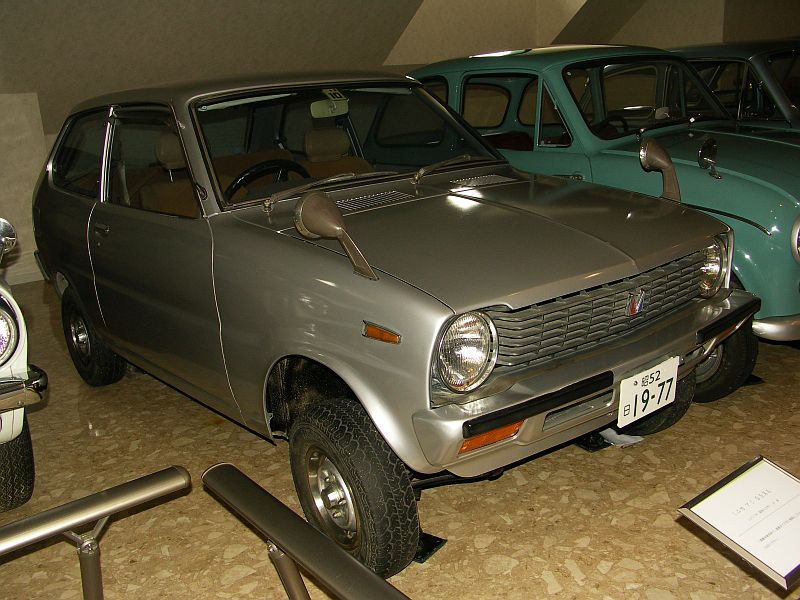
The Mitsubishi Minica Ami 55 XL was a compact Japanese passenger car introduced during the late 1970s as part of Mitsubishi’s continuing development of its long-running Minica range. Designed for the Japanese domestic market, the Ami 55 belonged to the kei-car category, which offered favourable taxation and registration conditions for vehicles meeting strict limits on engine capacity and exterior dimensions. The XL was a better-equipped version of the Ami 55, combining the economical operation of Mitsubishi’s small-capacity engine with improved interior trim and convenience features. Retaining the traditional front-engine, rear-wheel-drive layout of earlier Minicas, the Ami 55 represented an important transitional model between the original 360 cc kei cars of the 1960s and the more modern front-wheel-drive hatchbacks that would appear during the 1980s. Although modest in performance, the Minica Ami 55 XL provided practical, affordable transport and reflected the increasing sophistication of Japan’s smallest passenger cars.
The origins of the Mitsubishi Minica Ami 55 XL can be traced to the introduction of the original Mitsubishi Minica in October 1962. Developed from the Mitsubishi 360 light commercial vehicle, the first Minica was designed to provide economical personal transport at a time when private car ownership was expanding rapidly in Japan.
The original Minica employed a compact two-door saloon body, a 359 cc air-cooled two-stroke twin-cylinder engine and rear-wheel drive. Its small dimensions and low running costs made it suitable for Japan’s narrow streets and crowded urban environments.
The Minica competed in the kei-car category, which had been established by the Japanese government to encourage the development of affordable small vehicles. By the early 1960s, kei cars were restricted to an engine capacity of 360 cc and tightly controlled exterior dimensions.
These limitations encouraged Japanese manufacturers to develop innovative engineering solutions that maximised performance, passenger accommodation and practicality within the permitted limits.
Mitsubishi continued to refine the Minica throughout the 1960s, introducing improved engines, revised styling and additional equipment.
In 1969, the company introduced the second-generation Minica, commonly known as the Minica 70. The revised model adopted more contemporary styling while retaining the basic front-engine, rear-wheel-drive arrangement.
The Minica 70 was available with improved versions of Mitsubishi’s two-stroke twin-cylinder engine, while the range subsequently expanded to include four-stroke alternatives.
In 1972, Mitsubishi introduced the Minica F4, which employed a sophisticated 359 cc water-cooled four-stroke four-cylinder engine.
The F4 represented a significant departure from the earlier two-stroke models and reflected the growing importance of exhaust-emissions regulations in Japan.
Although the four-cylinder engine offered improved refinement, its exceptionally small displacement limited torque and required relatively high engine speeds to maintain performance.
By the mid-1970s, Japanese manufacturers were increasingly concerned that the 360 cc engine-capacity limit was restricting the development of practical and economical small cars.
In January 1976, the Japanese government increased the permitted kei-car engine capacity from 360 cc to 550 cc and allowed larger exterior dimensions.
These changes represented a major turning point in the development of the kei-car category.
Manufacturers could now develop engines with greater torque and flexibility, while the increased dimensional limits allowed improved passenger accommodation and crash protection.
Mitsubishi responded by introducing the Minica 5 in 1976, which employed a larger engine and revised bodywork.
The Minica 5 was an interim development intended to take advantage of the new regulations while retaining much of the existing Minica platform.
In 1977, Mitsubishi introduced the Minica Ami 55, representing a further development of the larger-capacity Minica range.
The Ami 55 incorporated revised styling, improved equipment and mechanical refinements intended to make the car more competitive against increasingly sophisticated kei-class rivals.
The XL was one of the better-equipped versions of the Ami 55, offering additional comfort and convenience features compared with more basic models.
The Ami 55 retained the conventional front-engine, rear-wheel-drive arrangement used by earlier Minicas.
Although front-wheel drive was becoming increasingly popular among small-car manufacturers, Mitsubishi continued to use rear-wheel drive because it allowed the company to develop its existing platform without the expense of introducing an entirely new drivetrain architecture.
The engine was mounted longitudinally at the front, with power transmitted to the rear wheels through a manual gearbox and propeller shaft.
This arrangement was mechanically straightforward and familiar to Mitsubishi’s engineers, although it occupied more interior space than the front-wheel-drive layouts being adopted by some competitors.
The Minica Ami 55 XL employed a water-cooled four-stroke engine developed from Mitsubishi’s small-capacity engine family.
The engine displaced approximately 546 cc, placing it within the revised kei-car regulations.
The larger displacement provided improved torque and flexibility compared with the earlier 359 cc engines, making the car more suitable for everyday transport.
The engine retained a four-cylinder configuration, reflecting Mitsubishi’s experience with the earlier Minica F4.
The additional displacement allowed the engine to produce useful power at lower rotational speeds, reducing the need for frequent gear changes.
Engine output varied according to specification and production year, but the Ami 55 generally developed approximately 28 to 31 PS, equivalent to around 21 to 23 kW.
The engine employed a conventional overhead-valve arrangement, with fuel supplied through a carburettor.
Water cooling allowed consistent control of engine temperature, helping improve reliability and emissions performance.
The four-cylinder configuration provided relatively smooth operation compared with the two-cylinder and three-cylinder engines used by many competing kei cars.
However, the additional cylinders also increased mechanical complexity and manufacturing costs.
The engine was designed primarily for economical operation rather than sporting performance.
Its modest power output was sufficient for urban driving and moderate-speed touring, although acceleration remained relatively leisurely by the standards of larger passenger cars.
The Minica Ami 55 XL was generally equipped with a manual gearbox, providing ratios suited to the engine’s limited torque output.
The rear-wheel-drive layout offered predictable handling and a conventional driving experience.
The car’s lightweight construction helped compensate for its modest engine power, allowing adequate performance for everyday transport.
The Ami 55 XL’s body was based on the established Minica platform but incorporated styling changes intended to give the car a more contemporary appearance.
The body retained a compact two-door saloon configuration, with a short bonnet, upright passenger compartment and small rear luggage area.
The revised kei-car regulations allowed slightly larger exterior dimensions than the earlier 360 cc models.
The Ami 55 therefore benefited from increased body width and improved passenger accommodation.
The front styling incorporated circular headlamps and a revised grille treatment, giving the car a more modern appearance than its predecessors.
The bonnet and front wings retained relatively simple forms, reflecting the car’s economical character.
The side profile was dominated by the upright passenger compartment and relatively large windows, which contributed to good outward visibility.
The two-door arrangement reduced body complexity and manufacturing costs, although access to the rear seats was less convenient than in larger four-door cars.
At the rear, the Ami 55 retained a conventional boot rather than the hatchback configuration that would become increasingly popular among small cars during the following decade.
The boot was relatively small but adequate for shopping and everyday personal belongings.
The XL specification was intended to provide a more comfortable and attractive alternative to the basic Ami 55.
Exterior trim could include additional brightwork, decorative mouldings and model identification badges, depending on production year and specification.
The XL was also available in a range of exterior colours, reflecting the changing tastes of Japanese motorists during the late 1970s.
The overall appearance was relatively restrained, but the additional trim helped distinguish the XL from more basic versions.
Inside, the Mitsubishi Minica Ami 55 XL offered improved equipment and trim compared with the entry-level models.
The dashboard incorporated a conventional instrument arrangement, with the speedometer and essential gauges positioned ahead of the driver.
The controls were arranged simply, reflecting the car’s economical purpose.
The XL specification included improved seat upholstery and additional interior trim, providing a more comfortable environment for everyday driving.
The front seats were relatively upright but offered sufficient support for short and medium-distance journeys.
The rear bench accommodated two additional passengers, although legroom remained limited by the car’s compact dimensions.
The large windows and relatively upright body contributed to good outward visibility, while the short bonnet made the car easy to position in traffic.
The cabin offered relatively modest sound insulation, and engine noise remained noticeable during acceleration and sustained high-speed operation.
Nevertheless, the four-cylinder engine provided a smoother mechanical character than many contemporary kei-car engines.
The XL’s improved trim and equipment reflected the growing expectations of Japanese small-car buyers during the late 1970s.
As incomes increased, motorists increasingly demanded greater comfort, convenience and refinement, even in the smallest vehicles.
Manufacturers responded by introducing more elaborate trim levels and additional equipment to differentiate their models.
The Ami 55 XL was part of this trend, offering a more appealing interior without sacrificing the economical running costs associated with the kei-car category.
The suspension was developed from the established Minica arrangement, with independent front suspension and a rear axle layout suited to the rear-wheel-drive configuration.
The suspension was designed to provide a balance between economical construction, ride comfort and predictable handling.
The short wheelbase and narrow track contributed to the car’s manoeuvrability, although they also meant that the ride could become unsettled on uneven surfaces.
The steering was mechanically operated without power assistance, but the car’s low weight made steering effort relatively modest.
The Ami 55 XL was particularly easy to manoeuvre in confined spaces, making it suitable for Japan’s crowded urban environments.
Braking was provided by conventional drum brakes, reflecting the technology commonly used in small Japanese passenger cars during the period.
The modest engine output and low vehicle weight meant that the braking system was adequate for normal use, although regular maintenance was necessary to maintain consistent performance.
The car rode on small steel wheels with narrow tyres, helping reduce rolling resistance and operating costs.
The tyres provided sufficient grip for the vehicle’s performance, but the narrow track and compact dimensions required a measured driving approach, particularly during sudden manoeuvres.
The Minica Ami 55 XL’s driving characteristics were dominated by its small engine and lightweight construction.
In urban conditions, the car was economical and easy to handle. Its compact dimensions made parking straightforward, while the relatively narrow body allowed it to negotiate congested streets with ease.
The larger 546 cc engine provided improved torque compared with the earlier 360 cc Minicas, making acceleration more flexible and reducing the need for frequent gear changes.
Nevertheless, the car remained relatively slow compared with larger passenger cars, particularly when carrying a full complement of passengers.
The Ami 55 XL was capable of maintaining moderate cruising speeds, although sustained high-speed touring was not its principal purpose.
Its economy and practicality were more important than outright performance.
Fuel consumption was relatively low, reflecting the small engine capacity and lightweight construction.
However, actual economy depended on driving conditions, engine tune, passenger load and the amount of time spent operating at higher engine speeds.
The Ami 55 XL competed in an increasingly sophisticated Japanese kei-car market.
Important rivals included the Suzuki Fronte, Daihatsu Fellow Max, Subaru Rex and Honda Life.
These manufacturers were also responding to the revised kei-car regulations by introducing larger engines and updated body designs.
The Suzuki Fronte offered a range of compact passenger cars with increasingly modern styling and mechanical specifications.
The Daihatsu Fellow Max and its successors provided economical transport with practical body designs.
The Subaru Rex continued to develop as an important competitor in the kei-car market, while Honda’s small-car programme demonstrated the growing emphasis on refinement and efficient packaging.
Against these competitors, the Mitsubishi Minica Ami 55 XL offered a combination of conventional engineering, economical operation and improved interior equipment.
Its four-cylinder engine was relatively unusual within the kei-car category, providing a distinctive mechanical character.
However, the rear-wheel-drive layout was becoming increasingly outdated as competitors adopted front-wheel drive.
Front-wheel-drive designs offered significant packaging advantages because they eliminated the need for a longitudinal transmission tunnel and rear differential.
This allowed more efficient use of interior space within the strict kei-car dimensional limits.
Mitsubishi would eventually adopt front-wheel drive for the Minica range in 1984, but the Ami 55 XL belonged to the final period of the traditional rear-wheel-drive Minica architecture.
During the late 1970s, Mitsubishi continued to refine the Ami 55 range through mechanical and equipment updates.
Changes to engine tuning, emissions equipment and interior trim reflected the company’s efforts to maintain competitiveness.
The Ami 55 also benefited from Mitsubishi’s growing experience in small-car manufacturing.
The company was expanding its passenger-car range with models such as the Lancer, Galant and Mirage, while the Minica continued to serve the domestic kei-car market.
The introduction of the Mitsubishi Mirage in 1978 marked an important stage in the company’s development of modern front-wheel-drive small cars.
Although the Mirage was larger than the Minica, its transverse-engine, front-wheel-drive layout demonstrated the direction in which Mitsubishi’s small-car engineering was moving.
The Ami 55 XL therefore occupied an interesting position within the company’s range, combining traditional rear-wheel-drive engineering with improved equipment and a more modern engine.
By the early 1980s, however, the Minica’s basic platform was becoming increasingly dated.
Japanese competitors were introducing more modern hatchback bodies, improved engines and front-wheel-drive layouts.
Mitsubishi responded by developing a new generation of Minica models that would eventually replace the traditional rear-wheel-drive range.
The introduction of the front-wheel-drive Minica in 1984 marked the end of the engineering architecture that had originated with the Mitsubishi 360 and first-generation Minica.
The Ami 55 XL therefore represents one of the later developments of Mitsubishi’s original kei-car platform.
Its historical significance lies partly in its position as a transitional model between the early 360 cc Minicas and the more modern front-wheel-drive cars of the 1980s.
The Ami 55 XL also illustrates the influence of Japanese kei-car regulations on automotive development.
The increase in permitted engine capacity from 360 cc to 550 cc allowed Mitsubishi to develop a more flexible and practical small car without abandoning the established Minica platform.
The larger engine improved everyday performance, while the revised body dimensions provided greater passenger accommodation.
The XL specification demonstrated the growing importance of comfort and equipment in the kei-car market.
By the late 1970s, kei cars were no longer regarded solely as the cheapest form of private transport.
They were increasingly expected to provide a reasonable level of refinement, convenience and individuality.
The Minica Ami 55 XL reflected this development by offering a better-equipped version of Mitsubishi’s economical small car.
Today, the Mitsubishi Minica Ami 55 XL is a relatively rare and historically interesting Japanese classic.
Its rarity reflects both its age and its original purpose as inexpensive everyday transport.
Many examples were used intensively and eventually scrapped after reaching the end of their useful service lives.
Unlike sporting or luxury cars, small economy vehicles were rarely preserved when new, and relatively few were considered valuable enough to restore during the decades following their withdrawal from service.
Consequently, surviving examples of the Ami 55 XL have become increasingly interesting to collectors and museums specialising in Japanese automotive history.
The model is particularly relevant to enthusiasts studying Mitsubishi’s early kei-car development and the transition from 360 cc to 550 cc engines.
Restoring a surviving example can present considerable challenges.
Original mechanical components, body panels and interior trim may be difficult to locate, particularly outside Japan.
The small four-cylinder engine requires careful maintenance, especially concerning its cooling system, carburettor, ignition equipment and valve gear.
The cooling system should be inspected for corrosion, leaks and deterioration of hoses and seals.
The carburettor and ignition system require careful adjustment to ensure reliable starting and consistent running.
The manual gearbox and rear-wheel-drive components should also be examined for wear, particularly on high-mileage vehicles.
Corrosion is another important consideration because the steel monocoque body can deteriorate around the sills, floor panels, wheel arches and suspension mounting points.
The condition of the body structure is especially important on such a small vehicle because corrosion can significantly weaken the passenger compartment.
Suspension bushes, dampers and steering components should be inspected carefully, while the drum brakes require regular maintenance.
Originality can be particularly important for collectors because the Ami 55 XL represents a distinctive stage in Mitsubishi’s engineering development.
Correct engine identification, body details, badges and interior components help establish whether a surviving example retains its original specification.
Despite the challenges associated with restoration, the Minica Ami 55 XL offers considerable historical interest.
Its compact dimensions, conventional engineering and improved interior equipment provide an insight into the changing expectations of Japanese motorists during the late 1970s.
The car also demonstrates how government regulations influenced automotive design, encouraging manufacturers to develop more practical and refined vehicles within strict limits.
The Mitsubishi Minica Ami 55 XL represents an important chapter in the development of Japan’s kei-car industry. Introduced during the late 1970s as a better-equipped version of the Minica Ami 55, it combined a compact two-door saloon body with a 546 cc four-stroke engine and conventional rear-wheel drive. Its improved interior trim and greater engine flexibility reflected the changing expectations of Japanese small-car buyers following the increase in permitted kei-car engine capacity in 1976. Although its traditional mechanical layout was eventually superseded by more modern front-wheel-drive designs, the Ami 55 XL remains historically significant as one of the later developments of Mitsubishi’s original Minica platform. Today, it is remembered as a rare and distinctive Japanese small car, representing the transition from the basic kei vehicles of the 1960s to the more refined and practical models that emerged during the 1980s.