
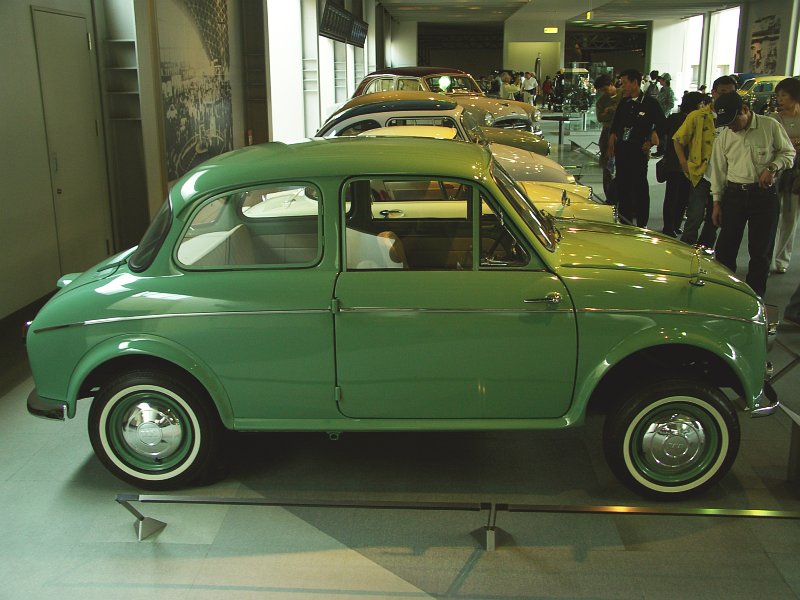
The Mitsubishi 500 A11 was a compact Japanese passenger car introduced in 1960 by Shin Mitsubishi Heavy Industries, marking the company’s return to passenger-car manufacturing after an absence of almost four decades. Designed as an affordable family vehicle for Japan’s rapidly expanding domestic market, the A11 combined a lightweight two-door saloon body with a rear-mounted, air-cooled, two-cylinder engine and rear-wheel drive. Its simple mechanical construction, economical fuel consumption and compact dimensions reflected the growing demand for inexpensive private transport during Japan’s post-war economic recovery. Although the Mitsubishi 500 had a relatively short production life, the A11 was particularly significant because it established the engineering foundation for the later Mitsubishi 500 Super Deluxe and Colt 600. It also represented an important step in Mitsubishi’s transformation from a manufacturer primarily associated with commercial vehicles and industrial machinery into a major producer of passenger cars.
The origins of the Mitsubishi 500 A11 can be traced to Mitsubishi’s earliest involvement in automobile manufacturing. In 1917, Mitsubishi Shipbuilding Company introduced the Mitsubishi Model A, generally regarded as Japan’s first series-production passenger car. The Model A was a relatively large and expensive vehicle intended for government officials, business executives and wealthy private customers.
Production ended in 1921 after approximately 22 examples had been manufactured. The limited domestic market and high production costs made continued manufacture commercially impractical, and Mitsubishi subsequently concentrated on commercial vehicles, buses and industrial machinery.
During the following decades, Mitsubishi developed considerable experience in automotive engineering through the production of trucks, buses and specialist vehicles. However, conventional passenger cars remained outside the company’s principal manufacturing activities.
Following Japan’s defeat in the Second World War, Mitsubishi Heavy Industries was divided into three regional companies under the Allied occupation authorities. These companies continued manufacturing activities in various industrial sectors, including commercial vehicles, machinery and transport equipment.
One of Mitsubishi’s most successful early post-war products was the Silver Pigeon motor scooter, introduced in 1946. The scooter provided affordable personal transport during a period when Japan was rebuilding its economy and private car ownership remained beyond the means of most households.
As Japan’s economy improved during the 1950s, demand for small passenger cars began to increase. Rising industrial employment, improving household incomes and the gradual expansion of road infrastructure created new opportunities for domestic manufacturers.
The Japanese government also encouraged the development of an affordable domestic passenger-car industry. In 1955, the Ministry of International Trade and Industry proposed the People’s Car concept, which envisaged an economical vehicle capable of carrying four occupants while remaining affordable for ordinary Japanese families.
Although the proposed specifications were not adopted as a formal production standard, the initiative influenced the development of several Japanese small cars during the late 1950s and early 1960s.
Shin Mitsubishi Heavy Industries recognised the opportunity to re-enter the passenger-car market with a compact and economical vehicle that could be produced at a competitive price.
Development of the Mitsubishi 500 began during the late 1950s, with engineers concentrating on a lightweight design that would minimise manufacturing costs while providing adequate accommodation for four occupants.
The resulting car was unveiled at the Tokyo Motor Show in 1959 before entering production in April 1960.
The Mitsubishi 500 A11 was positioned as an affordable family car rather than a sporting or luxury vehicle. Its principal attractions were low purchase cost, economical fuel consumption and mechanical simplicity.
Although compact, the A11 was not classified as a kei car. Its engine capacity exceeded the 360 cc limit then applicable to the kei category, placing it within Japan’s larger small-passenger-car classification.
This allowed Mitsubishi greater freedom in engine design and performance while retaining the benefits of a lightweight and economical vehicle.
The Mitsubishi 500 A11 employed a rear-engine, rear-wheel-drive layout, an arrangement widely used in European economy cars during the period.
The Volkswagen Beetle, Fiat 500 and Renault Dauphine demonstrated the advantages of placing the engine at the rear of a compact passenger car, particularly in terms of mechanical packaging and manufacturing simplicity.
Mitsubishi adopted a similar approach, mounting the engine behind the rear axle and transmitting power directly to the rear wheels through a compact transaxle arrangement.
This eliminated the need for a conventional propeller shaft running through the passenger compartment and allowed more efficient use of the available interior space.
The rear-engine layout also reduced drivetrain complexity and contributed to the car’s relatively low manufacturing cost.
The Mitsubishi 500 A11 featured a compact two-door saloon body constructed using steel monocoque principles.
Its styling was relatively simple and functional, reflecting the economic priorities of its intended market.
The body featured a short, rounded bonnet, upright passenger compartment and gently curved roofline.
Circular headlamps were mounted within the front wings, while the absence of a conventional front radiator grille gave the car a distinctive appearance.
The front panel was relatively smooth, with simple bumper detailing and minimal ornamentation.
The side profile featured a relatively high roofline and large windows, providing good outward visibility and helping maximise passenger accommodation.
The two-door configuration reduced manufacturing costs and structural complexity, although access to the rear seats was less convenient than in larger four-door cars.
At the rear, the engine compartment was incorporated beneath a compact lid, with ventilation openings allowing cooling air to reach the engine.
The rear styling was restrained, with small lamp units and simple bumper detailing.
The Mitsubishi 500 A11 measured approximately 3,140 mm in length, 1,390 mm in width and 1,380 mm in height, with a wheelbase of approximately 2,065 mm.
These compact dimensions made the car well suited to Japan’s narrow streets and limited parking facilities.
The relatively short wheelbase also contributed to manoeuvrability, although it influenced ride comfort and stability on uneven roads.
The body was designed to accommodate four occupants, with two individual front seats and a rear bench.
Despite its small exterior dimensions, the rear-engine arrangement allowed a relatively useful passenger compartment.
The front luggage compartment provided limited storage space, although the position of the steering components and other mechanical equipment restricted its capacity.
Additional small storage areas were provided within the passenger compartment.
The Mitsubishi 500 A11 was powered by a 493 cc air-cooled, four-stroke, two-cylinder engine.
The engine was mounted at the rear of the vehicle and employed a relatively simple overhead-valve arrangement.
The two-cylinder configuration helped minimise weight, manufacturing costs and mechanical complexity.
Air cooling eliminated the need for a radiator, water pump and associated cooling hoses, reducing the number of components requiring maintenance.
The engine employed a carburettor for fuel delivery and a conventional ignition system.
In its original specification, the engine developed approximately 21 PS, equivalent to around 15 kW or 21 bhp.
Although modest by modern standards, this output was sufficient for a vehicle weighing approximately 490 kg.
The low weight helped the Mitsubishi 500 A11 provide acceptable acceleration for urban driving and moderate-speed journeys.
The engine’s relatively small capacity also contributed to economical fuel consumption, an important consideration for Japanese motorists during the early 1960s.
However, the two-cylinder engine produced noticeable vibration and mechanical noise, particularly when operating at higher engine speeds.
The air-cooled design also required careful attention to cooling airflow, especially during sustained operation in hot conditions.
The Mitsubishi 500 A11 was equipped with a three-speed manual transmission, with power transmitted directly to the rear wheels through the transaxle.
The gearbox was designed primarily for economical operation and reliability rather than sporting performance.
The limited number of ratios meant that drivers needed to select gears carefully when accelerating or climbing hills.
Nevertheless, the car’s low weight and modest engine output made the transmission suitable for its intended purpose.
The Mitsubishi 500 A11’s performance was typical of small economy cars of the period.
The original model was capable of reaching a maximum speed of approximately 90 km/h, although actual performance depended on road conditions, passenger load and engine condition.
Acceleration was relatively leisurely, but adequate for the traffic conditions common in Japan during the early 1960s.
The car was intended primarily for everyday transport rather than sustained high-speed touring.
Its compact dimensions and low operating costs were more important than outright performance.
The suspension was designed to provide acceptable ride comfort while maintaining economical construction.
The front suspension employed an independent arrangement, allowing the front wheels to respond individually to road irregularities.
At the rear, the suspension accommodated the compact engine and transaxle assembly while providing sufficient wheel movement for ordinary road use.
The rear-engine layout placed a relatively high proportion of the vehicle’s weight over the driven wheels, providing useful traction on slippery surfaces.
However, the rearward weight distribution also influenced handling, particularly during abrupt changes of direction.
The steering was mechanically operated without power assistance, but the car’s low weight made steering effort relatively modest.
The Mitsubishi 500 A11 was particularly manoeuvrable in confined spaces, making it suitable for urban driving.
Braking was provided by hydraulic drum brakes, reflecting the technology commonly used in small passenger cars during the period.
The modest engine output and low vehicle weight meant that the braking system was adequate for normal use, although regular adjustment and maintenance were necessary.
The car rode on small steel wheels with narrow tyres, helping reduce rolling resistance and operating costs.
The tyres provided sufficient grip for the vehicle’s performance, but the narrow track and short wheelbase required a measured driving approach.
Inside, the Mitsubishi 500 A11 featured a simple and functional cabin designed to provide affordable transport for four occupants.
The dashboard incorporated basic instrumentation, including a speedometer and essential warning indicators.
The controls were relatively simple, reflecting the car’s economical purpose.
The front seats were upright and relatively narrow, helping maximise the available interior space.
The rear bench accommodated two additional passengers, although legroom was limited by the compact body dimensions.
Interior trim was modest, with durable materials selected for economy and ease of maintenance.
The car offered little of the refinement associated with larger passenger cars, but its simplicity was appropriate for its intended market.
The large windows and relatively upright body contributed to good outward visibility, while the short bonnet made the car easy to position in traffic.
Heating and ventilation equipment were relatively basic, reflecting the standards of inexpensive passenger cars during the early 1960s.
Noise insulation was limited, and engine noise remained noticeable during acceleration and sustained high-speed operation.
Nevertheless, the Mitsubishi 500 A11 provided a significant improvement in comfort and weather protection compared with motorcycles and motor scooters, which remained common forms of personal transport in Japan.
The Mitsubishi 500 A11 entered a competitive market dominated by small domestic and imported passenger cars.
Important rivals included the Subaru 360, Suzuki Suzulight, Toyota Publica and various European economy cars.
The Subaru 360, introduced in 1958, became one of Japan’s most recognisable early kei cars because of its lightweight construction and distinctive rounded styling.
Although the Subaru was smaller and benefited from kei-car taxation advantages, the Mitsubishi 500 A11 offered a larger engine and somewhat greater performance.
The Toyota Publica, introduced in 1961, represented another important competitor in the affordable passenger-car market.
The Publica employed a front-mounted, air-cooled, two-cylinder engine and rear-wheel drive, offering a more conventional mechanical layout.
Against these competitors, the Mitsubishi 500 A11 offered a combination of compact dimensions, lightweight construction and economical operation.
Its rear-engine layout distinguished it from some domestic rivals, while its modest purchase price made it accessible to a growing number of Japanese motorists.
However, the Mitsubishi 500 A11 faced challenges in a market where consumer expectations were changing rapidly.
Japanese buyers increasingly demanded greater engine performance, improved comfort and more sophisticated styling.
Mitsubishi therefore introduced an improved version of the 500 in 1961.
The revised model, known as the Mitsubishi 500 Super Deluxe, employed an enlarged 594 cc engine.
The larger engine provided improved torque and acceleration, making the car more suitable for everyday transport.
Power output increased to approximately 25 PS, equivalent to around 18 kW or 25 bhp.
The additional displacement improved flexibility, reducing the need for frequent gear changes when climbing hills or carrying passengers.
The Super Deluxe also incorporated equipment and trim improvements intended to make the car more attractive to buyers seeking greater comfort.
The revised model retained the basic rear-engine, rear-wheel-drive arrangement and compact body design of the original Mitsubishi 500 A11.
The larger engine provided a useful improvement in performance without significantly increasing vehicle weight.
The Mitsubishi 500’s sporting potential became evident during the early 1960s when Mitsubishi entered the model in international competition.
In 1962, Mitsubishi participated in the Macau Grand Prix meeting with competition-prepared versions of the 500.
The cars competed in the under-750 cc category, where their lightweight construction and improved engine performance proved advantageous.
Mitsubishi achieved a notable class victory, with the 500 Super Deluxe demonstrating the capabilities of the company’s small-car engineering.
The success was particularly significant because it represented one of Mitsubishi’s earliest international motorsport achievements.
It also provided valuable publicity for the company at a time when Japanese manufacturers were beginning to establish their reputations beyond the domestic market.
The Macau result demonstrated that a modest economy car could be developed into a competitive racing machine through careful preparation and engineering.
Although the Mitsubishi 500 A11 was never intended primarily as a sporting vehicle, its competition success helped establish a tradition of motorsport involvement that would become an important part of Mitsubishi’s identity.
During subsequent decades, Mitsubishi would achieve considerable success in rallying and other forms of motorsport, particularly with the Lancer and Pajero.
The Mitsubishi 500 therefore occupies an important position in the early development of the company’s sporting reputation.
Despite its competition achievements, the Mitsubishi 500 A11’s production life was relatively short.
By the early 1960s, Mitsubishi recognised the need for a more modern and versatile small passenger car.
The company therefore developed the Mitsubishi Colt 600, introduced in 1962.
The Colt 600 retained the basic rear-engine, rear-wheel-drive arrangement of the Mitsubishi 500 but featured a revised body and improved accommodation.
Its more contemporary styling and increased practicality reflected the changing expectations of Japanese motorists.
The Colt 600 was subsequently followed by additional Colt models, including the larger Colt 1000 introduced in 1963.
These vehicles helped establish the Colt name as an important part of Mitsubishi’s passenger-car range.
Production of the Mitsubishi 500 A11 ended in 1961 as the larger-engined A12 version became available, while the broader Mitsubishi 500 family remained in production until 1962.
Although the A11 was manufactured for a relatively short period, it played an important role in Mitsubishi’s return to passenger-car manufacturing.
The experience gained through the development and production of the A11 helped Mitsubishi establish modern passenger-car engineering and manufacturing capabilities.
The company gained valuable experience in lightweight monocoque construction, compact engine design and economical production methods.
These capabilities became increasingly important as Mitsubishi expanded its passenger-car range during the 1960s.
The Mitsubishi 500 A11 also demonstrated the influence of European small-car design on Japan’s emerging automotive industry.
Its rear-engine layout, compact dimensions and simple mechanical construction reflected engineering principles widely used in European economy cars during the period.
However, the vehicle was developed specifically for Japanese conditions, where narrow roads, limited parking space and the need for economical transport influenced purchasing decisions.
The Mitsubishi 500 A11 therefore represented a combination of international engineering ideas and domestic market requirements.
Today, the Mitsubishi 500 A11 is a rare and historically significant Japanese classic car.
Its rarity reflects both its age and its original purpose as an inexpensive everyday vehicle.
Many examples were used intensively and eventually scrapped after reaching the end of their useful service lives.
Unlike sporting or luxury cars, small economy vehicles were rarely preserved when new, and relatively few were considered valuable enough to restore during the decades following their withdrawal from service.
Consequently, surviving examples of the Mitsubishi 500 A11 have become increasingly important to collectors and museums interested in Japanese automotive history.
The model is particularly significant because it represents Mitsubishi’s return to passenger-car manufacturing after the discontinuation of the Model A in 1921.
It also provides an important link between Mitsubishi’s early post-war industrial activities and the company’s subsequent development into a major international automobile manufacturer.
Restoring a surviving Mitsubishi 500 A11 can present considerable challenges.
Original mechanical components, body panels and interior trim may be difficult to locate, particularly outside Japan.
The air-cooled two-cylinder engine requires careful maintenance, particularly concerning its cooling arrangements, carburettor and ignition equipment.
The condition of the engine’s cooling passages and ventilation arrangements is especially important because restricted airflow can lead to overheating.
The carburettor and ignition system require careful adjustment to ensure reliable starting and consistent running.
The transaxle and rear-wheel-drive components should also be examined for wear, particularly on high-mileage vehicles.
Corrosion is another important consideration because the steel monocoque body can deteriorate around the sills, floor panels, wheel arches and suspension mounting points.
The condition of the body structure is especially important on such a small vehicle because corrosion can significantly weaken the passenger compartment.
Suspension bushes, dampers and steering components should be inspected carefully, while the drum brakes require regular maintenance.
Originality can be particularly important for collectors because the Mitsubishi 500 A11 represents a historically significant stage in the company’s development.
Correct engine identification, body details, badges and interior components help establish whether a surviving example retains its original specification.
The Mitsubishi 500 A11 represents an important milestone in the history of Mitsubishi passenger-car production. Introduced in April 1960, it combined a lightweight two-door saloon body with a rear-mounted, 493 cc air-cooled two-cylinder engine and rear-wheel drive, providing affordable and economical transport for Japanese motorists. Although its performance was modest and production of the original A11 version was relatively brief, the model helped establish Mitsubishi’s modern passenger-car manufacturing capabilities and provided the foundation for the subsequent A12 Super Deluxe and Colt 600. Its compact dimensions, simple engineering and distinctive rear-engine layout reflected the practical requirements of Japan’s rapidly expanding motoring population. Today, the Mitsubishi 500 A11 is remembered as a rare and historically significant Japanese classic, representing the beginning of Mitsubishi’s transformation into a major international passenger-car manufacturer.