
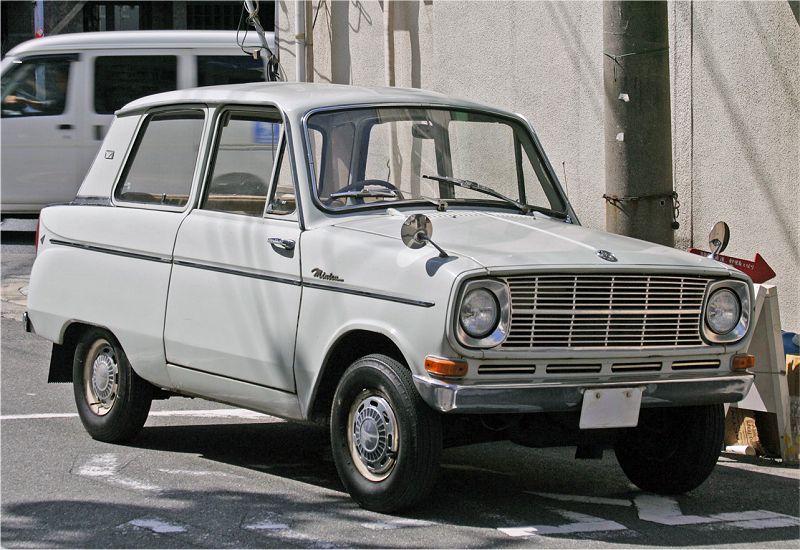
The Mitsubishi Minica was one of Japan’s longest-running small-car model lines, introduced in 1962 and developed through eight generations before production ended in 2011. Designed primarily for the Japanese domestic market, the Minica belonged to the kei-car category, which encouraged the development of compact, economical vehicles through restrictions on engine capacity and exterior dimensions. Over nearly five decades, the Minica evolved from a simple rear-wheel-drive saloon into a modern front-wheel-drive hatchback, reflecting major changes in Japanese automotive engineering, safety regulations and consumer expectations. Although never as internationally prominent as Mitsubishi’s larger passenger cars, the Minica played an important role in establishing the company’s reputation for producing affordable and practical small vehicles. Its history encompassed conventional economy cars, sporting derivatives, commercial vans and technically interesting models such as the Minica Dangan ZZ, demonstrating the adaptability of Mitsubishi’s smallest passenger-car range.
The origins of the Mitsubishi Minica can be traced to the development of Japan’s automotive industry during the years following the Second World War. Mitsubishi had previously manufactured the Model A passenger car between 1917 and 1921, but its early automotive activities were primarily concentrated on commercial vehicles, buses and industrial machinery.
Following the war, Mitsubishi resumed civilian vehicle production with products such as the Silver Pigeon motor scooter, introduced in 1946. These relatively simple and economical vehicles provided affordable transport during a period when Japan was rebuilding its economy and industrial infrastructure.
As economic conditions improved during the 1950s, demand for small passenger cars increased. The Japanese government encouraged the development of compact vehicles through the kei-car classification, which provided tax and registration advantages for cars meeting specified dimensional and engine-capacity limits.
The original kei-car regulations were introduced in 1949 and subsequently revised as the category developed. By the mid-1950s, the permitted engine capacity for conventional kei cars had increased to 360 cc, establishing the framework within which many early Japanese small cars were designed.
Mitsubishi recognised the potential of this expanding market and began developing vehicles intended to provide affordable personal transport for Japanese families.
The Mitsubishi 500, introduced in 1960, represented the company’s return to passenger-car manufacturing. Although larger than a kei car, it demonstrated Mitsubishi’s growing commitment to the domestic small-car market.
The Minica followed in October 1962, providing Mitsubishi with a dedicated kei-class passenger car and establishing a model name that would remain in production for almost fifty years.
The first-generation Minica, designated LA20, was developed from the Mitsubishi 360 light commercial vehicle. It employed a compact two-door saloon body with a conventional three-box appearance, distinguishing it from some contemporary kei cars that adopted more rounded or unconventional styling.
The original Minica was powered by a 359 cc air-cooled two-stroke twin-cylinder engine mounted at the front and driving the rear wheels.
The engine produced approximately 17 bhp, providing modest but adequate performance for a lightweight car intended primarily for urban transport.
The two-stroke design was relatively simple and compact, with fewer moving components than a conventional four-stroke engine. However, it required oil to be supplied as part of the lubrication process and produced the characteristic exhaust sound and emissions associated with two-stroke powerplants.
Power was transmitted through a manual gearbox to the rear wheels. The conventional front-engine, rear-wheel-drive arrangement reflected Mitsubishi’s existing experience with light commercial vehicles.
The Minica’s compact dimensions allowed it to comply with Japanese kei-car regulations while providing accommodation for four occupants.
The body was designed to maximise usable interior space within the restricted exterior dimensions. Its relatively upright passenger compartment and large windows contributed to good visibility and practical everyday use.
The suspension was designed for simplicity and durability, while the small wheels and lightweight construction helped keep manufacturing and running costs low.
The original Minica competed against established Japanese kei cars such as the Subaru 360 and Mazda Carol. These vehicles were important in expanding private car ownership among Japanese households during the country’s rapid economic development.
Although the Minica offered modest performance, its affordability, economical fuel consumption and compact dimensions made it suitable for the narrow streets and crowded urban environments common in Japan.
During the 1960s, Mitsubishi gradually improved the Minica through mechanical and styling revisions. Engine output increased, while changes to trim and equipment reflected growing consumer expectations.
The introduction of more powerful engine versions helped improve acceleration and flexibility, particularly as Japanese road conditions and traffic speeds developed.
The first-generation Minica remained in production until 1969, establishing a foundation for Mitsubishi’s continuing involvement in the kei-car market.
The second-generation Minica, introduced in 1969, represented a substantial departure from the original model. Known as the Minica 70, it adopted a more rounded and contemporary body design while retaining the basic front-engine, rear-wheel-drive arrangement.
The revised body featured a larger glass area and more modern proportions, reflecting the styling trends of Japanese small cars during the late 1960s.
The Minica 70 was offered with improved versions of Mitsubishi’s small two-stroke engine, while the range subsequently expanded to include four-stroke alternatives.
The introduction of four-stroke engines was an important development because increasingly demanding emissions regulations were making traditional two-stroke powerplants less attractive.
Four-stroke engines generally offered cleaner exhaust emissions, improved fuel efficiency under many operating conditions and a more conventional driving character.
The Minica 70 also benefited from improvements to interior trim, instrumentation and passenger accommodation.
During the early 1970s, Mitsubishi introduced the Minica Skipper, a distinctive fastback derivative with sporting styling.
The Skipper featured a sloping rear roofline and a more youthful appearance, reflecting the growing popularity of compact sporting cars in Japan.
Although its performance remained limited by the kei-car engine-capacity regulations, the Skipper demonstrated Mitsubishi’s willingness to develop more individual and fashionable versions of its smallest car.
The Skipper became particularly notable for its unusual rear styling and compact proportions, which distinguished it from conventional small saloons.
The Minica range continued to evolve during the early 1970s, with further engine and equipment improvements intended to maintain competitiveness.
In 1972, Mitsubishi introduced the Minica F4, featuring a four-stroke engine. This development reflected the growing importance of emissions compliance and the gradual transition away from two-stroke engines in the Japanese kei-car market.
The F4 employed a small four-cylinder engine, an unusual configuration for a vehicle of such limited displacement.
The four-cylinder arrangement provided smoother operation than many contemporary twin-cylinder engines, although it also introduced additional mechanical complexity.
The Minica F4 demonstrated Mitsubishi’s willingness to pursue technically distinctive solutions within the constraints of the kei-car regulations.
The third-generation Minica, introduced in 1972, continued the development of the model with revised styling and mechanical improvements.
This generation retained the basic rear-wheel-drive layout but incorporated changes intended to improve comfort, practicality and emissions performance.
The body design reflected the increasingly angular styling trends of the 1970s, while the interior offered improved instrumentation and trim.
The Minica remained primarily an economical urban car, but Mitsubishi continued to offer different equipment levels to appeal to a wider range of customers.
During the mid-1970s, changes to Japanese kei-car regulations had a significant influence on the Minica’s development.
In 1976, the permitted engine capacity increased from 360 cc to 550 cc, while the maximum exterior dimensions were also enlarged.
These changes allowed manufacturers to develop more powerful and practical kei cars, improving their suitability for everyday transport.
Mitsubishi responded by introducing the Minica 5, which employed a larger engine and revised bodywork.
The Minica 5 retained the familiar rear-wheel-drive layout but offered improved torque and performance compared with the earlier 360 cc models.
The larger engine made the car more flexible in traffic and better suited to longer journeys.
The Minica 5 was subsequently developed into the Minica Ami 55, introduced in 1977.
The Ami 55 incorporated further styling changes and improved equipment, reflecting the increasing sophistication of Japanese kei cars.
The model retained the compact dimensions required by the kei-car classification while providing improved interior accommodation and everyday usability.
The Minica Ami 55 was offered in several versions, including passenger and commercial variants.
Commercial models were particularly important in Japan, where small vans and light-duty utility vehicles benefited from favourable taxation and operating costs.
The Minica’s simple construction and compact dimensions made it suitable for delivery services, small businesses and other commercial applications.
By the late 1970s, however, the rear-wheel-drive layout was becoming increasingly outdated in the small-car market.
Front-wheel-drive designs offered significant packaging advantages because they eliminated the need for a longitudinal transmission tunnel and rear differential.
Mitsubishi therefore began developing a new generation of Minica models based around a more modern front-wheel-drive arrangement.
The fourth-generation Minica, introduced in 1984, represented one of the most important developments in the model’s history.
It adopted a transverse front-engine, front-wheel-drive layout, bringing the Minica into line with contemporary small-car engineering.
The new arrangement allowed more efficient use of interior space and reduced the number of drivetrain components required.
The body adopted a modern hatchback design, replacing the traditional saloon proportions of earlier generations.
Three-door and five-door versions were offered, providing greater flexibility for buyers seeking economical personal or family transport.
The hatchback body allowed easier access to the luggage compartment and improved the car’s everyday practicality.
The fourth-generation Minica employed a 548 cc three-cylinder engine, reflecting the kei-car regulations then in force.
The three-cylinder arrangement provided a useful compromise between compact dimensions, mechanical simplicity and smoothness.
The engine was mounted transversely at the front of the car and drove the front wheels through a manual or automatic transmission, depending on specification.
The new Minica offered improved handling, interior packaging and fuel economy compared with its rear-wheel-drive predecessors.
The front-wheel-drive layout also provided good traction in wet conditions, making the car suitable for Japan’s varied climate.
The revised suspension arrangement was designed to provide a balance between ride comfort, predictable handling and low manufacturing costs.
The interior featured a more modern dashboard, improved ventilation and greater attention to ergonomics.
The fourth-generation Minica helped Mitsubishi maintain its position in the increasingly competitive kei-car market during the 1980s.
Rivals included the Suzuki Alto, Daihatsu Mira and Subaru Rex, all of which were developing rapidly as Japanese manufacturers competed to offer greater refinement and practicality.
The Minica’s compact dimensions and economical running costs remained important selling points, particularly in densely populated urban areas.
The fifth-generation Minica, introduced in 1989, continued the development of the front-wheel-drive platform with more rounded styling and improved interior equipment.
This generation became particularly notable for the introduction of sporting derivatives that demonstrated the performance potential of Mitsubishi’s small three-cylinder engines.
The Minica Dangan ZZ was one of the most distinctive examples. It employed a turbocharged and intercooled 548 cc three-cylinder engine with double overhead camshafts and five valves per cylinder.
The engine produced approximately 64 PS, equivalent to around 63 bhp, placing it among the most powerful kei cars permitted under the Japanese voluntary power-output limit.
The five-valve-per-cylinder design was particularly unusual for such a small engine, reflecting Mitsubishi’s willingness to apply advanced technology to its smallest vehicles.
The turbocharger improved power and torque, while the intercooler reduced the temperature of the compressed intake air.
The Dangan ZZ combined this sophisticated engine with a lightweight body, providing lively acceleration and a distinctive sporting character.
Some versions were available with four-wheel drive, improving traction and making the car particularly suitable for Japan’s mountainous and snowy regions.
The Dangan ZZ became an important part of the Minica’s enthusiast reputation, demonstrating that a kei car could offer entertaining performance despite strict engine-capacity regulations.
In 1990, the Japanese government increased the permitted kei-car engine capacity from 550 cc to 660 cc, while also allowing a modest increase in exterior dimensions.
These changes encouraged manufacturers to develop larger and more refined engines, improving performance and everyday usability.
Mitsubishi responded by introducing revised Minica models with 657 cc three-cylinder engines.
The additional displacement provided improved torque and flexibility, particularly in naturally aspirated versions intended for economical transport.
Turbocharged sporting versions continued to offer performance close to the kei-car power limit.
The sixth-generation Minica, introduced in 1993, featured a more rounded body design and further improvements to interior space, refinement and equipment.
This generation was developed during a period when Japanese kei cars were becoming increasingly sophisticated.
Buyers expected features such as air conditioning, power steering, electric windows and improved safety equipment, particularly in higher-specification models.
The Minica range therefore expanded to include more comfortable and better-equipped versions alongside basic economy models.
The sixth-generation Minica was available in three-door and five-door body styles, providing flexibility for different buyers.
Its compact dimensions remained suitable for crowded urban environments, while the front-wheel-drive layout allowed efficient use of interior space.
The 657 cc three-cylinder engine was offered in several configurations, including naturally aspirated and turbocharged versions.
The naturally aspirated engines provided economical everyday performance, while the turbocharged versions offered stronger acceleration.
Four-wheel-drive versions were also available, reflecting the popularity of small all-weather vehicles in Japan.
The Minica Dangan continued to represent the sporting side of the range, combining compact dimensions with advanced engine technology.
The sixth-generation Minica also formed the basis for several distinctive derivatives, including the Minica Toppo.
The Toppo adopted a taller roofline and more upright body design, providing substantially increased headroom and interior flexibility.
This concept anticipated the growing popularity of tall-bodied kei cars, which would become an important part of the Japanese domestic market during the 1990s.
The Minica Toppo demonstrated Mitsubishi’s ability to adapt a conventional small-car platform to meet changing customer requirements.
The seventh-generation Minica, introduced in 1998, reflected another major revision to Japanese kei-car regulations.
The revised regulations permitted slightly larger exterior dimensions but also introduced more demanding crash-safety requirements.
Manufacturers responded by developing new body structures with improved occupant protection while maintaining the compact proportions required by the kei-car classification.
The seventh-generation Minica adopted a more modern and rounded appearance, with a revised front end, larger glass area and improved interior packaging.
The body was designed to provide greater passenger space and improved structural protection compared with earlier generations.
The engine range continued to centre on Mitsubishi’s 657 cc three-cylinder units, with different specifications offered according to market requirements.
The Minica remained available in both front-wheel-drive and four-wheel-drive configurations, providing flexibility for urban and rural buyers.
The interior featured improved ergonomics, revised instrumentation and greater attention to passenger comfort.
The model continued to compete against the Suzuki Alto, Daihatsu Mira and other increasingly sophisticated kei cars.
The final generation of the Minica was introduced in 1998 and remained in production, with updates, until 2011. The late-production models retained the compact hatchback configuration and economical three-cylinder engines that had become central to the Minica’s identity.
During the 2000s, the Japanese kei-car market changed considerably. Tall-bodied vehicles offering greater interior space became increasingly popular, while manufacturers introduced more advanced safety equipment and improved fuel efficiency.
Mitsubishi responded by developing models such as the eK Wagon, introduced in 2001, which offered a taller body and more modern interior packaging.
The eK Wagon increasingly occupied the position previously held by the Minica as Mitsubishi’s principal practical kei passenger car.
Nevertheless, the Minica continued to appeal to buyers seeking straightforward, economical transport.
Late-production Minica models were often positioned towards the lower end of the market, emphasising affordability, reliability and low running costs.
Commercial and fleet applications remained important, particularly where purchase price and operating economy were more significant than luxury equipment.
The Minica’s simple mechanical design and compact dimensions made it suitable for urban delivery work and other light-duty applications.
Production of the Mitsubishi Minica ended in 2011, bringing to a close a model line that had remained part of the Japanese automotive market for nearly five decades.
The Minica’s long production history reflected the importance of the kei-car category in Japan and Mitsubishi’s ability to adapt its smallest vehicles to changing regulations and consumer expectations.
Throughout its development, the Minica remained closely associated with economical personal transport.
Its early rear-wheel-drive models reflected the engineering practices of the 1960s, while later front-wheel-drive hatchbacks demonstrated the influence of modern small-car design.
The transition from two-stroke engines to four-stroke units, the adoption of front-wheel drive and the introduction of turbocharged multi-valve engines illustrated the considerable technological changes that occurred during the Minica’s lifetime.
The Minica also played an important role in Mitsubishi’s broader automotive development.
Experience gained through the production of compact engines, lightweight bodies and economical transmissions contributed to the company’s expertise in small-car engineering.
The model’s sporting derivatives demonstrated Mitsubishi’s interest in advanced engine technology, while commercial versions reflected the practical requirements of Japanese businesses.
The Minica’s influence extended beyond its own model line through derivatives such as the Minica Toppo, which helped establish the concept of tall-bodied kei cars within Mitsubishi’s range.
Today, early Mitsubishi Minica models are increasingly appreciated by enthusiasts interested in Japanese automotive history.
The first-generation cars are particularly significant because they represent Mitsubishi’s early involvement in the kei-car market and the transition from commercial-vehicle-derived designs to dedicated small passenger cars.
Surviving examples of the earliest Minicas are relatively uncommon, particularly outside Japan.
Corrosion, mechanical wear and the limited availability of model-specific components can make restoration challenging.
The early two-stroke engines require specialist knowledge, particularly concerning lubrication, ignition and fuel-system maintenance.
Later four-stroke models are generally easier to maintain, although parts availability can still present difficulties outside Japan.
The sporting Minica Dangan models have developed a particular following because of their advanced engines, compact dimensions and distinctive performance characteristics.
The turbocharged five-valve engines are technically interesting but require careful maintenance, particularly concerning cooling, lubrication and turbocharger condition.
Four-wheel-drive versions introduce additional drivetrain components that require inspection and maintenance.
Later Minica models are generally more practical for everyday use, benefiting from improved refinement, fuel efficiency and equipment.
However, their compact dimensions and relatively modest engine outputs mean that they remain best suited to urban and moderate-speed driving.
The Mitsubishi Minica represents an important chapter in the development of Japan’s small-car industry. Introduced in 1962 as a compact rear-wheel-drive kei car, it evolved through successive generations into a modern front-wheel-drive hatchback, adapting to changing regulations, engineering developments and consumer expectations. Its history encompassed economical family cars, practical commercial vehicles and technically sophisticated sporting derivatives, demonstrating the versatility of Mitsubishi’s smallest passenger-car range. Although production ended in 2011, the Minica remains historically significant as one of Mitsubishi’s longest-running model lines and an important contributor to the growth of affordable personal transport in Japan. From the simple two-stroke models of the 1960s to the turbocharged Dangan and later economical hatchbacks, the Minica illustrates the remarkable progress of Japanese small-car engineering during the second half of the twentieth century.