
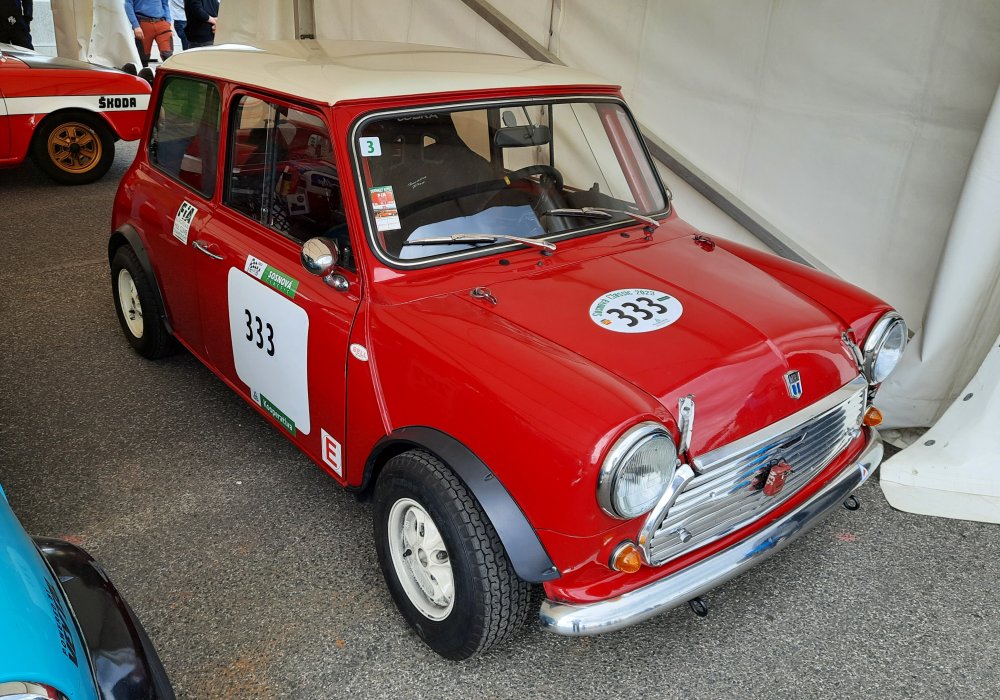
The Mini Cooper S Racing represents one of the most successful and influential chapters in British motorsport history. Developed from the revolutionary Mini designed by Alec Issigonis, the competition-prepared Cooper S combined a lightweight body, compact transverse engine, front-wheel-drive traction and exceptional handling with a highly developed version of the British Motor Corporation’s A-series four-cylinder engine. During the 1960s, the Mini Cooper S achieved remarkable success in international rallying, touring car racing, hill climbs and endurance events, frequently defeating larger and more powerful competitors. Its achievements established the Mini as a genuine motorsport icon and demonstrated that intelligent engineering, low weight and responsive handling could be just as important as outright engine power. The racing Cooper S also became one of the most extensively modified small competition cars of its era, with factory teams and independent specialists developing increasingly sophisticated engines, transmissions, suspension systems and braking arrangements.
The origins of the Mini Cooper S Racing can be traced to the introduction of the original Mini in August 1959. Designed by Alec Issigonis for the British Motor Corporation, the Mini was conceived as an economical family car capable of accommodating four occupants within exceptionally compact dimensions.
Its transverse engine and front-wheel-drive arrangement represented a major departure from conventional small-car engineering. By positioning the gearbox beneath the engine and placing the wheels close to the corners of the body, Issigonis created a vehicle with exceptional interior space, low weight and unusually responsive handling.
Although the original Mini was intended primarily for everyday transport, its competition potential quickly became apparent. The short wheelbase, relatively wide track and low centre of gravity allowed the car to change direction rapidly, while the front-wheel-drive layout provided excellent traction in difficult conditions.
John Cooper, whose racing cars had achieved considerable success in Formula One, recognised these qualities and believed that the Mini could become an outstanding small competition saloon. Cooper had established a close working relationship with Issigonis and persuaded BMC to develop a more powerful version of the car.
The first Mini Cooper appeared in 1961, featuring a larger 997 cc engine, twin carburettors, improved brakes and revised transmission ratios. These modifications transformed the Mini into a lively performance car while retaining its practical four-seat body.
The Cooper quickly demonstrated its potential in motorsport, but increasing competition encouraged the development of a more powerful and durable version. The result was the Mini Cooper S, introduced in 1963.
The original Cooper S employed a specially developed 1,071 cc A-series engine, incorporating a strengthened crankshaft, improved cylinder head and numerous modifications intended to withstand demanding competition use.
The 1071 Cooper S was followed by the short-stroke 970 cc version and the larger 1,275 cc model. These different engine capacities allowed the Mini to compete in various motorsport classes, with the 1275 eventually becoming the most widely recognised and successful specification.
The racing Cooper S was not a single standardised production model. Instead, it represented a range of competition-prepared vehicles developed by BMC’s works competition department, specialist tuning companies and private entrants.
Individual cars differed according to their intended use, competition regulations and preparation period. Circuit racing Minis generally emphasised maximum engine performance, reduced weight and precise handling, while rally cars required greater durability, improved ground clearance and equipment suitable for long-distance events.
The 1,275 cc A-series engine became the principal power unit for many racing Cooper S models. It featured a cast-iron cylinder block and cylinder head, with overhead valves operated by pushrods from a camshaft mounted within the block.
The standard 1275 Cooper S engine employed a bore of 70.61 mm and a stroke of 81.28 mm, giving a displacement of 1,275 cc.
In road-going specification, the engine developed approximately 76 bhp at 5,800 rpm, with maximum torque of around 79 lb ft (107 Nm) at 3,000 rpm. These figures were already impressive for a small production saloon of the period.
Competition engines were extensively modified to increase power output and improve high-speed durability. Typical modifications included carefully prepared cylinder heads, larger valves where permitted, revised combustion chambers, competition camshafts and strengthened internal components.
The cylinder head was particularly important because the A-series engine’s performance was strongly influenced by airflow through its inlet and exhaust ports. Specialist tuners developed extensive knowledge of port shaping, valve sizing and combustion chamber modifications.
Competition camshafts employed more aggressive valve timing and increased lift, allowing the engine to produce greater power at higher revolutions. These modifications generally reduced flexibility at low engine speeds but were suitable for circuit racing, where the engine could be kept within a relatively narrow power band.
Higher compression ratios were also employed, taking advantage of the high-octane fuels available for competition. Strengthened pistons, connecting rods and crankshaft components helped withstand the increased mechanical loads associated with sustained high engine speeds.
Fuel delivery was commonly provided by twin SU carburettors, although alternative induction systems could be employed where permitted by the applicable regulations. Larger carburettors and carefully developed inlet manifolds improved airflow and mixture distribution.
The exhaust system was also modified, with tubular manifolds and less restrictive exhaust arrangements improving the removal of combustion gases. These systems contributed to the distinctive sound of the racing Mini, particularly at high engine speeds.
Depending on specification and preparation, a competition Cooper S engine could produce approximately 100 to 130 bhp or more. Highly developed circuit racing engines could achieve even greater outputs, although reliability and engine life often became significant considerations.
The relatively low weight of the Mini made these power figures particularly effective. Competition-prepared cars could weigh substantially less than standard road-going examples, depending on the regulations and equipment required.
The resulting power-to-weight ratio allowed the racing Cooper S to accelerate strongly and maintain high average speeds on technical circuits.
The engine was mounted transversely at the front of the car, with the gearbox positioned beneath the engine in the sump. This compact arrangement was one of the defining features of the Mini’s original design.
Power was transmitted to the front wheels through a four-speed manual gearbox. Racing versions commonly employed close-ratio gearsets designed to keep the engine operating within its most effective power range.
Alternative final-drive ratios were selected according to the requirements of individual circuits. Shorter gearing improved acceleration on tight tracks, while taller ratios were more suitable for faster circuits with long straights.
Limited-slip differentials were also employed on competition cars where permitted, helping improve traction when accelerating out of corners. This was particularly valuable in a powerful front-wheel-drive car, where the inside wheel could otherwise lose traction under hard acceleration.
The gearbox and differential were subjected to considerable stress during competition. Strengthened components and careful maintenance were therefore essential, particularly on highly tuned engines producing substantially more power than the standard Cooper S.
The Mini Cooper S Racing retained the basic steel monocoque body of the production Mini. Its compact dimensions remained a major advantage, particularly on circuits with frequent changes of direction.
The standard Mini measured approximately 3,054 mm in length, 1,410 mm in width and 1,346 mm in height, with a wheelbase of 2,036 mm. Competition modifications could alter the effective track width and overall dimensions slightly, depending on wheel and tyre selection.
The bodywork was generally strengthened in areas subjected to high competition loads. Reinforcement could be added around suspension mounting points, subframe attachments and other structural locations.
Weight reduction was another important aspect of racing preparation. Depending on the regulations, competition cars could employ lighter interior fittings, reduced sound insulation and other modifications intended to minimise unnecessary mass.
Some racing Minis used lightweight body panels and alternative glazing materials where permitted. These modifications reduced weight and improved acceleration, braking and cornering performance.
The exterior appearance of racing Cooper S models varied considerably. Some retained relatively standard bodywork with competition numbers and sponsor identification, while others incorporated widened wheel arches, additional ventilation and other modifications.
The small 10-inch wheels remained an important feature of the Mini’s design. Racing cars employed wider wheels and specialised tyres to improve grip, particularly on dry tarmac circuits.
Widened wheel arches were often fitted to accommodate the increased tyre width. These could be constructed from lightweight materials and were designed to provide adequate clearance during suspension movement.
The Mini’s compact body allowed it to negotiate tight corners more effectively than many larger competitors. This advantage was particularly noticeable on technical circuits, where outright engine power was less important than agility and traction.
The suspension system retained the basic independent layout developed for the original Mini. At the front, upper and lower wishbones provided wheel location, while the rear employed trailing arms.
Early racing Minis used rubber cone suspension, which provided compact springing and relatively firm handling characteristics. During the 1960s, some competition cars employed the Hydrolastic suspension system introduced on production Minis.
Hydrolastic suspension used interconnected fluid-filled displacer units to provide springing and damping. Although primarily developed to improve ride comfort, it could also be adapted for competition use.
Racing suspension settings were modified to provide improved control and reduced body movement. Depending on the regulations, cars could employ different springing arrangements, dampers and suspension components.
Suspension geometry was carefully adjusted to improve cornering performance. Changes to camber, caster and toe settings allowed the car to maintain effective tyre contact during aggressive driving.
The Mini’s relatively wide track and short wheelbase contributed to exceptional agility. Its low centre of gravity helped reduce body roll, while the compact dimensions allowed rapid changes of direction.
The steering employed a direct rack-and-pinion system, providing precise feedback and rapid responses. Racing drivers valued the Mini’s ability to communicate changes in grip and respond immediately to steering inputs.
The braking system was based on the improved Cooper S arrangement, featuring front disc brakes and rear drums. The standard Cooper S employed 7.5-inch front discs designed to fit within the compact 10-inch wheels.
Competition brake systems could incorporate upgraded friction materials, revised hydraulic components and additional cooling arrangements where permitted. These modifications improved resistance to fade during prolonged racing.
The Mini’s low weight reduced the demands placed on the braking system compared with heavier competitors. Nevertheless, repeated high-speed braking required careful preparation and maintenance.
The interior of a racing Cooper S was designed primarily for competition rather than comfort. Road-going trim was often reduced or removed, while essential controls and instrumentation were retained.
Competition seats provided improved support during hard cornering, while safety harnesses helped secure the driver. Roll-over protection was fitted according to the requirements of the event and period regulations.
The dashboard commonly incorporated additional instruments for monitoring oil pressure, coolant temperature and other important engine conditions. Switches for electrical systems and competition equipment were positioned within easy reach.
The driver sat close to the steering wheel and gear lever, maintaining the distinctive upright driving position of the original Mini.
The racing Cooper S became particularly successful in British touring car competition during the 1960s. Its exceptional cornering ability allowed drivers to maintain high speeds through bends, compensating for the greater straight-line performance of larger saloons.
The British Saloon Car Championship provided an important arena for the Mini’s competition achievements. Drivers such as John Rhodes, John Fitzpatrick and others demonstrated the Cooper S’s effectiveness in closely contested touring car races.
The Mini was particularly competitive in smaller-capacity classes, where its low weight and responsive handling provided significant advantages.
However, its success was not limited to class victories. On circuits with numerous tight corners, skilled drivers could exploit the Mini’s agility to challenge cars with substantially more powerful engines.
The front-wheel-drive layout provided strong traction under acceleration, particularly in poor weather conditions. The relatively low weight also reduced tyre and brake wear, making the Mini competitive in longer races.
The Mini Cooper S also achieved considerable success in international rallying. Its compact dimensions and front-wheel-drive traction made it particularly effective on narrow roads, slippery surfaces and demanding mountain stages.
The Monte Carlo Rally became closely associated with the Mini’s competition reputation. In 1964, Paddy Hopkirk and co-driver Henry Liddon won the event in a Mini Cooper S, achieving one of the most celebrated victories in British motorsport history.
That victory was achieved in a 1071 Cooper S, before the 1275 version became the principal competition model. Nevertheless, it established the reputation that the larger-engined Cooper S would subsequently develop.
In 1965, Timo Mäkinen and co-driver Paul Easter won the Monte Carlo Rally in a Mini Cooper S, providing BMC with another prestigious international victory.
The following year, the Mini Cooper S appeared to have achieved another remarkable result when three works-entered cars finished in the leading positions on the 1966 Monte Carlo Rally.
However, the cars were controversially disqualified because of technical infringements relating to their lighting equipment. The decision generated considerable publicity and remains one of the most widely discussed incidents in rallying history.
The Mini returned to Monte Carlo in 1967, when Rauno Aaltonen and co-driver Henry Liddon secured another outright victory. This result confirmed the Cooper S as one of the most successful rally cars of the decade.
The Mini Cooper S also achieved success in numerous other international rallies, including events in Britain, Scandinavia and continental Europe.
Its ability to maintain traction on snow, ice and loose surfaces made it particularly effective in difficult conditions. The compact dimensions allowed drivers to negotiate narrow mountain roads and tight corners with remarkable precision.
The racing Cooper S also became popular in hill climbs and sprint events. Its low weight and responsive handling made it suitable for short competitions where rapid acceleration and precise cornering were essential.
Private entrants throughout Britain and Europe adopted the Cooper S for a wide range of motorsport disciplines. The availability of specialist tuning components and extensive competition knowledge made it particularly attractive to amateur competitors.
Specialist British tuners played an important role in the development of racing Minis. Companies such as Downton Engineering and other performance specialists developed engine, transmission and suspension modifications that allowed private entrants to achieve impressive results.
The A-series engine became one of the most extensively developed small competition engines of its period. Its relatively simple construction and considerable tuning potential allowed specialists to extract remarkable performance from its modest displacement.
During the late 1960s, however, the Mini faced increasingly powerful opposition. Cars such as the Ford Escort Twin Cam, Ford Escort RS1600 and Alfa Romeo GTA offered greater engine power and increasingly sophisticated competition preparation.
The Mini’s principal advantage remained its agility. On circuits with numerous tight corners, skilled drivers could exploit its responsive handling to challenge cars with substantially more powerful engines.
Nevertheless, the increasing sophistication of rival competition cars gradually reduced the Mini’s competitiveness at the highest international level.
The original factory-produced Cooper S was discontinued in 1971, marking the end of an important era in British performance car production.
Although the Mini remained in manufacture for many years, the Cooper S name would not return to mainstream production until the revival of the Mini Cooper during the 1990s.
Despite the discontinuation of the original Cooper S, racing Minis continued to compete extensively in club motorsport. Their relatively low running costs, extensive parts availability and distinctive driving characteristics ensured their continued popularity.
Historic racing has subsequently become an important part of the Mini Cooper S’s legacy. Carefully restored and newly prepared competition Minis regularly appear at historic motorsport events, recreating the close racing that made the model famous.
Today, genuine period Mini Cooper S racing cars are highly desirable among collectors and historic motorsport enthusiasts. Their value depends heavily on originality, documented competition history and the authenticity of their mechanical specifications.
Many surviving cars have been modified repeatedly during their competition lives, making it difficult to establish their original configuration. Others have been restored to represent particular periods or famous competition specifications.
The popularity of the Mini Cooper S has also led to the construction of numerous replicas and continuation-style competition cars. These can provide an authentic driving experience, but they should be distinguished from genuine period competition vehicles.
Chassis identification, engine numbers, period photographs, competition records and homologation documentation are particularly important when assessing the provenance of a racing Cooper S.
Restoration requires careful attention to the steel monocoque body, particularly the sills, floor panels, front wings, wheel arches and subframe mounting points. Corrosion can be extensive, especially on cars that have been used in demanding competition conditions.
The front and rear subframes should also be inspected for corrosion, distortion and fatigue. Competition use can place substantial loads on suspension mounting points and structural joints.
The A-series engine requires specialist knowledge when restored to period competition specification. Correct cylinder heads, camshafts, carburettors and internal components can be difficult or expensive to obtain, particularly where originality is important.
The gearbox and differential also require careful inspection because competition use places considerable stress on their components. Close-ratio gearsets and limited-slip differentials may require specialist maintenance or replacement parts.
Suspension components, steering joints and braking equipment should be examined for wear and fatigue, particularly on cars that have competed extensively in historic motorsport.
The Mini Cooper S Racing remains a rewarding competition car because of its exceptional handling, compact dimensions and distinctive driving character. Its relatively modest engine capacity encourages drivers to maintain momentum through corners, rewarding precision and smoothness rather than relying solely on straight-line power.
The Mini Cooper S Racing represents one of the most remarkable achievements in British motorsport engineering. By combining Alec Issigonis’s revolutionary small-car design with John Cooper’s competition expertise and the extensively developed A-series engine, BMC created a racing saloon capable of challenging much larger and more powerful machinery. Its victories in international rallying, particularly the Monte Carlo Rally, and its success in touring car racing established a reputation that extended far beyond its modest dimensions. Although increasingly powerful rivals eventually challenged its dominance, the racing Cooper S remained competitive through its agility, traction and exceptional cornering ability. Today, it is remembered as one of the most influential small competition cars ever produced and an enduring symbol of Britain’s extraordinary motorsport heritage.