
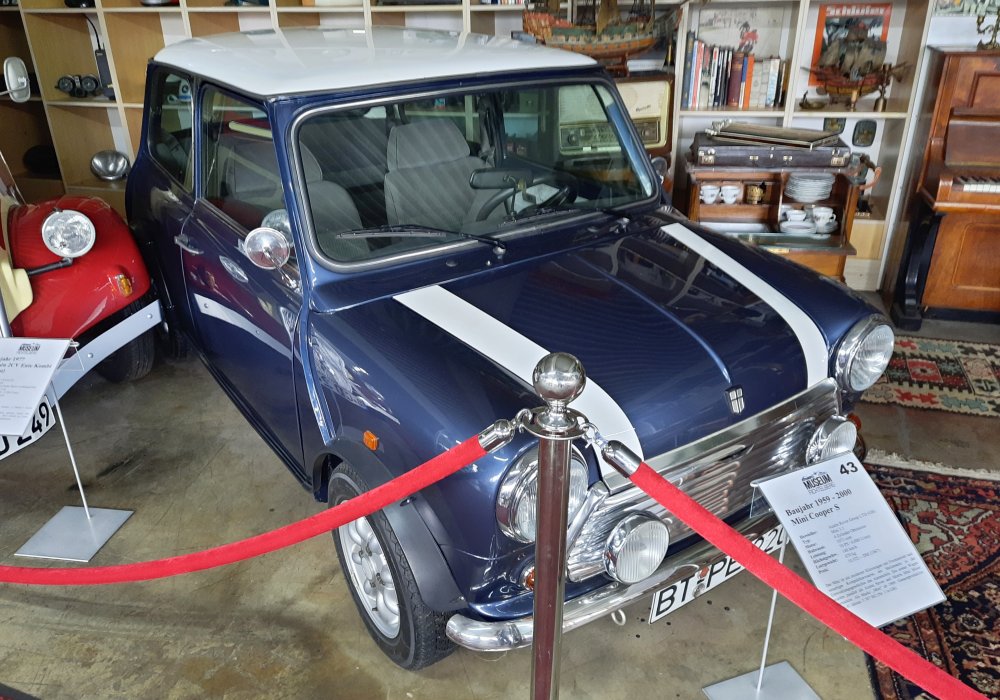
The Mini Cooper S Mk III was the final factory-produced version of the original high-performance Mini Cooper S, manufactured by British Leyland between 1969 and 1971. Combining the improved body construction of the third-generation Mini with the celebrated 1,275 cc A-series engine, the Cooper S Mk III retained the exceptional handling, strong performance and competition heritage that had established the Cooper name during the 1960s. Its introduction marked a significant change in the Mini’s development, with concealed door hinges, wind-up front windows and revised body details replacing several distinctive features of earlier models. Although produced for a relatively short period and in considerably smaller numbers than its predecessors, the Mk III Cooper S represented the culmination of a decade of development and became one of the most desirable versions of the classic British Mini.
The origins of the Mini Cooper S Mk III can be traced to the introduction of the original Mini in August 1959. Designed by Alec Issigonis for the British Motor Corporation, the Mini revolutionised small-car engineering through its transverse engine, front-wheel-drive layout and exceptionally efficient use of interior space.
The original Mini was conceived primarily as economical family transport, but its compact dimensions, low centre of gravity and relatively wide track gave it remarkable handling characteristics. The wheels were positioned close to the four corners of the body, reducing overhangs and allowing the car to change direction with exceptional agility.
John Cooper, whose racing cars had achieved considerable success in Formula One, quickly recognised the Mini’s potential as a competition vehicle. Working with BMC, he developed the original Mini Cooper, introduced in 1961 with a larger engine, improved brakes and revised transmission ratios.
The Cooper proved successful in both rallying and circuit racing, but increasing competition encouraged the development of the more powerful Cooper S. Introduced in 1963, the Cooper S incorporated a strengthened engine, improved braking system and numerous modifications intended to withstand demanding motorsport use.
The original 1,071 cc Cooper S was followed by the short-stroke 970 cc version and the larger 1,275 cc model. The 1275 became the principal performance engine because of its combination of strong torque, high-revving capability and considerable tuning potential.
During the mid-1960s, the Mini Cooper S achieved international fame through its success in rallying. Victories on the Monte Carlo Rally in 1964, 1965 and 1967 established the Mini as one of the most successful competition cars of the decade.
The car also enjoyed considerable success in circuit racing, where its exceptional cornering ability allowed it to challenge larger and more powerful saloons.
By the late 1960s, however, the Mini’s original body design was beginning to show its age. Although its engineering remained innovative, certain features, including external door hinges and sliding front windows, were increasingly regarded as outdated.
The introduction of the Mini Mk II in 1967 brought relatively modest improvements, including a larger rear window, revised grille and updated rear lamp assemblies. More substantial changes followed with the introduction of the Mk III in 1969.
The Mk III was developed during a period of considerable restructuring within the British motor industry. The merger of British Motor Holdings and Leyland Motor Corporation in 1968 created British Leyland, bringing Austin, Morris, MG, Triumph, Rover and several other marques under a single organisation.
One consequence of this consolidation was the gradual abandonment of the separate Austin and Morris identities for the Mini. The Mk III Cooper S was marketed simply as the Mini Cooper S, reflecting the model’s established recognition and the company’s desire to simplify its range.
The Mini Cooper S Mk III retained the 1,275 cc engine that had become synonymous with the high-performance Mini. However, the revised body construction and detail changes distinguished it from the earlier Mk I and Mk II versions.
The most noticeable exterior modification was the introduction of concealed door hinges. Earlier Minis had employed externally mounted hinges, which were simple and economical to manufacture but increasingly old-fashioned in appearance.
The Mk III’s concealed hinges gave the body a cleaner and more modern appearance. The doors were also redesigned to incorporate conventional wind-up front windows, replacing the sliding windows used on earlier models.
These changes improved convenience, weather protection and refinement, making the Cooper S more suitable for everyday use.
The Mk III retained the larger rear window introduced on the Mk II, providing improved rearward visibility compared with the original Mini design.
The body continued to employ a compact steel monocoque structure, with front and rear subframes carrying the engine, transmission and suspension components.
The Mini Cooper S Mk III measured approximately 3,054 mm in length, 1,410 mm in width and 1,346 mm in height, with a wheelbase of 2,036 mm. These dimensions remained remarkably close to those of the original 1959 Mini.
Despite its small exterior dimensions, the Cooper S provided accommodation for four occupants and a modest luggage compartment. Its efficient packaging remained one of the Mini’s greatest advantages over more conventionally engineered small cars.
The exterior styling retained the familiar two-box shape, with a short bonnet, upright windscreen, compact passenger compartment and nearly vertical rear panel.
The front featured circular headlamps mounted within the wings, together with a distinctive radiator grille and chrome bumper. Cooper S badging identified the model’s sporting specification.
The Mk III Cooper S was available in a range of exterior colours, with contrasting roof finishes remaining closely associated with the Cooper tradition.
The compact 10-inch wheels contributed to the car’s distinctive appearance and responsive handling. Wider wheels and tyres than those fitted to ordinary Minis improved grip and stability.
The Cooper S retained the traditional Mini’s restrained exterior styling. Unlike later performance cars with prominent spoilers and aerodynamic additions, its sporting character was communicated primarily through subtle badging, wheels and its established competition reputation.
The Mini Cooper S Mk III was powered by a 1,275 cc BMC A-series inline four-cylinder engine. The A-series had been introduced during the early 1950s and had become one of Britain’s most widely used small-car engines.
The Cooper S version was extensively developed for high-performance use, incorporating a strengthened crankshaft, improved connecting rods, revised pistons and a specially prepared cylinder head.
The engine featured a cast-iron cylinder block and cylinder head, with overhead valves operated by pushrods from a camshaft mounted within the block.
The 1,275 cc engine employed a bore of approximately 70.61 mm and a stroke of 81.28 mm. These dimensions provided a useful balance between displacement, torque and high-speed performance.
The cylinder head incorporated larger valves and improved porting compared with ordinary A-series engines, allowing greater airflow and increased power output.
Fuel was supplied through twin SU HS2 carburettors, providing responsive mixture delivery and strong performance across a relatively broad engine-speed range.
The compression ratio was approximately 9.75:1, reflecting the engine’s sporting character and the high-octane petrol requirements of the period.
In standard production specification, the Cooper S Mk III engine developed approximately 76 bhp at 5,800 rpm, with maximum torque of around 79 lb ft (107 Nm) at 3,000 rpm.
Although these figures appear modest by modern standards, they represented substantial performance in a car weighing approximately 650 to 700 kg, depending on specification and equipment.
The Cooper S Mk III was capable of reaching approximately 95 to 100 mph (153 to 161 km/h), while acceleration from 0 to 60 mph generally required around 10 to 11 seconds.
These figures made it one of the quickest small production saloons available during the period, particularly when compared with ordinary family cars.
The engine’s relatively strong torque delivery was particularly important. The 1275 provided improved flexibility compared with the earlier smaller-capacity Cooper S engines, making it suitable for everyday driving while retaining excellent competition potential.
The transverse engine was mounted at the front of the car, with the gearbox positioned beneath the engine in the sump. This compact arrangement allowed the powertrain to occupy very little space, preserving the Mini’s exceptional interior packaging.
Power was transmitted to the front wheels through a four-speed manual gearbox. The transmission was designed to withstand the increased torque of the Cooper S engine and provided relatively close ratios suitable for enthusiastic driving.
The gearbox shared its lubrication system with the engine, requiring careful attention to oil quality and maintenance intervals.
The front-wheel-drive arrangement was one of the Cooper S’s greatest advantages. By placing the engine and driven wheels at the front, the Mini achieved excellent traction and predictable handling, particularly on narrow and winding roads.
The suspension system was another important aspect of the Cooper S Mk III’s design. Earlier Cooper S models had employed both rubber cone and Hydrolastic suspension arrangements during their production lives.
The Mk III generation returned to the simpler rubber cone suspension system, reducing mechanical complexity and providing a relatively firm sporting ride.
The rubber cone suspension employed compact rubber springs that provided progressive resistance as they were compressed. This arrangement occupied considerably less space than conventional coil springs, allowing the wheels to be positioned close to the corners of the body.
At the front, the suspension employed upper and lower wishbones, while the rear used trailing arms. Hydraulic dampers controlled suspension movement.
The rubber cone suspension was relatively firm, particularly on uneven roads, but it contributed to the Mini’s responsive handling and limited body roll.
The Mini’s short wheelbase and relatively wide track gave it exceptional agility. The car could change direction rapidly, making it particularly enjoyable on winding roads.
The steering employed a direct rack-and-pinion system, providing precise feedback and relatively quick responses. The absence of power assistance meant that steering effort could be noticeable during parking manoeuvres, but the car’s low weight helped keep it manageable.
The Cooper S Mk III employed front disc brakes and rear drum brakes. The front discs measured approximately 7.5 inches in diameter and were specifically developed to fit within the compact 10-inch wheels.
These brakes provided substantially improved stopping performance compared with the drum brakes fitted to ordinary Minis, particularly during repeated heavy braking.
The braking system contributed to the Cooper S’s effectiveness in competition, where strong and consistent stopping power was essential.
The Mini Cooper S Mk III was fitted with wider tyres than ordinary Mini models, providing improved traction and cornering grip.
The combination of low weight, direct steering, firm suspension and front-wheel-drive traction gave the Cooper S exceptional handling characteristics.
Inside, the Mini Cooper S Mk III retained the functional simplicity of earlier models while incorporating improvements associated with the revised body design.
The dashboard featured a distinctive instrument arrangement, with a speedometer, tachometer and supplementary gauges providing essential information.
The Cooper S’s additional instrumentation reflected its sporting specification and allowed the driver to monitor engine operation more closely than in ordinary Mini models.
The seats were relatively simple but provided adequate support for the period. The driving position was upright, with a large steering wheel and closely spaced pedals contributing to the Mini’s distinctive character.
The gear lever emerged from the central floor area, allowing the driver to operate the four-speed transmission.
Despite its compact dimensions, the Cooper S remained a practical four-seat car. The rear bench could accommodate two passengers, while the boot provided space for everyday luggage.
The introduction of wind-up windows improved convenience and weather protection, making the Mk III more practical than earlier Cooper S models.
The Mini Cooper S Mk III retained the engaging driving character that had made its predecessors famous. Its relatively light weight and responsive engine allowed lively acceleration, while the compact dimensions made it exceptionally manoeuvrable.
On winding roads, the Cooper S could maintain high cornering speeds, allowing skilled drivers to exploit its handling rather than relying solely on engine power.
The front-wheel-drive layout provided strong traction in wet or slippery conditions, while the direct steering communicated changes in road surface and grip.
The relatively firm suspension could produce a harsh ride on uneven roads, particularly compared with larger saloons. Road and engine noise were also noticeable, reflecting the limited sound insulation and compact body construction.
Nevertheless, these characteristics contributed to the Cooper S’s distinctive personality and were generally accepted by enthusiasts seeking a genuine sporting driving experience.
The Cooper S Mk III was introduced at a time when the Mini’s competition dominance was beginning to decline. Although the model had achieved remarkable success during the 1960s, increasingly powerful and sophisticated rivals were emerging.
Cars such as the Ford Escort Twin Cam, Ford Escort RS1600 and various European touring saloons offered greater engine power and improved competition potential.
The Mini’s compact dimensions and front-wheel-drive traction remained advantageous on technical circuits and rally stages, but its relatively small engine capacity limited its competitiveness against larger rivals.
Nevertheless, the Cooper S continued to be used extensively in club motorsport, including rallying, circuit racing, hill climbs and sprint events.
The 1,275 cc A-series engine remained highly suitable for tuning, benefiting from extensive competition development during the preceding decade.
Specialist tuners offered modified cylinder heads, camshafts, carburettors, exhaust systems and transmission components, allowing substantial performance improvements.
The Cooper S Mk III also benefited from the established reputation of the Mini in international motorsport. Although its most famous Monte Carlo victories had been achieved by earlier versions, the Mk III inherited the sporting identity created by those successes.
Production of the Mini Cooper S Mk III continued until 1971, when British Leyland discontinued the model as part of a broader rationalisation of its small-car range.
The Mini 1275 GT, introduced in 1969, provided an alternative sporting model with a 1,275 cc engine and distinctive Clubman styling. However, it lacked the full high-performance specification of the Cooper S.
The discontinuation of the Cooper S marked the end of the original factory-produced Cooper S lineage. Although the Mini remained in production for many years, the Cooper S name would not return to mainstream production until the revival of the Mini Cooper during the 1990s.
The Mk III Cooper S was produced in relatively small numbers compared with earlier versions, contributing to its rarity and desirability today. Approximately 1,570 Mk III Cooper S cars were manufactured, making it one of the less common factory Cooper S variants.
The limited production volume reflected the model’s short manufacturing life and the changing priorities of British Leyland during the early 1970s.
Today, the Mini Cooper S Mk III is regarded as one of the most collectible versions of the classic Mini. Its combination of the powerful 1,275 cc Cooper S engine, improved Mk III body and limited production makes it particularly attractive to enthusiasts.
Original examples are especially desirable because many Cooper S cars were modified during their lives or used in competition.
The popularity of the Cooper S has also led to the creation of numerous replicas and modified cars. Standard Minis have frequently been converted to Cooper S appearance or specification, making careful identification essential when assessing authenticity.
Chassis numbers, engine numbers and factory production records can help establish whether a vehicle is a genuine Mk III Cooper S.
Restoration requires careful attention to corrosion, particularly around the sills, floor panels, front wings, wheel arches, door bottoms and subframe mounting points.
The front and rear subframes should also be inspected for corrosion and structural deterioration. These components carry important suspension and drivetrain loads, making their condition essential for safe operation.
The A-series engine is generally robust and benefits from extensive specialist knowledge and good parts availability. However, original Cooper S components can be expensive, particularly where correct period specifications are required.
The gearbox requires careful maintenance because it shares its lubrication system with the engine. Regular oil changes and correct lubricant selection are important for preserving the transmission and differential.
The cooling system should also be maintained carefully, particularly on tuned engines or cars used in demanding conditions. The compact engine compartment and side-mounted radiator arrangement require efficient airflow and a properly functioning cooling system.
Suspension components, steering joints and braking equipment should be inspected regularly, particularly on vehicles that have been used in competition or modified for higher performance.
The interior presents additional restoration considerations because original seats, instruments, switches and trim components contribute significantly to the authenticity of Mk III Cooper S models.
Despite these considerations, the Mini Cooper S Mk III remains a rewarding classic car to own and drive. Its compact dimensions, responsive engine and exceptional handling provide a driving experience that is fundamentally different from that of larger sports cars.
The Mini Cooper S Mk III represents the final development of one of Britain’s most celebrated small performance cars. By combining the improved body construction of the third-generation Mini with the powerful 1,275 cc Cooper S engine and exceptional front-wheel-drive handling, British Leyland created a fitting conclusion to the original Cooper S lineage. Although its production life was brief and its competition achievements were overshadowed by those of earlier models, the Mk III retained the qualities that had made the Cooper S internationally famous. Today, it remains one of the rarest and most desirable classic Minis, celebrated for its distinctive character, sporting heritage and important place in British motoring history.