
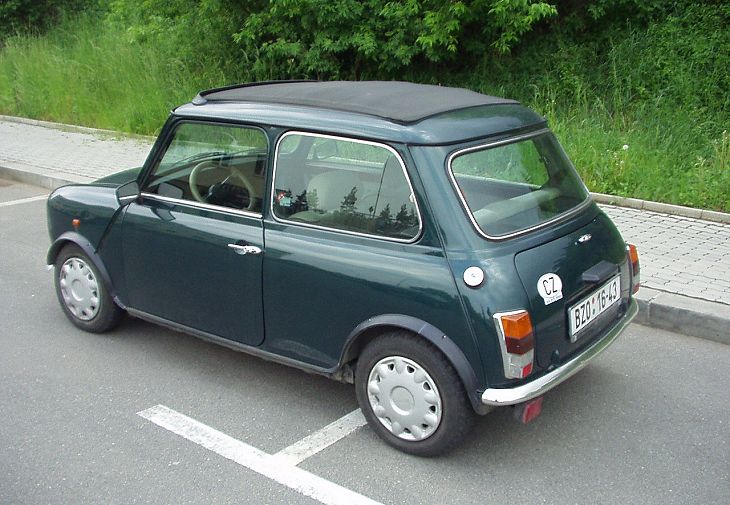
The Mini City 1000 was one of the most familiar and accessible versions of the classic British Mini during the 1980s, combining the revolutionary engineering principles established by Alec Issigonis in 1959 with a straightforward specification intended to provide economical and practical everyday transport. Introduced in 1982 as an entry-level model within the Austin Mini range, the City was powered by the dependable 998 cc A-series four-cylinder engine and retained the compact dimensions, front-wheel-drive layout and responsive handling that had made the original Mini famous. Although it lacked the additional equipment and decorative trim of more expensive versions such as the Mini Mayfair, the City 1000 offered an appealing combination of affordability, simplicity and distinctive character. Its long production life, modest running costs and suitability for urban driving helped maintain the Mini’s popularity during a period when increasingly modern European superminis were challenging its position in the small-car market.
The origins of the Mini City 1000 can be traced to the development of the original Mini during the late 1950s. The British Motor Corporation required a new small car capable of providing economical transport while accommodating four passengers within exceptionally compact dimensions. The Suez Crisis of 1956 had highlighted concerns about fuel availability and encouraged interest in smaller, more economical vehicles, prompting BMC chairman Leonard Lord to commission a practical small car that could compete with the increasingly popular European microcars.
Alec Issigonis approached the project by reconsidering conventional small-car engineering. Rather than employing a longitudinal engine driving the rear wheels, he selected a transverse engine mounted at the front, with power transmitted to the front wheels. The gearbox was positioned beneath the engine within the sump, allowing the entire powertrain to occupy remarkably little space. This arrangement enabled approximately 80 per cent of the Mini’s overall length to be devoted to passengers and luggage, an extraordinary achievement for a car measuring just over three metres long.
The original Mini was introduced in August 1959 under two names, the Austin Seven and Morris Mini-Minor. Both versions were mechanically similar, featuring an 848 cc A-series engine, four-speed manual gearbox and independent suspension. The Mini quickly became recognised for its innovative design, exceptional manoeuvrability and efficient use of interior space.
During the 1960s, the Mini evolved into one of Britain’s most successful and recognisable cars. The introduction of the Mini Cooper in 1961 and Cooper S in 1963 established its sporting reputation, while numerous special editions and alternative body styles broadened its appeal. The Mini also became closely associated with British popular culture, its distinctive appearance and association with celebrities helping transform it from a practical economy car into a fashionable symbol of the decade.
By the late 1970s, however, the original Mini’s design was becoming increasingly dated. Although its engineering remained innovative, newer European superminis offered improved refinement, more modern styling and greater luggage flexibility.
The Ford Fiesta, Renault 5, Volkswagen Polo and Fiat 127 had established a new generation of small cars, while British Leyland’s own Austin Metro, introduced in 1980, provided a more modern alternative within the company’s range.
Despite these developments, the original Mini continued to attract buyers who appreciated its distinctive character, compact dimensions and economical running costs. British Leyland recognised that the Mini occupied a unique position in the market and could continue to appeal to customers seeking an inexpensive and recognisable small car.
The Mini City was introduced in 1982 as part of a simplified range intended to maintain the Mini’s competitiveness. Positioned below the better-equipped Mini Mayfair, the City offered essential equipment without the additional trim and convenience features associated with more expensive versions.
The City name emphasised the Mini’s suitability for urban transport, reflecting its compact dimensions, manoeuvrability and economical engine. It was particularly attractive to younger drivers, first-time car buyers and households seeking an inexpensive second vehicle.
The Mini City 1000 retained the familiar steel monocoque body of the classic Mini, with front and rear subframes carrying the engine, transmission and suspension components. Its compact dimensions remained remarkably close to those of the original 1959 design.
The car measured approximately 3,054 mm in length, 1,410 mm in width and 1,346 mm in height, with a wheelbase of 2,036 mm. These dimensions gave the Mini exceptional manoeuvrability and allowed it to occupy parking spaces that would be difficult for larger cars.
The exterior styling retained the traditional short bonnet, upright windscreen, compact passenger compartment and nearly vertical rear panel. Circular headlamps were mounted within the front wings, while the familiar radiator grille and simple bumpers preserved the Mini’s distinctive appearance.
The short front and rear overhangs contributed to the car’s characteristic proportions. The wheels were positioned close to the four corners of the body, giving the Mini a relatively wide stance despite its narrow overall width.
The Mini City retained the concealed door hinges and wind-up front windows introduced with the Mk III generation in 1969. These features gave the body a cleaner appearance and provided greater convenience than the original sliding-window design.
Early Mini City models were fitted with 10-inch wheels and drum brakes at all four corners, reflecting the established specification of the basic Mini range. During 1984, the mainstream Mini saloon range adopted larger 12-inch wheels and front disc brakes, bringing a useful improvement in braking performance.
The larger wheels slightly altered the Mini’s traditional appearance but allowed the revised braking equipment to be accommodated. They also provided improved tyre availability and helped the Mini meet changing expectations for everyday usability.
The Mini City was available in a range of exterior colours, reflecting the changing tastes of the 1980s. Basic solid finishes were generally favoured, although colour availability varied according to production year and market.
Exterior trim was deliberately restrained to maintain the model’s economical character. Simple grille detailing, modest wheel trims and limited decorative brightwork distinguished the City from the more luxurious Mayfair.
The Mini City 1000 was powered by the familiar 998 cc BMC A-series inline four-cylinder engine. The A-series had been introduced during the early 1950s and had become one of Britain’s most widely used small-car engines, powering numerous Austin, Morris and MG models.
The engine featured a cast-iron cylinder block and cylinder head, with overhead valves operated by pushrods from a camshaft mounted within the block. The 998 cc version employed a bore of approximately 64.6 mm and a stroke of 76.2 mm, giving a displacement of 998 cc.
The engine was designed primarily for durability, economy and ease of maintenance rather than outright performance. Its relatively simple construction made it suitable for everyday use and allowed servicing to be undertaken by ordinary garages.
Fuel was supplied through a single SU carburettor, providing a straightforward and reliable induction system. The carburettor automatically adjusted its effective venturi area according to engine demand, helping maintain a suitable fuel mixture across a range of operating conditions.
In typical Mini City 1000 specification, the engine developed approximately 40 bhp at around 5,250 rpm, with maximum torque of approximately 52 lb ft (71 Nm) at around 2,700 rpm. Exact figures varied according to production year, emissions requirements and market specification.
Although these outputs were modest, the Mini’s relatively low weight allowed the engine to provide adequate performance for everyday driving. The 998 cc engine offered a useful balance between economy and flexibility, making it suitable for both urban transport and occasional longer journeys.
The Mini City 1000 was capable of reaching approximately 80 mph (129 km/h), depending on specification and conditions. Acceleration from 0 to 60 mph generally required around 17 to 20 seconds.
Fuel economy remained one of the model’s principal attractions. Under favourable conditions, the Mini City could achieve approximately 35 to 45 miles per imperial gallon, depending on driving style, vehicle condition and operating conditions.
The engine was mounted transversely at the front of the car, with the gearbox positioned beneath the engine in the sump. This compact arrangement remained one of the defining features of the Mini’s engineering.
Power was transmitted to the front wheels through a four-speed manual gearbox. The transmission employed a floor-mounted gear lever and relatively simple mechanical linkage.
The gearbox shared its lubrication system with the engine, requiring careful attention to oil quality and maintenance intervals. This arrangement reduced packaging requirements but also meant that engine oil had to lubricate the transmission components.
The front-wheel-drive layout provided good traction in wet or slippery conditions, while the concentration of engine and transmission weight over the driven wheels contributed to predictable handling.
The Mini City 1000 retained the independent suspension arrangement developed for the original Mini. At the front, upper and lower wishbones provided wheel location, while the rear employed trailing arms.
Compact rubber cone springs provided the suspension’s springing action, offering progressive resistance as they were compressed. This arrangement occupied considerably less space than conventional coil springs, allowing the wheels to be positioned close to the corners of the body.
Hydraulic dampers controlled suspension movement, while the relatively firm springing contributed to the Mini’s responsive handling and limited body roll.
The revised subframe mounting arrangements introduced during the 1970s helped reduce the transmission of road vibration into the passenger compartment, providing a modest improvement in refinement compared with earlier Minis.
The Mini’s short wheelbase and relatively wide track gave it exceptional agility. The car could change direction rapidly, making it particularly enjoyable on winding roads.
The steering employed a direct rack-and-pinion system, providing precise feedback and relatively quick responses. The absence of power assistance meant that steering effort could be noticeable during parking manoeuvres, but the car’s low weight helped keep it manageable.
The Mini City 1000 initially employed drum brakes at all four wheels, reflecting its economical specification. These brakes were adequate for the car’s modest performance but required regular adjustment and maintenance.
From 1984, the adoption of front disc brakes across the mainstream Mini range provided improved stopping performance and greater resistance to fade during repeated braking.
The rear brakes remained drum-operated, while the larger 12-inch wheels accommodated the revised front braking equipment.
Inside, the Mini City 1000 retained the simple and functional character of earlier models. The interior was designed primarily to maximise passenger accommodation while keeping manufacturing costs low.
The dashboard featured a straightforward instrument arrangement, providing essential information without unnecessary complexity. Depending on production year, the instruments were housed in a simple binnacle positioned ahead of the driver.
The seats were relatively upright and offered limited adjustment compared with larger cars. Nevertheless, the Mini’s efficient packaging provided surprisingly generous accommodation for a vehicle of its size.
The front seats could be adjusted fore and aft, while the rear bench provided seating for two additional passengers. Legroom was limited by modern standards, but the Mini remained practical for short journeys with four occupants.
The large glass area and relatively thin body pillars contributed to excellent outward visibility. The upright windscreen and compact bonnet made the car particularly easy to position in traffic and during parking.
The interior trim was deliberately basic, reflecting the City model’s position as an economical small car. Cloth or vinyl upholstery, simple door panels and modest carpeting were typical features.
Additional equipment was limited compared with the Mayfair, although specification changed during the model’s production life as customer expectations and manufacturing requirements evolved.
The Mini’s door bins and interior storage compartments remained useful, reflecting Issigonis’s emphasis on practical design.
The boot was relatively small but could accommodate everyday luggage and shopping. The fuel tank occupied part of the rear luggage area, limiting available space.
The Mini City 1000 was intended primarily as practical urban transport, but its responsive handling and compact dimensions also made it enjoyable to drive.
In urban conditions, the Mini excelled because of its manoeuvrability, good visibility and economical engine. Its short overall length made parking relatively easy, while the front-wheel-drive layout provided predictable handling.
On country roads, the Mini’s direct steering and low centre of gravity allowed it to maintain relatively high cornering speeds despite its modest engine power.
The firm suspension could produce a relatively harsh ride on uneven surfaces, particularly when compared with more modern small cars. Road and engine noise were also noticeable, reflecting the Mini’s ageing design and limited sound insulation.
At motorway speeds, the Mini City could maintain a reasonable cruising pace, although the engine operated at relatively high revolutions because of the four-speed gearbox and relatively short gearing.
The Mini’s short wheelbase and light weight could make it sensitive to strong crosswinds, but its direct steering and predictable handling generally inspired confidence.
The Mini City 1000 competed against a growing number of modern European small cars during the 1980s. Rivals included the Ford Fiesta, Renault 5, Volkswagen Polo, Fiat Uno and Peugeot 205.
These newer models offered more contemporary styling, improved refinement and, in many cases, greater luggage flexibility. The Peugeot 205, introduced in 1983, became particularly successful because of its attractive styling, practical interior and wide range of engines.
The Fiat Uno, also introduced in 1983, offered exceptional interior space for its exterior dimensions, demonstrating how modern engineering had developed the principles originally established by the Mini.
Although the Mini’s basic design was becoming increasingly dated, its compact dimensions, low running costs and distinctive character helped maintain its popularity.
The Mini also benefited from an established reputation for mechanical simplicity and widespread availability of replacement parts.
During the 1980s, Austin Rover increasingly recognised that the Mini occupied a unique position in the market. Rather than competing solely on practicality or performance, it could appeal to customers seeking an individual and recognisable small car.
The City model played an important role in maintaining the Mini’s accessibility. While special editions and more luxurious versions attracted buyers seeking distinctive styling and additional equipment, the City continued to provide a relatively inexpensive entry point into Mini ownership.
The Mini City also became popular among younger drivers and enthusiasts because of its relatively low purchase price and extensive opportunities for personalisation.
Numerous aftermarket companies offered performance upgrades, including modified cylinder heads, carburettors, exhaust systems and suspension components. These modifications allowed owners to improve performance while retaining the basic character of the car.
The A-series engine proved particularly suitable for tuning, benefiting from decades of competition development associated with the Mini Cooper and Cooper S.
Although the Mini City was not intended as a sporting model, it also found use in amateur motorsport, where its lightweight construction and responsive handling made it suitable for autotests, hill climbs and club events.
The modest engine output encouraged drivers to maintain momentum through corners, rewarding precision and smoothness rather than relying solely on acceleration.
By the late 1980s, the Mini’s role within the Austin Rover range had changed considerably. The Metro provided the company’s mainstream small-car offering, while the Mini increasingly appealed to buyers seeking its distinctive styling and traditional driving character.
The Mini City remained an important part of the range, providing a relatively affordable alternative to the more luxurious Mayfair and various special editions.
The continuing popularity of the Mini encouraged the development of more luxurious and sporting versions during the early 1990s. The revival of the Mini Cooper name in 1990 demonstrated the enduring appeal of the original performance model.
The 998 cc Mini remained in production into the early 1990s, although the wider adoption of the 1,275 cc engine and updated fuel systems eventually brought significant changes to the range.
The Mini would ultimately remain in production until 2000, more than forty years after its introduction, making it one of the longest-lived and most recognisable British car designs.
Today, the Mini City 1000 is regarded as an appealing and relatively accessible classic car. Its simple specification, economical engine and established mechanical design make it a practical example of the classic Mini, while its compact dimensions and responsive handling preserve the character of the original model.
Surviving examples vary considerably in condition, from carefully restored cars to heavily modified vehicles and those requiring extensive structural repairs.
Corrosion is one of the most important considerations when assessing a Mini City 1000. The steel monocoque body is vulnerable to rust, particularly around the sills, floor panels, front wings, wheel arches, door bottoms and subframe mounting points.
The front and rear subframes should also be inspected carefully because corrosion can weaken their structural integrity. These components carry important suspension and drivetrain loads and are essential for safe operation.
The 998 cc A-series engine is generally robust and benefits from excellent parts availability. However, regular maintenance is important, particularly concerning the cooling system, lubrication and ignition components.
The gearbox requires careful attention because it shares its oil supply with the engine. Worn synchromesh, noisy bearings and differential wear can develop, especially on high-mileage or poorly maintained cars.
The rubber cone suspension can deteriorate with age, causing reduced ride height and a harsher ride. Replacement cones, dampers and suspension bushes remain available through specialist suppliers.
The braking system requires regular inspection, while steering joints and wheel bearings should be checked for wear.
Interior restoration is generally straightforward because many trim components and replacement panels remain available. However, original details can be important for collectors seeking to preserve the correct appearance of individual City models.
Despite these considerations, the Mini City 1000 remains a rewarding classic car to own and drive. Its compact dimensions, economical engine and straightforward specification provide a driving experience that combines the traditional Mini character with the practicality of an affordable small car.
The Mini City 1000 represents an important chapter in the later history of one of Britain’s most influential motor cars. Introduced in 1982 as an economical entry-level version of the classic Mini, it retained the revolutionary transverse-engine, front-wheel-drive layout and compact dimensions that had made Alec Issigonis’s original design famous. The dependable 998 cc A-series engine provided economical performance, while the simple interior and restrained exterior trim helped keep purchase and running costs relatively low. Although increasingly challenged by more modern small cars during the 1980s, the Mini City remained popular because of its distinctive character, practicality and affordability. Today, it is remembered as an enduring example of British small-car engineering, combining everyday usability with the unmistakable charm of the classic Mini.