
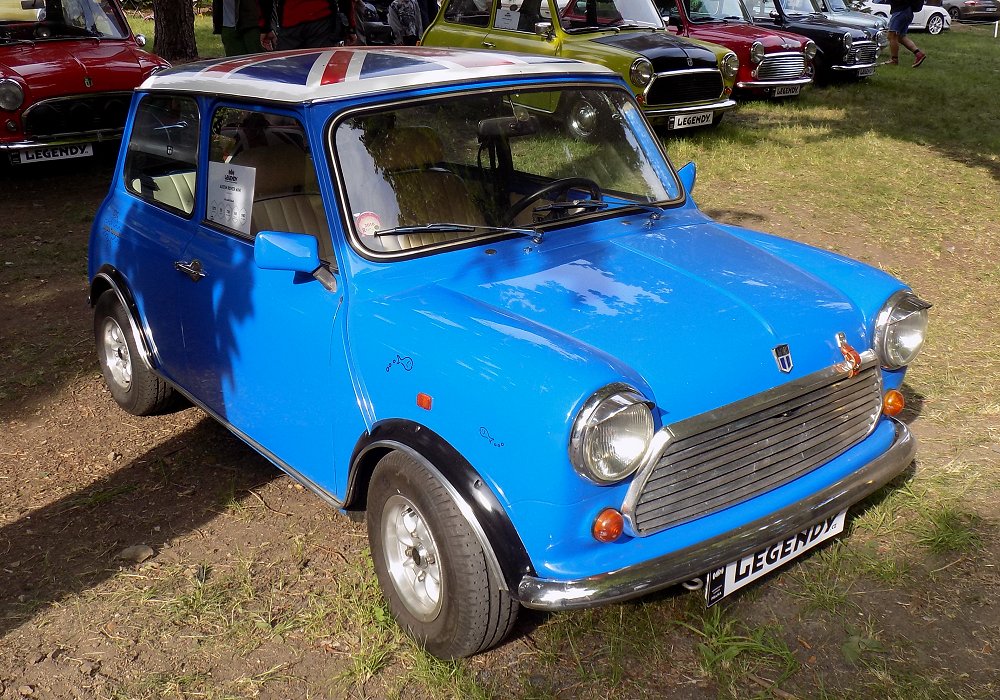
The Mini 1000 Mk V 1.3 represents an interesting variation of the classic British Mini, combining the compact body and familiar engineering of the fifth-generation Mini with the greater performance of a 1,275 cc A-series four-cylinder engine. Although the Mini 1000 designation traditionally referred to models equipped with the 998 cc engine, some Mk V Minis were subsequently fitted with the larger 1.3-litre power unit through specialist conversions, engine replacements or market-specific modifications. The designation Mini 1000 Mk V 1.3 is therefore best understood as describing a Mk V Mini originally associated with the 1000 range but equipped with a 1,275 cc engine, rather than a separate, universally recognised factory production model. Such cars combined the traditional Mini’s exceptional manoeuvrability and responsive handling with improved acceleration, stronger mid-range torque and greater flexibility for everyday driving.
The origins of the Mini 1000 Mk V 1.3 can be traced to the introduction of the original Mini in August 1959. Designed by Alec Issigonis for the British Motor Corporation, the Mini was conceived as an economical family car capable of accommodating four passengers within exceptionally compact dimensions. Its innovative transverse-engine and front-wheel-drive arrangement allowed the powertrain to occupy very little space, maximising the proportion of the body available for passengers and luggage.
The original Mini was introduced as the Austin Seven and Morris Mini-Minor, both powered by an 848 cc A-series four-cylinder engine. The compact powertrain arrangement, small wheels and efficient body design established principles that would subsequently influence the development of front-wheel-drive small cars throughout the motor industry.
During the 1960s, the Mini evolved into one of Britain’s most successful and recognisable cars. The introduction of the Mini Cooper in 1961 and Cooper S in 1963 demonstrated the sporting potential of Issigonis’s design, while numerous victories in international rallying and touring car racing established its reputation as an exceptionally capable small performance car.
The development of larger A-series engines played an important role in the Mini’s evolution. The original 848 cc unit was supplemented by engines of 997 cc, 998 cc, 1,071 cc, 970 cc and 1,275 cc in various Mini and Cooper applications. The 1,275 cc engine became particularly important because it offered a useful increase in power and torque without requiring a fundamentally different engine installation.
The 1,275 cc A-series engine was introduced in the Mini Cooper S during the 1960s and subsequently appeared in other British Leyland models. Its relatively compact dimensions and compatibility with the Mini’s transverse-engine layout made it a popular choice for later performance conversions.
By the early 1980s, the original Mini’s design was becoming increasingly dated. Newer European superminis offered improved refinement, more modern styling and greater luggage flexibility, while Austin Rover’s own Metro provided a contemporary alternative within the company’s range.
Despite these developments, the Mini continued to attract buyers who appreciated its distinctive character, compact dimensions and responsive handling. Austin Rover increasingly promoted the Mini as a fashionable and individual small car rather than relying solely on its original role as basic family transport.
The Mk V generation is generally associated with the mechanical changes introduced during 1984, particularly the adoption of larger 12-inch wheels and front disc brakes across the mainstream Mini saloon range. These developments improved braking performance and allowed the Mini to accommodate changing expectations for everyday usability.
The standard Mini 1000 Mk V retained the 998 cc A-series engine, while the larger 1,275 cc unit was associated with other Mini derivatives and later performance-oriented models. However, the interchangeability of many A-series components encouraged enthusiasts and specialist workshops to install larger engines in existing Mini 1000 bodies.
A Mini 1000 Mk V fitted with a 1,275 cc engine therefore offered an attractive combination of relatively understated styling and improved mechanical performance. Depending on the conversion, such vehicles could retain the standard Mini 1000 appearance or incorporate additional sporting equipment.
The Mk V retained the familiar steel monocoque body of the classic Mini, with front and rear subframes carrying the engine, transmission and suspension components. Its compact dimensions remained remarkably close to those of the original 1959 design.
The car measured approximately 3,054 mm in length, 1,410 mm in width and 1,346 mm in height, with a wheelbase of 2,036 mm. These dimensions gave the Mini exceptional manoeuvrability and allowed it to occupy parking spaces that would be difficult for larger cars.
The exterior styling retained the traditional short bonnet, upright windscreen, compact passenger compartment and nearly vertical rear panel. Circular headlamps were mounted within the front wings, while the familiar radiator grille and chrome bumpers preserved the Mini’s distinctive appearance.
The Mk V retained the concealed door hinges and wind-up front windows introduced with the Mk III generation in 1969. These features gave the body a cleaner appearance and provided greater convenience than the original sliding-window design.
The larger 12-inch wheels introduced during the Mk V period slightly altered the Mini’s traditional appearance but allowed the revised front disc brakes to be accommodated.
Depending on the conversion, the Mini 1000 Mk V 1.3 could feature wider wheels and tyres, wheel-arch extensions, revised suspension settings or additional exterior trim. However, many conversions retained the standard bodywork, creating a relatively discreet performance model.
The principal mechanical distinction was the installation of the 1,275 cc A-series inline four-cylinder engine. This power unit shared the basic architecture of the smaller A-series engines but employed a larger bore and stroke to increase displacement.
The 1,275 cc engine featured a cast-iron cylinder block and cylinder head, with overhead valves operated by pushrods from a camshaft mounted within the block. Its simple construction contributed to durability, ease of maintenance and extensive opportunities for performance tuning.
The engine employed a bore of approximately 70.6 mm and a stroke of 81.3 mm, giving a displacement of 1,275 cc.
The 1,275 cc A-series was produced in numerous specifications, ranging from relatively mild road-going versions to highly tuned competition engines. Consequently, the performance of a Mini 1000 Mk V 1.3 depended heavily on the source and specification of the installed engine.
A standard road-going 1,275 cc engine from a contemporary British Leyland application could develop approximately 50 to 65 bhp, depending on carburation, compression ratio, cylinder head and camshaft specification.
More highly tuned engines could produce substantially greater outputs, particularly when fitted with modified cylinder heads, performance camshafts, improved carburettors and freer-flowing exhaust systems.
The 1,275 cc engine provided a useful increase in torque compared with the standard 998 cc unit. This improved acceleration from low and medium engine speeds, reducing the need for frequent gear changes during everyday driving.
The larger engine also improved the Mini’s ability to maintain speed on hills and when carrying passengers. This made the car more flexible for longer journeys and motorway driving.
Fuel was generally supplied through an SU carburettor or a pair of SU carburettors, depending on engine specification. Later conversions could also employ alternative carburettor arrangements or fuel-injection systems.
The engine retained the transverse mounting arrangement characteristic of the Mini, with the gearbox positioned beneath the engine in the sump. This compact configuration allowed the larger engine to be installed without fundamentally altering the vehicle’s body structure.
Power was transmitted to the front wheels through a four-speed manual gearbox. Depending on the conversion, the transmission could retain the original Mini 1000 ratios or incorporate alternative gearing better suited to the increased engine output.
The gearbox shared its lubrication system with the engine, requiring careful attention to oil quality and maintenance intervals.
The increased torque of the 1,275 cc engine placed additional demands on the transmission, particularly where the original gearbox had already accumulated considerable mileage.
Specialist conversions therefore sometimes incorporated rebuilt gearboxes, strengthened components or revised final-drive ratios to improve durability and performance.
The performance of the Mini 1000 Mk V 1.3 varied considerably according to engine specification, gearing and vehicle weight. A relatively standard 1,275 cc conversion could achieve a maximum speed of approximately 90 to 100 mph (145 to 161 km/h), depending on its power output and gearing.
Acceleration from 0 to 60 mph could fall to approximately 11 to 14 seconds in a suitably specified road-going conversion, representing a substantial improvement over the standard Mini 1000.
More highly tuned engines could provide considerably stronger performance, although such modifications often involved compromises in fuel economy, refinement and reliability.
Fuel consumption depended on engine specification and driving style. A relatively mild 1,275 cc conversion could remain economical, while more highly tuned engines generally consumed more fuel.
The Mini 1000 Mk V 1.3 retained the independent suspension arrangement developed for the original Mini. At the front, upper and lower wishbones provided wheel location, while the rear employed trailing arms.
Compact rubber cone springs provided the suspension’s springing action, offering progressive resistance as they were compressed. This arrangement occupied considerably less space than conventional coil springs, allowing the wheels to be positioned close to the corners of the body.
Hydraulic dampers controlled suspension movement, while the relatively firm springing contributed to the Mini’s responsive handling and limited body roll.
The revised subframe mounting arrangements introduced during the 1970s helped reduce the transmission of road vibration into the passenger compartment, providing a modest improvement in refinement compared with earlier Minis.
The installation of the larger engine did not fundamentally alter the Mini’s suspension geometry, although the additional performance encouraged some owners to fit uprated dampers, springs and suspension bushes.
The Mini’s short wheelbase and relatively wide track gave it exceptional agility. The car could change direction rapidly, making it particularly enjoyable on winding roads.
The steering employed a direct rack-and-pinion system, providing precise feedback and relatively quick responses. The absence of power assistance meant that steering effort could be noticeable during parking manoeuvres, but the car’s low weight helped keep it manageable.
The Mini 1000 Mk V employed front disc brakes and rear drum brakes, reflecting the improved braking specification introduced across the mainstream Mini range during 1984.
These brakes provided more consistent stopping performance than the all-drum systems fitted to earlier basic Minis, particularly during repeated braking.
For more powerful 1,275 cc conversions, additional braking improvements could be desirable. Some owners fitted uprated pads, improved discs or other components intended to provide greater resistance to fade.
The larger 12-inch wheels allowed the revised braking equipment to be accommodated while maintaining the Mini’s compact suspension layout.
Inside, the Mini 1000 Mk V 1.3 generally retained the simple and functional character of the standard Mini. The interior specification depended largely on the original donor vehicle and the extent of the conversion.
Basic models featured relatively simple instrumentation and modest trim, while better-equipped versions incorporated additional instruments and more elaborate dashboard arrangements.
Some conversions included a tachometer, additional gauges or alternative steering wheel to reflect the increased engine performance.
The seats were relatively upright and offered limited adjustment compared with larger cars. Nevertheless, the Mini’s efficient packaging provided surprisingly generous accommodation for a vehicle of its size.
The front seats could be adjusted fore and aft, while the rear bench provided seating for two additional passengers. Legroom was limited by modern standards, but the Mini remained practical for short journeys with four occupants.
The large glass area and relatively thin body pillars contributed to excellent outward visibility. The upright windscreen and compact bonnet made the car particularly easy to position in traffic and during parking.
The boot remained relatively small but could accommodate everyday luggage and shopping. The fuel tank occupied part of the rear luggage area, limiting available space.
The Mini 1000 Mk V 1.3 offered a driving experience that differed noticeably from the standard 998 cc model. The additional torque improved acceleration and made the car more flexible in everyday traffic.
In urban conditions, the car retained the Mini’s exceptional manoeuvrability and good visibility. Its compact dimensions made parking relatively easy, while the larger engine provided stronger acceleration when joining traffic or negotiating busy junctions.
On country roads, the combination of increased engine performance and responsive handling made the car particularly enjoyable. The Mini’s direct steering and low centre of gravity allowed it to maintain relatively high cornering speeds, while the additional power improved acceleration between bends.
The front-wheel-drive layout provided good traction in wet or slippery conditions, although enthusiastic acceleration could produce wheelspin or torque steer depending on engine output and suspension condition.
The firm suspension could produce a relatively harsh ride on uneven surfaces, particularly when compared with more modern small cars. Road and engine noise were also noticeable, reflecting the Mini’s ageing design and limited sound insulation.
At motorway speeds, the 1,275 cc engine provided greater flexibility than the standard 998 cc unit, although the four-speed gearbox and relatively short gearing could still result in high engine revolutions.
The Mini’s short wheelbase and light weight could make it sensitive to strong crosswinds, but its direct steering and predictable handling generally inspired confidence.
The Mini 1000 Mk V 1.3 occupied an interesting position within the broader classic Mini community. Although it was not a standard factory production model, the combination of a Mk V body and larger A-series engine became popular among enthusiasts seeking improved performance without sacrificing the original Mini’s character.
The widespread availability of A-series components made engine conversions relatively straightforward for experienced specialists. The 1,275 cc engine shared many design features with the smaller units, allowing much of the original Mini’s mechanical layout to be retained.
The larger engine also provided a strong foundation for further tuning. Modified cylinder heads, performance camshafts, alternative carburettors and improved exhaust systems could increase output considerably.
However, the installation of a more powerful engine required careful attention to braking, suspension and transmission condition. A well-engineered conversion provided a balanced driving experience, while poorly executed modifications could compromise reliability and safety.
The growing popularity of 1,275 cc Mini conversions reflected the enduring influence of the original Mini Cooper S. Although the Cooper S had ceased production in its original form during the early 1970s, its combination of compact dimensions and strong engine performance continued to inspire enthusiasts.
The revival of the Mini Cooper name in 1990 demonstrated the continuing appeal of a more powerful Mini. The revived Cooper employed a 1,275 cc engine and provided a factory-produced alternative to the numerous specialist conversions already in circulation.
During the early 1990s, the Mini range underwent further mechanical changes, including the wider adoption of the 1,275 cc engine and updated fuel systems. These developments eventually reduced the distinction between specialist 1.3-litre conversions and standard production Minis.
The Mini would ultimately remain in production until 2000, more than forty years after its introduction, making it one of the longest-lived and most recognisable British car designs.
Today, the Mini 1000 Mk V 1.3 is regarded as an appealing variation of the classic Mini, particularly among enthusiasts who value improved performance while retaining the traditional body style.
Because the designation does not identify a single standardised factory model, the specification and quality of individual vehicles can vary considerably. The history of the conversion, engine identification and supporting documentation are therefore important when assessing a particular example.
Surviving cars range from relatively standard Mini 1000 saloons fitted with replacement 1,275 cc engines to extensively modified vehicles incorporating upgraded transmissions, suspension and braking systems.
Corrosion remains one of the most important considerations when assessing a Mini 1000 Mk V 1.3. The steel monocoque body is vulnerable to rust, particularly around the sills, floor panels, front wings, wheel arches, door bottoms and subframe mounting points.
The front and rear subframes should also be inspected carefully because corrosion can weaken their structural integrity. These components carry important suspension and drivetrain loads and are essential for safe operation.
The 1,275 cc A-series engine is generally robust and benefits from excellent parts availability. However, regular maintenance is important, particularly concerning the cooling system, lubrication and ignition components.
The gearbox requires careful attention because it shares its oil supply with the engine. Worn synchromesh, noisy bearings and differential wear can develop, especially where the transmission has been subjected to increased torque.
The rubber cone suspension can deteriorate with age, causing reduced ride height and a harsher ride. Replacement cones, dampers and suspension bushes remain available through specialist suppliers.
The braking system requires regular inspection, particularly where the engine has been modified to produce substantially more power than the original 998 cc unit.
Interior restoration is generally straightforward because many trim components and replacement panels remain available. However, originality and the quality of modifications can influence the desirability of individual vehicles.
Despite these considerations, the Mini 1000 Mk V 1.3 remains a rewarding classic car to own and drive. Its compact dimensions, stronger engine performance and distinctive appearance provide a driving experience that combines the traditional Mini character with improved acceleration and flexibility.
The Mini 1000 Mk V 1.3 represents an interesting example of the adaptability of Alec Issigonis’s revolutionary small-car design. By combining the established Mk V body and chassis with the larger 1,275 cc A-series engine, enthusiasts and specialist workshops created a more powerful version of the classic Mini while retaining its compact dimensions and responsive handling. Although not a universally recognised factory production model, the designation reflects the long tradition of Mini modification and the enduring appeal of the larger A-series engine. Today, the Mini 1000 Mk V 1.3 is remembered as a distinctive and enjoyable variation of the classic Mini, demonstrating the remarkable versatility and lasting popularity of one of Britain’s most celebrated automotive designs.