
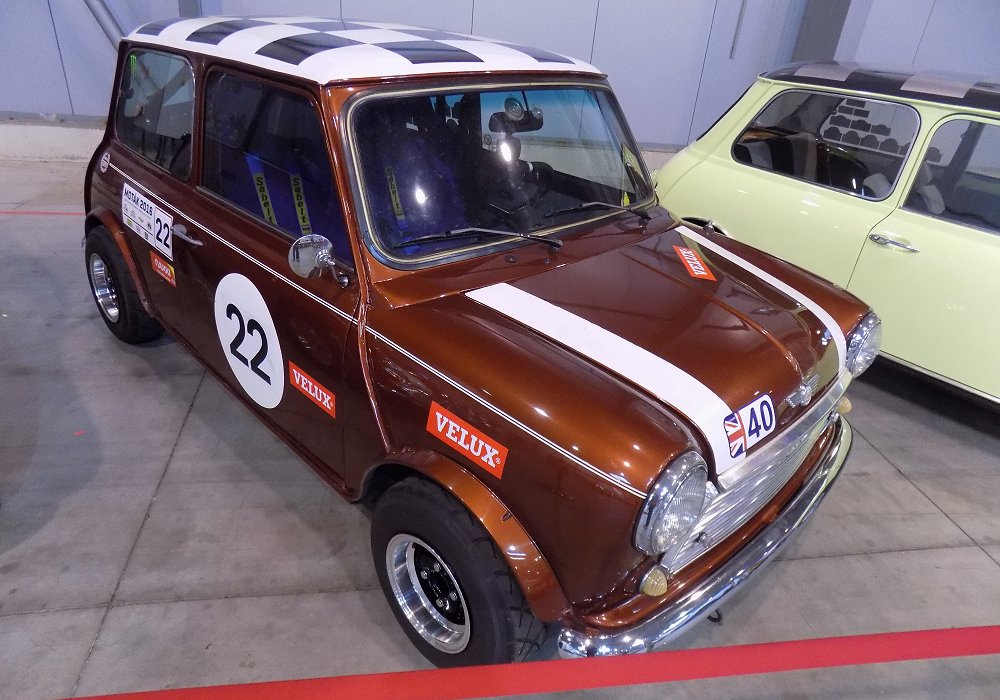
The Mini Cooper is one of the most celebrated small performance cars in automotive history, combining the revolutionary engineering of Alec Issigonis’s original Mini with the sporting expertise of racing car designer John Cooper. First introduced in 1961, the Mini Cooper transformed a modest economy car into a highly capable sporting machine, establishing a reputation for exceptional handling, responsive performance and remarkable success in international motorsport. Its compact dimensions, transverse engine and front-wheel-drive layout provided an unconventional foundation for a performance car, but the combination of low weight, precise steering and carefully developed mechanical components proved extraordinarily effective. From its early successes in rallying and touring car racing to its revival during the 1990s, the Mini Cooper became an enduring symbol of British engineering ingenuity and one of the most recognisable sporting cars of the twentieth century.
The origins of the Mini Cooper can be traced to the development of the original Mini during the late 1950s. The British Motor Corporation required a new small car capable of providing economical transport while accommodating four passengers within exceptionally compact dimensions. The Suez Crisis of 1956 had highlighted concerns about fuel availability and encouraged interest in smaller, more economical vehicles, prompting BMC chairman Leonard Lord to commission a practical small car that could compete with the increasingly popular European microcars.
Alec Issigonis approached the project by reconsidering conventional small-car engineering. Rather than employing a longitudinal engine driving the rear wheels, he selected a transverse engine mounted at the front, with power transmitted to the front wheels. The gearbox was positioned beneath the engine within the sump, allowing the entire powertrain to occupy remarkably little space.
This arrangement enabled approximately 80 per cent of the Mini’s overall length to be devoted to passengers and luggage, an extraordinary achievement for a car measuring just over three metres long. The compact powertrain, small wheels and efficient body design established principles that would subsequently influence the development of front-wheel-drive small cars throughout the motor industry.
The original Mini was introduced in August 1959 under two names, the Austin Seven and Morris Mini-Minor. Both versions were mechanically similar, featuring an 848 cc A-series engine, four-speed manual gearbox and independent suspension. The Mini quickly became recognised for its innovative design, exceptional manoeuvrability and efficient use of interior space.
John Cooper, whose racing car company had achieved considerable success with lightweight rear-engined competition cars, recognised the Mini’s potential as a sporting vehicle. Cooper had developed a close relationship with Issigonis and understood that the Mini’s low weight, wide track and responsive handling could provide an excellent foundation for competition.
Although Issigonis had originally intended the Mini as economical family transport, Cooper believed that relatively modest increases in engine performance, combined with improved braking and transmission components, could transform the car into an effective sporting machine.
Cooper persuaded BMC management to support the development of a performance version, leading to the introduction of the Austin Mini Cooper and Morris Mini Cooper in September 1961.
The original Mini Cooper employed a 997 cc version of the BMC A-series four-cylinder engine. This engine featured a longer stroke than the standard 848 cc unit and incorporated modifications intended to improve power output and responsiveness.
The 997 cc engine employed a bore of approximately 62.4 mm and a stroke of 81.3 mm, giving a displacement of 997 cc. It featured a higher compression ratio, revised camshaft timing and twin SU carburettors.
These modifications increased maximum output to approximately 55 bhp at 6,000 rpm, with maximum torque of around 54 lb ft (73 Nm) at 3,600 rpm. Although modest by modern standards, this represented a substantial improvement over the standard Mini’s output of approximately 34 bhp.
The Mini Cooper also incorporated a close-ratio four-speed manual gearbox, allowing the driver to make better use of the engine’s increased performance. The gearbox remained positioned beneath the engine within the sump, preserving the compact transverse powertrain arrangement.
One of the most important improvements was the adoption of front disc brakes. The standard Mini employed drum brakes at all four wheels, which were adequate for ordinary driving but less suitable for sustained high-speed use.
The Cooper’s front disc brakes provided improved stopping performance and greater resistance to fade, particularly during enthusiastic driving and competition.
The suspension retained the basic independent layout developed for the original Mini, with compact rubber cone springs providing the springing action. However, the Cooper benefited from revised settings and improved tyres intended to enhance road holding.
The combination of low weight, responsive steering and improved engine performance made the Mini Cooper exceptionally agile. Its compact dimensions allowed it to change direction rapidly, while the front-wheel-drive layout provided good traction on wet or slippery surfaces.
The original Mini Cooper was capable of reaching approximately 85 mph (137 km/h), with acceleration from 0 to 60 mph taking around 13 to 14 seconds. These figures were impressive for a small car of its period, particularly given its relatively modest engine displacement.
The Mini Cooper quickly established a reputation as an entertaining and capable sporting car. Its performance was not based solely on engine power but on the ability to maintain high cornering speeds and exploit its exceptional handling.
In 1963, the original 997 cc engine was replaced by a revised 998 cc unit. This engine employed a larger bore and shorter stroke, providing improved flexibility and allowing greater commonality with other A-series engines.
The 998 cc Cooper engine featured a bore of approximately 64.6 mm and a stroke of 76.2 mm. It retained twin SU carburettors and developed approximately 55 bhp, providing similar performance to the earlier 997 cc version.
The revised engine offered a slightly different power delivery and became the standard power unit for the Mini Cooper until the original model was discontinued in 1969.
The Mini Cooper’s exterior styling remained closely related to the standard Mini. The compact two-door saloon body retained its short bonnet, upright windscreen, nearly vertical rear panel and distinctive circular headlamps.
The principal visual differences included Cooper identification badges, a revised grille and distinctive wheel trims. Many examples featured contrasting roof colours, although appearance varied according to production year and specification.
The restrained exterior styling contributed to the Cooper’s appeal. Unlike larger sports cars with aggressive bodywork, the Mini Cooper retained the practical appearance of an ordinary small saloon while offering substantially improved performance.
The original Mini Cooper measured approximately 3,054 mm in length, 1,410 mm in width and 1,346 mm in height, with a wheelbase of 2,036 mm. These compact dimensions contributed to its exceptional manoeuvrability and distinctive road behaviour.
The interior retained much of the standard Mini’s simple and functional design. The driving position was relatively upright, while the large glass area provided excellent outward visibility.
The Cooper featured additional instrumentation, including supplementary gauges intended to provide the driver with more information about engine operation.
The seats offered improved support compared with the most basic Mini models, although comfort and adjustment remained relatively limited by modern standards.
Despite its sporting character, the Mini Cooper retained accommodation for four passengers and a modest luggage compartment. This practicality distinguished it from many contemporary sports cars and contributed to its popularity as an everyday vehicle.
The Mini Cooper’s reputation was significantly enhanced by its success in motorsport. Its combination of compact dimensions, front-wheel drive and responsive handling proved particularly effective in rallying, where narrow roads, poor weather and difficult surfaces often reduced the advantage of more powerful cars.
The Mini’s small size allowed drivers to negotiate tight corners and narrow mountain roads with exceptional precision. Its front-wheel-drive layout provided good traction on snow, ice and wet surfaces, while its relatively low weight reduced the demands placed on tyres and brakes.
The development of the more powerful Mini Cooper S in 1963 further strengthened the Mini’s competition potential. The Cooper S employed larger engines, improved braking equipment and additional mechanical modifications intended for high-performance road use and motorsport.
The Cooper S initially appeared with a 1,071 cc engine, followed by 970 cc and 1,275 cc versions. The 1,275 cc Cooper S became particularly successful, providing substantially greater torque and acceleration than the standard Cooper.
The Mini Cooper and Cooper S achieved numerous victories in international rallying and touring car racing during the 1960s. Their most celebrated successes came in the Monte Carlo Rally, where the Mini Cooper S won outright in 1964, 1965 and 1967.
In 1964, Paddy Hopkirk and Henry Liddon drove a Mini Cooper S to victory, defeating larger and more powerful rivals on the demanding Alpine roads.
The following year, Timo Mäkinen and Paul Easter secured another victory, reinforcing the Mini’s reputation as an exceptional rally car.
In 1966, Mini Cooper S crews occupied the leading positions at the finish of the Monte Carlo Rally, but the cars were controversially disqualified because of lighting regulations. The decision became one of the most widely discussed incidents in rallying history.
In 1967, Rauno Aaltonen and Henry Liddon secured another outright Monte Carlo victory, confirming the Mini Cooper S as one of the most successful rally cars of the decade.
Although these victories were achieved by the more powerful Cooper S rather than the standard 997 cc or 998 cc Cooper, they contributed enormously to the reputation and popularity of the entire Mini Cooper range.
The Mini Cooper also achieved considerable success in circuit racing. Its low weight, responsive handling and relatively modest dimensions made it highly competitive in touring car events, particularly on circuits with numerous tight corners.
Drivers such as John Rhodes became closely associated with racing Minis, demonstrating the effectiveness of the car’s chassis and the tuning potential of the A-series engine.
The Mini’s competition success encouraged the development of a substantial specialist tuning industry. Companies offered modified cylinder heads, performance camshafts, carburettors, exhaust systems and suspension components, allowing owners to increase performance considerably.
The A-series engine proved particularly suitable for tuning, benefiting from extensive development by both factory competition departments and independent specialists.
During the late 1960s, the Mini range underwent significant changes. The introduction of the Mk II in 1967 brought a larger rear window, revised grille and updated rear lamp assemblies.
The Mini Cooper continued in production during this period, retaining the 998 cc engine and its established sporting specification.
However, the original Mini Cooper was discontinued in 1969 as British Leyland reorganised the Mini range. The introduction of the Mini 1275 GT provided a new sporting model, although it differed significantly from the traditional Cooper in both styling and character.
The 1275 GT employed the longer-nosed Mini Clubman body and a 1,275 cc A-series engine, offering improved performance and a more contemporary appearance.
The Mini Cooper S continued briefly into the Mk III generation before production ended in 1971, bringing the original factory Cooper era to a close.
Despite the disappearance of the Cooper name from the mainstream Mini range, its reputation remained strong throughout the 1970s and 1980s. Enthusiasts continued to restore, modify and compete with earlier Cooper models, while the Mini itself remained in production.
The enduring popularity of the Cooper eventually encouraged Rover to revive the name in 1990. The new Mini Cooper was introduced during a period when the classic Mini was increasingly marketed as a distinctive and fashionable small car rather than basic family transport.
The revived Cooper employed a 1,275 cc A-series engine, providing stronger performance than the contemporary 998 cc Mini models.
The initial limited-edition Rover Mini Cooper used a carburettor-fed 1,275 cc engine developing approximately 61 bhp. Its specification included distinctive Cooper badging, sporting trim and alloy wheels, recalling the appearance and character of the original models.
The success of the limited-edition model encouraged Rover to introduce the Mini Cooper as a regular production model.
During the early 1990s, the Cooper received further mechanical development, including the introduction of single-point fuel injection in 1991.
The fuel-injected 1,275 cc engine provided improved fuel metering, more consistent starting and better emissions performance compared with earlier carburettor-equipped versions.
The single-point injection system employed an electronically controlled injector supplying fuel through a throttle-body arrangement, while engine management electronics controlled ignition and fuel delivery.
The fuel-injected Cooper generally developed approximately 63 bhp, providing lively performance in the Mini’s compact and lightweight body.
The revival of the Cooper name also encouraged the development of additional performance packages and specialist conversions. The John Cooper Garages organisation offered tuning upgrades intended to increase power and improve the driving experience.
These packages reflected the continuing relationship between the Cooper name and the Mini’s sporting heritage.
In 1996, Rover introduced further developments to the Mini range, including multi-point fuel injection and a revised engine installation.
The multi-point injection system employed separate fuel injectors serving the inlet ports, providing more precise fuel delivery and improved emissions performance.
The later 1,275 cc A-series engine retained the fundamental cast-iron block and overhead-valve construction of the original design but incorporated numerous refinements accumulated over decades of development.
The multi-point injection Cooper generally developed approximately 63 bhp at 5,500 rpm, with maximum torque of around 70 lb ft (95 Nm) at approximately 3,000 rpm.
The later Mini Cooper also incorporated a revised cooling system, updated electrical equipment and improvements intended to meet increasingly demanding safety and emissions regulations.
The radiator was relocated to the front of the engine compartment, replacing the traditional side-mounted arrangement used on earlier Minis.
The later models also featured a driver’s airbag, revised interior trim and additional safety equipment, reflecting the changing requirements of the 1990s.
Despite these developments, the Mini Cooper retained the basic dimensions and engineering principles established by Issigonis in 1959.
The late-production Mini Cooper measured approximately 3,054 mm in length, 1,410 mm in width and 1,346 mm in height, with a wheelbase of 2,036 mm.
Its compact dimensions and relatively low weight continued to provide exceptional manoeuvrability and responsive handling.
The later Cooper was capable of reaching approximately 90 mph (145 km/h), with acceleration from 0 to 60 mph taking around 11 to 12 seconds, depending on specification.
Although these figures were modest compared with contemporary hot hatchbacks, the Mini Cooper remained highly entertaining to drive because of its direct steering, low centre of gravity and distinctive road behaviour.
The suspension retained the compact rubber cone arrangement developed for the original Mini, with independent front suspension and rear trailing arms.
The relatively firm suspension contributed to limited body roll and precise handling, although ride comfort remained noticeably harsher than that of more modern small cars.
The steering employed a direct rack-and-pinion system without power assistance, providing excellent feedback and a strong connection between the driver and the road.
The front disc brakes and rear drums provided adequate stopping performance for the car’s relatively modest weight and engine output.
The Mini Cooper’s interior evolved considerably during its production history. Early models featured simple instrumentation, basic trim and a relatively austere cabin.
Later Rover Cooper models incorporated more elaborate dashboards, improved upholstery, additional sound insulation and greater attention to comfort and appearance.
Leather upholstery, wood-effect dashboard trim and distinctive steering wheels became associated with certain later versions, reflecting the Mini’s transformation into a fashionable premium small car.
Despite these improvements, the cabin retained the compact dimensions and upright driving position of the original design.
The Mini Cooper remained practical for short journeys with four occupants, although rear passenger space and luggage capacity were limited compared with more modern small cars.
The Mini Cooper’s appeal extended beyond Britain. The car developed a strong international following, particularly in Europe, Japan and other markets where its distinctive styling and British heritage attracted enthusiasts.
In Japan, the classic Mini became especially popular during the 1980s and 1990s, with buyers appreciating its compact dimensions, traditional appearance and extensive opportunities for personalisation.
The Cooper name also became closely associated with the broader culture of classic Mini ownership, including specialist clubs, restoration businesses and motorsport events.
The Mini Cooper’s long production history created considerable variation between individual models. Early 997 cc and 998 cc Coopers differed substantially from the later 1,275 cc Rover versions in engine specification, braking equipment, interior trim and manufacturing details.
The original Cooper models are particularly valued for their historical significance and association with the Mini’s early sporting development.
The 997 cc Cooper is notable as the first production version, while the 998 cc Cooper represents the more developed and widely produced form of the original model.
The Cooper S occupies a separate position within the Mini’s history because of its larger engines, enhanced braking systems and exceptional competition record.
The revived Rover Cooper models are generally more suitable for regular road use because of their improved equipment, stronger engines and greater availability of later mechanical components.
However, all classic Mini Cooper models share the same fundamental characteristics of compact dimensions, front-wheel drive and responsive handling.
Production of the classic Mini Cooper ended in October 2000, when the final original-style Mini left the Longbridge factory. This brought more than four decades of continuous Mini production to a close.
The final years of production included several commemorative models, reflecting the Mini’s status as one of Britain’s most important automotive designs.
The Cooper name subsequently continued with the modern MINI range developed under BMW ownership, although these later vehicles represented a fundamentally different generation of engineering and design.
Today, the classic Mini Cooper is regarded as one of the most desirable and historically significant British small cars. Its combination of innovative engineering, sporting performance and competition success has established it as an enduring collector’s vehicle.
Surviving examples vary considerably in condition, from carefully preserved original cars to restored vehicles and extensively modified examples.
Originality is particularly important when assessing early Cooper models because their historical significance and relatively limited production have made them attractive to collectors.
Correct engine identification, chassis numbers, body details, instrumentation and trim can help establish whether a vehicle is a genuine Cooper rather than a standard Mini modified to resemble one.
Corrosion remains one of the most important considerations when assessing a classic Mini Cooper. The steel monocoque body is vulnerable to rust, particularly around the sills, floor panels, front wings, wheel arches, door bottoms and subframe mounting points.
The front and rear subframes should also be inspected carefully because corrosion can weaken their structural integrity. These components carry important suspension and drivetrain loads and are essential for safe operation.
The A-series engine is generally robust and benefits from extensive specialist knowledge and excellent parts availability. However, regular maintenance is important, particularly concerning the cooling system, lubrication and ignition components.
The gearbox requires careful attention because it shares its oil supply with the engine. Worn synchromesh, noisy bearings and differential wear can develop, especially on high-mileage or heavily modified cars.
The rubber cone suspension can deteriorate with age, causing reduced ride height and a harsher ride. Replacement cones, dampers and suspension bushes remain available through specialist suppliers.
The braking system requires regular inspection, while steering joints and wheel bearings should be checked for wear.
Later fuel-injected Cooper models also require attention to electronic engine management components, sensors and fuel-system condition.
Interior restoration can present additional challenges because original Cooper upholstery, instruments and trim components may be more difficult to obtain than standard Mini parts.
Despite these considerations, the Mini Cooper remains a rewarding classic car to own and drive. Its compact dimensions, responsive engine and exceptional handling provide a driving experience that is fundamentally different from that of larger and more powerful cars.
The Mini Cooper represents one of the most successful transformations of an economical production car into a sporting icon. By combining Alec Issigonis’s revolutionary transverse-engine, front-wheel-drive design with John Cooper’s competition expertise, BMC created a small car capable of challenging much larger and more powerful rivals. Its remarkable achievements in rallying and touring car racing established an international reputation that extended far beyond its modest engine capacity and compact dimensions. Although the original Cooper disappeared from production in 1969, its revival during the 1990s demonstrated the enduring appeal of the name and the distinctive character of the classic Mini. Today, the Mini Cooper is remembered as one of Britain’s greatest sporting small cars, combining innovative engineering, exceptional handling and a competition heritage that has secured its place among the most influential automobiles of the twentieth century.