
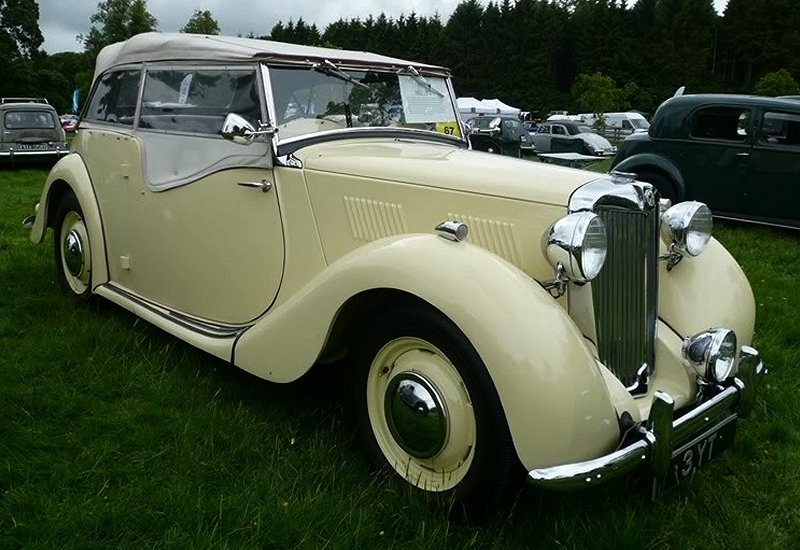
The MG YT 1.25 Litre Tourer was an elegant four-seat open touring car produced by the MG Car Company between 1948 and 1950. Developed from the MG YA saloon, the YT combined the relatively advanced chassis engineering of the Y-type range with the traditional sporting character of MG’s open sports cars. Featuring a 1,250 cc XPAG four-cylinder engine, independent front suspension and a spacious convertible body, the YT offered an appealing balance of performance, comfort and practicality. Although produced in relatively small numbers, it remains one of the most distinctive MG models of the immediate post-war period and an important example of the company’s efforts to expand its international markets.
The origins of the MG YT can be traced to the development of the Y-type saloon during the late 1930s. The original project, designated EX166, was intended to provide MG with a compact sporting saloon that would complement its established range of two-seat sports cars. Although development was substantially completed before the outbreak of the Second World War, civilian vehicle production was suspended during the conflict, delaying the introduction of the MG YA until 1947.
Following the successful launch of the YA, MG recognised an opportunity to develop an open touring version that would appeal particularly to overseas customers. The resulting YT Tourer was introduced in 1948, offering four-seat accommodation and the enjoyment of open-air motoring while retaining the comfort and relatively sophisticated mechanical engineering of the saloon. Unlike the smaller TC Midget, which was designed primarily as a two-seat sports car, the YT provided sufficient space for additional passengers and luggage, making it particularly suitable for longer journeys.
The YT was developed with export markets in mind, especially Australia and other Commonwealth countries where open touring cars remained popular. The model was also offered in left-hand-drive form for markets such as the United States, although its greatest commercial success was achieved in Australia. Its combination of British styling, practical accommodation and MG sporting heritage made it an attractive proposition for motorists seeking a versatile open car.
Power was supplied by the familiar 1,250 cc XPAG inline four-cylinder engine, featuring overhead valves operated by pushrods. Unlike the single-carburettor arrangement used in the YA saloon, the YT was equipped with twin SU carburettors, similar to those fitted to the MG TC sports car. This increased engine output to approximately 54.5 horsepower at 5,200 rpm, providing improved performance compared with the saloon.
The XPAG engine was renowned for its durability, relatively straightforward maintenance and responsive characteristics. Its cast-iron cylinder block and cylinder head provided a robust foundation, while the overhead-valve arrangement contributed to efficient breathing and respectable performance for a small-capacity engine of the period. The twin carburettors offered improved throttle response and allowed the YT to deliver a more sporting driving experience than the standard YA.
Although the YT was heavier than the two-seat TC, its engine provided sufficient power for comfortable touring and enjoyable open-road driving. The relatively flexible power delivery made the car suitable for everyday use, while the engine’s willingness to operate at higher speeds encouraged enthusiastic driving when road conditions permitted.
Power was transmitted to the rear wheels through a four-speed manual gearbox incorporating synchromesh on the upper three ratios. The transmission was closely related to that used in MG’s contemporary sports cars, providing a direct mechanical feel and allowing the driver to make effective use of the engine’s available power. First gear remained unsynchronised, requiring careful selection, particularly when the vehicle was moving.
The MG YT was capable of reaching approximately 75 mph (121 km/h), depending on vehicle condition and road conditions. Acceleration was modest by modern standards, but the combination of a responsive engine and relatively sophisticated chassis made the car enjoyable to drive. Its performance was intended primarily for comfortable touring rather than outright competition use.
One of the YT’s most significant mechanical features was its independent front suspension. Derived from the Y-type saloon, the system employed coil springs and wishbones, providing improved wheel control and ride comfort compared with the rigid front axles used on MG’s earlier T-type sports cars. This arrangement was relatively advanced for a British touring car of the late 1940s and contributed significantly to the YT’s handling characteristics.
The YT also featured rack-and-pinion steering, providing precise and responsive control. Combined with the independent front suspension, this gave the car predictable handling and improved stability over uneven road surfaces. The system would subsequently influence the development of the MG TD sports car, introduced in 1950.
At the rear, the YT retained a conventional live axle supported by semi-elliptic leaf springs, with hydraulic shock absorbers controlling suspension movement. Hydraulically operated drum brakes provided stopping power at all four wheels. The chassis employed a substantial separate-frame construction, providing the strength required to support the open four-seat body.
The YT’s bodywork was one of its most distinctive features. While the YA saloon featured a traditional enclosed four-door body, the YT adopted an elegant open touring configuration with two doors and accommodation for four occupants. The long bonnet, upright MG radiator grille, separate chrome headlamps and sweeping wings retained the familiar styling of the Y-type range, while the folding fabric hood gave the car a more sporting appearance.
The open body featured a relatively low waistline, cut-down doors and a folding windscreen, contributing to the traditional character of British touring cars. The hood could be raised to provide protection from rain and wind, while detachable side screens offered additional weather protection. When lowered, the hood allowed occupants to enjoy the open-air driving experience that had become closely associated with MG.
The YT retained the traditional 16-inch road wheels used on the early Y-type range, contributing to its period appearance. The relatively narrow tyres and substantial suspension travel reflected the engineering conventions of the late 1940s, while the long wheelbase provided a stable and comfortable ride.
Inside, the MG YT offered considerably more accommodation than the contemporary TC Midget. The front seats provided comfortable seating for the driver and passenger, while the rear compartment offered additional space for two occupants. The four-seat arrangement made the YT particularly attractive to families and motorists who wanted the enjoyment of an open sports car without sacrificing practicality.
The interior featured leather upholstery, traditional trim and a dashboard incorporating the principal driving instruments. The speedometer, tachometer, oil-pressure gauge and other essential controls were arranged within an attractive fascia, while the large steering wheel and floor-mounted gear lever maintained the familiar MG driving environment.
The driving position was relatively upright, with good forward visibility and straightforward access to the controls. Although the open body provided limited insulation from wind and road noise, the YT offered a more relaxed touring experience than MG’s smaller two-seat sports cars. Its relatively generous passenger accommodation and comfortable suspension made it particularly suitable for longer journeys.
The driving experience of the MG YT was characterised by smooth and responsive engine performance, predictable handling and a comfortable ride. The independent front suspension absorbed road irregularities more effectively than the rigid-axle arrangements used on earlier MG sports cars, while the rack-and-pinion steering provided precise control. The relatively long wheelbase contributed to stability, making the YT an enjoyable touring car on both winding roads and open highways.
The YT occupied a distinctive position within the British sports car market. While the TC Midget appealed primarily to enthusiasts seeking a compact two-seat roadster, the YT offered a more versatile alternative with four-seat accommodation. Its principal competitors included open touring models from manufacturers such as Singer, Riley and other British marques, although the MG distinguished itself through its sporting heritage and relatively advanced chassis engineering.
The YT’s commercial performance was strongly influenced by export demand. Australia became its most important market, where the open body style was particularly well suited to local conditions. The model was less successful in Britain, where the growing preference for enclosed saloons and the relatively high cost of specialist open bodywork limited demand.
Production of the MG YT continued until 1950, with approximately 877 examples manufactured. This relatively small total makes the YT one of the rarest post-war production MG models. Its limited production reflected the specialised nature of the four-seat touring market and the growing popularity of more modern sports car designs.
The YT was discontinued as MG concentrated on the successful TD Midget and continued development of its saloon range. The Y-type family remained in production through the improved YB saloon, introduced in 1951, but no direct replacement for the YT Tourer was developed. As a result, the YT occupies a distinctive position in MG history as one of the company’s last traditional four-seat open touring cars.
Today, the MG YT 1.25 Litre Tourer is highly regarded among collectors of rare post-war British motor cars. Its elegant styling, relatively sophisticated chassis and practical four-seat accommodation make it particularly attractive to enthusiasts seeking something different from the more familiar T-type sports cars. Surviving examples are relatively uncommon, and well-preserved or accurately restored vehicles are especially desirable.
Restoration requires careful attention to the separate chassis, body structure, steel panels and mechanical components. The condition of the folding hood, side screens and interior trim is particularly important, as these items can be difficult and expensive to reproduce accurately. The XPAG engine benefits from extensive specialist knowledge and parts availability, although certain YT-specific body and trim components are considerably rarer.
The MG YT 1.25 Litre Tourer represents an important and distinctive chapter in MG’s post-war development. By combining the proven XPAG engine with independent front suspension, rack-and-pinion steering and elegant four-seat open bodywork, MG created a versatile sporting tourer that offered both practicality and traditional British character. Although produced in relatively small numbers, the YT remains a fascinating example of MG’s ability to adapt its engineering to different markets and customer requirements, and its rarity and distinctive appearance ensure its continuing appeal among collectors and enthusiasts of classic British cars.