
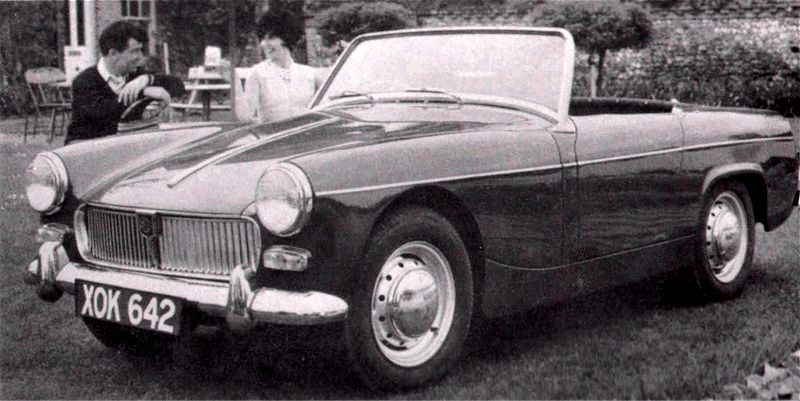
The MG Midget 950 Mk I was introduced in June 1961 as an affordable, lightweight two-seat sports car that revived one of the most celebrated names in MG’s history. Developed from the Austin-Healey Sprite, the new Midget combined compact dimensions, lively handling and straightforward mechanical engineering with the distinctive styling and sporting character associated with the MG marque. Powered by a 948 cc four-cylinder engine, the original Mk I represented the beginning of a successful new generation of MG Midgets that would remain in production, through successive developments, until 1979.
The introduction of the Midget marked MG’s return to the small sports car market following the discontinuation of the traditional T-type range in 1955. Although the MGA had successfully established a more modern sporting identity for the company, there remained considerable demand for a smaller and less expensive roadster. The Austin-Healey Sprite, introduced in 1958, had demonstrated the commercial potential of an economical two-seat sports car, and the British Motor Corporation recognised an opportunity to develop a closely related MG version.
The new MG Midget was based on the second-generation Austin-Healey Sprite, which appeared in 1961. Unlike the original Sprite, commonly known as the Frogeye because of its distinctive raised headlamps, the revised design featured a more conventional front end with headlamps integrated into the wings. The MG version shared much of its body structure and mechanical equipment with the Sprite but incorporated distinctive exterior trim, badging and interior details intended to establish a separate identity.
The Midget name had a long association with MG, having first been used on the M-type Midget introduced in 1929. During the 1930s, successive Midget models helped establish the company’s reputation for producing small, affordable sports cars capable of delivering considerable driving enjoyment. The revival of the name in 1961 therefore connected the new model with an important part of MG’s sporting heritage.
Power was supplied by a 948 cc version of the BMC A-series inline four-cylinder engine, featuring overhead valves operated by pushrods. The engine employed a cast-iron cylinder block and cylinder head, with twin SU carburettors providing fuel delivery. In MG Midget specification, it developed approximately 46 horsepower at 5,500 rpm, giving the lightweight roadster respectable performance for its modest displacement.
The A-series engine was already well established within the BMC range and had earned a reputation for reliability, simplicity and economical operation. Its compact dimensions and relatively low weight made it particularly suitable for the Midget, while the availability of components across several BMC models helped reduce manufacturing and maintenance costs.
Although the engine’s output was modest, the Midget’s relatively low kerb weight allowed it to deliver an enjoyable and responsive driving experience. The engine was willing to operate at higher speeds, and its twin-carburettor arrangement provided relatively sharp throttle response. The combination of a small engine and lightweight body encouraged drivers to maintain momentum through corners rather than relying on outright acceleration.
Power was transmitted to the rear wheels through a four-speed manual gearbox, with synchromesh on second, third and fourth gears. First gear remained unsynchronised, requiring careful selection when the car was moving. The gearbox featured relatively close ratios suited to the engine’s characteristics, allowing drivers to make effective use of the available power.
The MG Midget 950 Mk I was capable of reaching approximately 85 mph (137 km/h), depending on vehicle condition and road conditions. Acceleration from 0 to 60 mph generally required around 20 seconds. Although these figures were modest compared with larger contemporary sports cars, the Midget’s appeal lay primarily in its agility, responsive steering and engaging driving characteristics.
The chassis employed a lightweight unitary body construction rather than the separate ladder-frame arrangement used on earlier MG sports cars. This represented a significant departure from traditional MG engineering and contributed to the vehicle’s relatively low weight and compact dimensions. The integrated body and chassis structure also provided a rigid foundation for the suspension and mechanical components.
At the front, the Midget featured independent suspension using coil springs and wishbones, with lever-arm hydraulic shock absorbers forming part of the upper suspension arrangement. This provided relatively precise wheel control and contributed to the car’s responsive handling. The front suspension was closely related to that used on the Austin-Healey Sprite and was designed to combine simplicity with effective road holding.
At the rear, the Mk I retained a live axle supported by quarter-elliptic leaf springs, a compact arrangement that helped minimise weight and packaging requirements. Lever-arm hydraulic shock absorbers controlled suspension movement. Although the rear suspension was relatively simple, it provided predictable handling when driven within its limits and contributed to the Midget’s lively sporting character.
Braking was provided by hydraulically operated drum brakes on all four wheels. These were adequate for the performance of the original 948 cc model, although they required more effort and offered less resistance to fade than the disc brakes introduced on later versions. The braking system reflected the emphasis on simplicity, affordability and low weight that characterised the original Midget.
The steering employed a rack-and-pinion arrangement, providing direct and responsive control. Combined with the short wheelbase, narrow track and lightweight construction, this gave the Midget exceptional agility on winding roads. The car responded quickly to steering inputs and encouraged an enthusiastic driving style, making it particularly enjoyable on narrow British country lanes.
Externally, the MG Midget 950 Mk I featured compact and attractive styling that distinguished it from the earlier Frogeye Sprite. The front end incorporated headlamps within the wings, a low bonnet and a traditional MG grille, while the relatively short rear deck and rounded body panels created a balanced sporting appearance.
The body retained the simple open two-seat configuration associated with affordable British roadsters. Early Mk I models featured sliding side windows rather than conventional wind-up glass, while the doors lacked external handles. Access was gained through interior catches, reflecting the car’s lightweight and economical design. A removable folding hood and detachable side screens provided basic weather protection.
The Midget’s small dimensions were central to its appeal. Its low seating position, narrow body and short wheelbase created a close connection between the driver and the road. The compact proportions also made it easy to manoeuvre in towns and on narrow roads, while the low weight contributed to economical fuel consumption.
Inside, the Mk I offered a simple and functional cockpit with two individual seats, basic trim and a straightforward dashboard. The principal instruments included a speedometer, tachometer, fuel gauge and other essential controls. The large steering wheel and short gear lever provided a direct mechanical feel, while the low seating position reinforced the car’s sporting character.
The interior was deliberately uncomplicated, reflecting the Midget’s position as an affordable sports car. There was limited luggage space and relatively little protection from wind, road noise or adverse weather conditions. Nevertheless, the cockpit provided sufficient accommodation for two occupants and offered the distinctive open-air driving experience that had become closely associated with British sports cars.
The driving experience of the MG Midget 950 Mk I was characterised by its light weight, responsive steering and balanced handling. Although the engine produced relatively little power, the car’s compact dimensions and direct controls made it enjoyable at moderate speeds. Drivers could exploit its agility through corners, while the small engine encouraged frequent gear changes and an active driving style.
The Midget was particularly well suited to the British road network, where narrow lanes and winding country roads rewarded handling and manoeuvrability rather than outright speed. Its relatively economical operation also made it attractive to younger motorists and enthusiasts who wanted an accessible introduction to sports car ownership.
The MG Midget entered a competitive market that included the Austin-Healey Sprite, Triumph Spitfire and other small British sports cars. Its close relationship with the Sprite allowed BMC to offer two similar vehicles under different marques, with the MG benefiting from the company’s established sporting reputation and distinctive styling details.
The original 948 cc Midget was produced for a relatively short period before the introduction of an enlarged engine later in 1962. The replacement 1,098 cc version offered improved torque and acceleration, addressing one of the principal limitations of the original model. Although both versions belonged to the Mk I generation, the 948 cc car is often distinguished by enthusiasts as the Midget 950.
Production of the 948 cc MG Midget amounted to approximately 16,000 examples, making it a relatively uncommon version compared with later models. The early cars are particularly interesting because they retain the simplest mechanical specification and most basic body features of the original design.
The subsequent development of the Midget range brought larger engines, improved brakes, revised suspension and more practical bodywork. The Mk II introduced wind-up windows and improved weather protection, while later versions received further mechanical and styling changes. Despite these developments, the essential concept established by the original 950 remained unchanged: a compact, lightweight and affordable sports car designed primarily for driving enjoyment.
Today, the MG Midget 950 Mk I is regarded as an important model in the history of affordable British sports cars. Its simple construction, compact dimensions and lively handling make it particularly appealing to enthusiasts who appreciate traditional open-air motoring. The earliest 948 cc examples are also valued for their historical significance as the first models in the revived Midget range.
Restoration requires careful inspection of the unitary body structure, particularly the sills, floor panels, wheel arches, spring mounting points and other areas vulnerable to corrosion. The A-series engine is generally straightforward to maintain, and mechanical components benefit from extensive specialist support. However, early body fittings, trim and model-specific details can be more difficult to obtain than components used on later Midgets.
The MG Midget 950 Mk I represents a significant chapter in MG’s post-war history. By combining the proven mechanical engineering of the Austin-Healey Sprite with distinctive MG styling and a revived historic name, the company created an affordable sports car that captured the spirit of its earlier Midget models. Although its engine output and equipment were modest, the original 948 cc Midget offered lively handling, mechanical simplicity and considerable driving enjoyment. Its success established the foundations for one of MG’s longest-running sports car ranges and ensured the continuation of the Midget tradition into the modern era.