
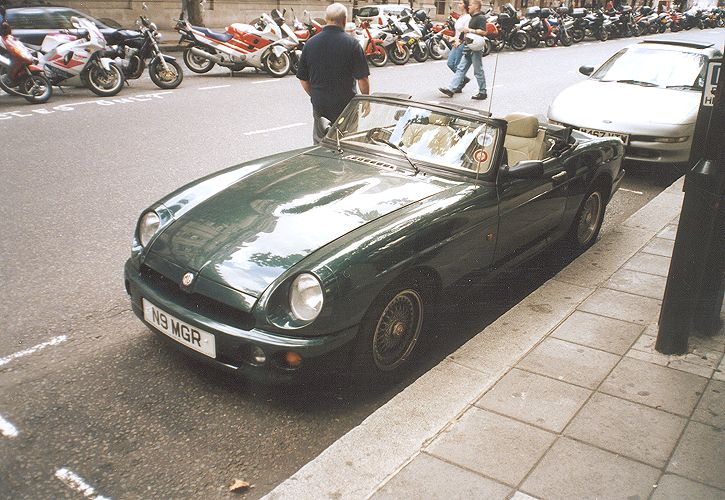
The MG RV8 was a two-seat British sports car produced by the Rover Group between 1992 and 1995, marking the return of traditional MG roadster production more than a decade after the closure of the famous Abingdon factory in 1980. Combining the classic proportions of the MGB Roadster with a powerful 3.9-litre Rover V8 engine, the RV8 represented an attempt to revive the character and heritage of the MG marque while introducing improved comfort, performance and refinement. Although based on the underlying architecture of the original MGB, the RV8 incorporated substantially revised bodywork, a redesigned interior and upgraded mechanical components. Produced in limited numbers, with approximately 1,983 examples manufactured, the MG RV8 became an important transitional model between the traditional MG sports cars of the twentieth century and the modern MG F introduced in 1995.
The origins of the MG RV8 can be traced to the closure of the MG factory at Abingdon in October 1980. The end of MGB production brought to a close one of the most successful chapters in British sports car history, leaving the MG marque without a traditional two-seat roadster for the first time in decades. Although the MG name continued to appear on sporting versions of Rover Group passenger cars, including the MG Metro, Maestro and Montego, these front-wheel-drive models differed considerably from the rear-wheel-drive sports cars that had established the marque’s international reputation.
During the late 1980s, interest in traditional British sports cars began to increase. The introduction of the Mazda MX-5 in 1989 demonstrated that there remained a substantial market for compact, affordable two-seat roadsters. Its success encouraged several manufacturers to reconsider the commercial potential of open sports cars, particularly those offering classic styling and an engaging driving experience.
Within the Rover Group, discussions began concerning the possibility of reviving the MG roadster. Although the company was developing a completely new mid-engined sports car that would eventually become the MG F, this project required considerable investment and development time. A more immediate solution was therefore sought to reintroduce a traditional MG sports car while the new model was being prepared.
The resulting project became the MG RV8, developed under the internal designation AD050. Rather than designing an entirely new vehicle, Rover engineers decided to use the established MGB body structure as the foundation for a modernised roadster. This approach reduced development costs and allowed the company to draw upon the extensive engineering knowledge and production experience associated with the original MGB.
The RV8 was developed with assistance from British Motor Heritage, which had continued manufacturing replacement body shells and panels for classic MG models. The availability of newly manufactured MGB body components made it possible to create a revised sports car without establishing an entirely new body manufacturing programme.
Although the RV8 retained the basic structural architecture of the MGB, its exterior appearance was extensively redesigned. The objective was to preserve the familiar proportions and character of the original roadster while giving the car a more substantial and contemporary appearance.
The MG RV8 was officially unveiled at the British International Motor Show in Birmingham in October 1992. Its introduction attracted considerable attention because it represented the return of a traditional rear-wheel-drive MG sports car after more than a decade.
The exterior styling was immediately recognisable as an evolution of the MGB. The long bonnet, short rear deck, low seating position and two-seat open body retained the classic British roadster proportions that had made the original car so popular.
However, the RV8 featured wider, more rounded body panels and a noticeably more muscular stance. The front wings were substantially revised, incorporating broader wheel arches and a smoother transition into the bonnet and front valance.
The traditional MGB radiator grille was replaced by a smaller, more rounded opening incorporating the familiar MG octagonal badge. The front bumper was integrated into the bodywork, giving the car a cleaner and more contemporary appearance than the chrome-bumper MGB.
The headlamps retained a traditional circular shape, although their installation was revised to complement the new front-end styling. The combination of rounded headlamps, a compact grille and flowing wings helped preserve the RV8’s visual connection with earlier MG sports cars.
At the rear, the bodywork was similarly revised, with wider wings, integrated bumpers and distinctive rear lamp assemblies. The overall effect was a car that retained the character of the MGB while appearing broader, lower and more substantial.
The RV8 was fitted with distinctive 15-inch alloy wheels, which complemented its wider bodywork and improved performance. The wheels were designed specifically for the model and contributed to its more modern appearance.
The body retained a conventional manually operated folding fabric hood, allowing the driver and passenger to enjoy open-air motoring. When raised, the hood provided weather protection, although the RV8 remained a traditional roadster rather than a fully insulated modern convertible.
The MG RV8 was powered by a 3,946 cc Rover V8 engine, a development of the aluminium-alloy V8 originally introduced by Rover during the 1960s. The engine had become one of Britain’s most successful and versatile power units, appearing in Rover saloons, Range Rovers, Land Rovers and numerous specialist sports cars.
The V8 featured an aluminium-alloy cylinder block and cylinder heads, with eight cylinders arranged in a 90-degree configuration. The engine employed overhead valves operated by pushrods through a centrally mounted camshaft, providing a compact and relatively lightweight design.
In RV8 specification, the engine developed approximately 190 bhp at 4,750 rpm, with maximum torque of around 234 lb ft (318 Nm) at 3,200 rpm. This represented a substantial increase over the output of the original four-cylinder MGB and also exceeded that of the factory MGB GT V8 produced during the 1970s.
The engine was equipped with electronic fuel injection and modern engine-management technology, providing improved fuel delivery, starting characteristics and emissions control compared with the carburettor-equipped engines used in earlier MG sports cars.
The Rover V8’s greatest advantage was its strong torque delivery. The relatively large displacement allowed the RV8 to accelerate rapidly from low engine speeds, providing effortless performance without requiring frequent gear changes.
The engine also produced the distinctive exhaust note associated with traditional V8 sports cars. Its smoothness and strong mid-range performance contributed significantly to the RV8’s character, making it particularly enjoyable during relaxed touring and open-road driving.
Power was transmitted to the rear wheels through a five-speed manual gearbox. The transmission was derived from the Rover LT77 family and was selected to accommodate the V8 engine’s substantial torque output.
The five-speed gearbox provided a useful range of ratios, allowing brisk acceleration through the lower gears while maintaining relatively relaxed engine speeds during motorway cruising. The conventional front-engine, rear-wheel-drive arrangement preserved the traditional mechanical layout associated with MG sports cars.
The MG RV8 was capable of reaching approximately 135 mph (217 km/h), making it one of the fastest production MG roadsters of its period. Acceleration from 0 to 60 mph generally required around 5.9 seconds, although published figures varied according to testing conditions.
These performance figures placed the RV8 well above the original MGB in terms of straight-line acceleration. The combination of a relatively light body and powerful V8 engine provided strong overtaking performance and effortless cruising ability.
Despite its increased performance, the RV8 retained much of the traditional engineering architecture of the MGB. The unitary steel body structure was extensively reinforced and modified to accommodate the larger engine, revised suspension and wider track.
The suspension arrangement remained relatively conventional compared with contemporary sports cars. At the front, independent suspension employed coil springs and wishbones, with telescopic hydraulic dampers replacing the lever-arm shock absorbers used on the original MGB.
At the rear, the RV8 retained a live axle supported by semi-elliptic leaf springs, although the arrangement was revised to accommodate the increased power and improve axle location. Additional locating links helped control axle movement under acceleration and cornering loads.
The retention of a live rear axle reflected the RV8’s traditional character and the decision to use the established MGB platform. Although this arrangement was less sophisticated than the independent rear suspension employed by some contemporary sports cars, it provided durability and predictable handling.
The suspension was tuned to provide a balance between ride comfort and sporting response. The wider track and larger tyres improved grip, while revised damping and spring rates helped control body movement.
Rack-and-pinion steering was retained, providing direct and responsive control. However, the RV8 did not feature power-assisted steering, and steering effort could be relatively heavy at low speeds, particularly during parking manoeuvres.
At higher speeds, the steering provided a reassuring sense of connection with the road. The combination of a low seating position, rear-wheel drive and strong V8 engine gave the RV8 a distinctly traditional sports car driving experience.
The braking system employed ventilated disc brakes at the front and drum brakes at the rear. Although the use of rear drums was relatively old-fashioned by the early 1990s, the system provided adequate stopping performance for the car’s weight and intended use.
The RV8 was equipped with wider tyres than the original MGB, contributing to improved traction and cornering grip. Nevertheless, the substantial torque produced by the V8 engine required careful throttle control, particularly on wet or slippery roads.
Inside, the MG RV8 represented a considerable departure from the relatively basic interior of the original MGB. Rover designers sought to create a more luxurious environment that would appeal to buyers seeking a traditional British sports car with a higher level of comfort and craftsmanship.
The interior featured extensive use of polished burr elm wood veneer, leather upholstery and traditional analogue instrumentation. The dashboard incorporated a distinctive wood-trimmed fascia, creating an appearance reminiscent of classic British grand touring cars.
The two individual seats were upholstered in leather and provided improved comfort and support compared with those fitted to earlier MG roadsters. The door panels and other interior surfaces also incorporated leather trim, reinforcing the car’s more upmarket positioning.
The instrument panel retained the traditional arrangement of large circular gauges, including a speedometer and tachometer, together with supplementary instruments for monitoring engine operation.
The steering wheel was designed to complement the traditional interior styling, while the centrally mounted gear lever reinforced the conventional sports car driving position.
The RV8’s interior was considerably more refined than that of the MGB, although the relatively narrow passenger compartment and limited luggage capacity reflected the dimensions of the underlying body structure.
The driving position was low and intimate, with the long bonnet extending ahead of the driver. This arrangement preserved the familiar atmosphere of a traditional British roadster, particularly when the hood was lowered.
The MG RV8 was intended primarily as a specialist sports car rather than a mass-market model. Its relatively high price reflected the limited production volume, extensive use of specialist components and labour-intensive manufacturing processes.
Production was undertaken at Rover’s Cowley facilities, with body shells and panels supplied through British Motor Heritage and other specialist manufacturers. The use of established components and relatively low-volume production methods allowed Rover to manufacture the car without the investment required for a completely new platform.
Although the RV8 attracted considerable attention in Britain, domestic sales were relatively modest. Its price placed it above many contemporary sports cars, while its traditional suspension and body structure made it less technologically advanced than newer competitors.
The Mazda MX-5, for example, offered modern suspension, lighter controls and a more affordable purchase price. The RV8 instead appealed to buyers who valued classic British styling, V8 performance and the heritage associated with the MG name.
The car’s commercial fortunes changed significantly when Rover began exporting the RV8 to Japan. Japanese enthusiasts had developed a strong interest in traditional British sports cars, and the RV8’s combination of classic styling and modern V8 power proved particularly attractive.
Japan became by far the most important market for the RV8, accounting for approximately three-quarters of total production. The majority of cars were therefore manufactured in right-hand-drive configuration, although a smaller number were supplied to other markets.
The Japanese market’s enthusiasm for the RV8 helped sustain production during its relatively short manufacturing life. Many examples were carefully maintained and used sparingly, contributing to the relatively good condition of numerous surviving cars.
The RV8 was offered in a limited selection of exterior colours, with Woodcote Green becoming particularly closely associated with the model. This distinctive metallic green complemented the traditional styling and luxurious interior, becoming one of the most recognisable features of the car.
Other colours were available, although Woodcote Green accounted for the overwhelming majority of production. The combination of green paintwork, leather upholstery and polished wood trim reinforced the RV8’s traditional British sporting identity.
Production continued until 1995, when the introduction of the completely new MG F marked the next stage in the revival of the MG marque. The MG F employed a mid-mounted four-cylinder engine, modern suspension and a purpose-designed body, representing a substantial departure from the traditional architecture of the RV8.
The RV8 had therefore served as an important transitional model, reintroducing a traditional MG roadster while Rover completed development of its modern successor.
A total of approximately 1,983 MG RV8s were manufactured between 1992 and 1995. The limited production volume reflected the car’s specialist nature and relatively high price, but it also contributed to its subsequent desirability among collectors.
The MG RV8 received a mixed response from contemporary motoring journalists. Its strong V8 engine, attractive styling and luxurious interior were widely praised, while its traditional suspension, relatively heavy steering and high purchase price attracted criticism.
Some reviewers considered the car outdated compared with modern sports cars, particularly in terms of handling refinement and chassis sophistication. Others appreciated its traditional character and regarded the RV8 as a successful modern interpretation of the classic British roadster.
The RV8’s driving experience was fundamentally different from that of a lightweight, high-revving sports car. Its greatest strengths were effortless acceleration, strong mid-range torque and relaxed open-air touring.
The V8 engine allowed the car to accelerate rapidly without requiring frequent gear changes, while the five-speed transmission provided comfortable cruising at higher speeds. The distinctive exhaust note and traditional driving position added to the sense of occasion.
On winding roads, the RV8 demanded a more measured driving style than some contemporary sports cars. The live rear axle and relatively soft suspension could produce noticeable body movement, particularly on uneven surfaces.
Nevertheless, the car remained enjoyable when driven within its intended character. Its strong engine, direct steering and rear-wheel-drive layout provided an engaging experience that reflected the traditions of earlier MG sports cars.
The RV8 also played an important role in maintaining the international reputation of the MG marque. Although production volumes were small, the car demonstrated Rover’s commitment to reviving MG as a manufacturer of dedicated sports cars rather than simply using the badge on performance versions of ordinary passenger vehicles.
Its success in Japan also highlighted the continuing international appeal of traditional British sports cars, particularly among enthusiasts who valued heritage, craftsmanship and distinctive styling.
Today, the MG RV8 is regarded as an increasingly desirable modern classic. Its limited production, powerful V8 engine and close association with the original MGB make it particularly attractive to collectors and MG enthusiasts.
Many surviving examples have been imported back to Britain from Japan, where they were often maintained to a high standard. These Japanese-market cars account for a substantial proportion of the RV8s now available in the British classic car market.
Restoration and maintenance require careful attention to the body structure, particularly the sills, floor panels, wheel arches and suspension mounting areas. Although the RV8 benefited from improved corrosion protection compared with earlier MG models, rust can still develop, particularly on vehicles exposed to damp conditions or road salt.
The Rover V8 engine is generally robust and benefits from extensive specialist knowledge and good parts availability. However, the cooling system, fuel-injection equipment and associated electrical components require careful maintenance.
The five-speed manual gearbox and rear axle should also be inspected for wear, particularly on cars that have been driven aggressively or have covered substantial mileages.
The RV8’s interior presents additional restoration considerations because of its distinctive leather upholstery, wood veneer and model-specific trim components. Replacement parts can be expensive or difficult to obtain, particularly where original materials or fittings are no longer manufactured.
The suspension and braking systems also require regular inspection, especially on cars that have spent long periods in storage. Ageing rubber bushes, hydraulic components and brake parts can affect handling and reliability.
Originality is particularly important when assessing an MG RV8, as the model’s limited production and distinctive specification contribute significantly to its value. Chassis identification numbers, service records and historical documentation can help establish a vehicle’s provenance.
The MG RV8 represents an important chapter in the modern history of the MG marque. By combining the traditional architecture of the MGB with a powerful 3.9-litre Rover V8 engine, revised bodywork and a luxurious interior, Rover created a distinctive sports car that celebrated MG’s heritage while preparing the way for a new generation of roadsters. Although its relatively high price and traditional engineering limited its commercial appeal, the RV8 succeeded in restoring the presence of a dedicated MG sports car to the market. Its rarity, strong performance and unmistakable British character have secured its place as one of the most interesting and collectible MG models of the 1990s.