
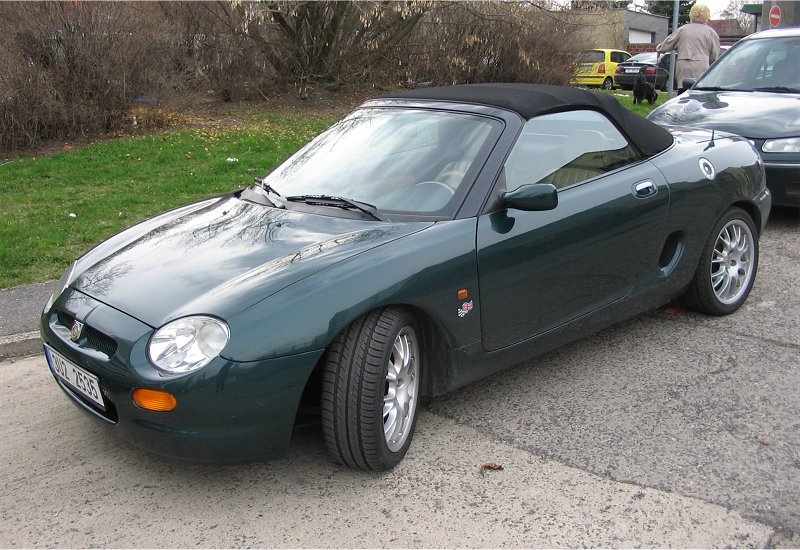
The MG MGF 1.8i VVC was the higher-performance version of the original MGF roadster, introduced in 1995 as part of the Rover Group’s revival of the MG marque. Combining a mid-mounted 1.8-litre K-series engine with an innovative Variable Valve Control system, the MGF VVC offered greater power and a more enthusiastic high-revving character than the standard 1.8i. Its lightweight construction, rear-wheel-drive layout, independent Hydragas suspension and attractive open-top bodywork made it one of the most distinctive British sports cars of the 1990s. Produced until 2002, when the MGF range was replaced by the revised MG TF, the VVC became an important part of MG’s modern sporting identity and demonstrated the potential of Rover’s advanced four-cylinder engine technology.
The origins of the MGF 1.8i VVC can be traced to the closure of the MG factory at Abingdon in October 1980. The discontinuation of the MGB ended nearly two decades of production of one of Britain’s most successful sports cars and left the MG marque without a traditional two-seat roadster.
Although the MG name continued to appear on sporting versions of Rover Group passenger cars, including the Metro, Maestro and Montego, these models differed considerably from the rear-wheel-drive sports cars that had established MG’s reputation.
During the late 1980s, interest in affordable open sports cars began to increase. The introduction of the Mazda MX-5 in 1989 demonstrated that there remained substantial demand for compact roadsters combining attractive styling, responsive handling and reasonable purchase prices.
Rover recognised the opportunity to revive MG as a manufacturer of dedicated sports cars. Although the MG RV8, introduced in 1992, provided a limited-production return to traditional roadster manufacturing, it was based on the older MGB architecture and was relatively expensive.
A completely new sports car was therefore developed under Rover’s internal project designation PR3. The resulting MGF was designed to offer modern engineering, practical everyday usability and affordable performance while retaining the character associated with the MG name.
One of the most significant decisions was to adopt a mid-engine layout rather than the traditional front-engine arrangement used by earlier MG roadsters. This configuration placed the engine immediately behind the passenger compartment, driving the rear wheels through a compact transverse transmission.
The mid-engine arrangement offered several advantages, including relatively balanced weight distribution, reduced polar moment of inertia and responsive handling. It also allowed Rover to use existing compact powertrain components from its passenger car range.
The MGF was officially unveiled at the Geneva Motor Show in March 1995, attracting considerable attention as the first completely new MG roadster since the introduction of the MGB in 1962.
The range initially consisted of two principal versions: the standard MGF 1.8i and the more powerful MGF 1.8i VVC. Both shared the same basic body structure, suspension arrangement and mid-engine layout, but the VVC featured a more sophisticated version of Rover’s K-series engine.
The exterior styling of the MGF was developed to create a modern interpretation of the traditional British roadster. The design retained familiar proportions, including a low bonnet, compact passenger compartment and short rear deck, while incorporating rounded bodywork and contemporary aerodynamic features.
The front featured oval-shaped headlamps, a small grille carrying the MG octagonal badge and a smoothly integrated bumper. The rounded wings and gently curved bonnet gave the car a friendly but sporting appearance.
The side profile was distinguished by prominent air intakes positioned ahead of the rear wheels. These openings provided cooling airflow to the mid-mounted engine and contributed to the car’s distinctive appearance.
At the rear, the MGF featured rounded wings, a compact boot lid and distinctive rear lamp assemblies. The short rear overhang and relatively broad stance emphasised the car’s mid-engine configuration.
The MGF 1.8i VVC was visually similar to the standard 1.8i, with relatively subtle differences in badging, wheels and equipment depending on model year. Rover deliberately avoided excessive aerodynamic additions, allowing the car’s basic styling to provide its sporting identity.
The body employed a steel monocoque structure designed specifically for an open sports car. Reinforcement was incorporated into the floorpan, sills and other structural areas to provide adequate rigidity without the support of a permanent roof.
The MGF was equipped with a manually operated folding fabric hood, allowing the driver and passenger to enjoy open-air motoring. A removable hardtop was also available, providing improved weather protection and refinement during winter use.
The MGF 1.8i VVC was powered by a 1,796 cc Rover K-series inline four-cylinder engine. The K-series was a lightweight and compact power unit featuring an aluminium-alloy cylinder block and cylinder head.
The engine employed double overhead camshafts operating four valves per cylinder, providing efficient airflow and strong performance for its displacement. Electronic fuel injection and modern engine management helped deliver responsive throttle control and reasonable fuel economy.
The defining feature of the VVC engine was Rover’s Variable Valve Control system. Unlike conventional engines with fixed camshaft timing, the VVC mechanism continuously varied the duration of the inlet valve opening according to engine speed and operating conditions.
This system allowed the engine to provide relatively strong torque at lower engine speeds while maintaining efficient breathing and increased power at higher revolutions. The result was a broader and more flexible power delivery than could be achieved with a conventional fixed-duration camshaft arrangement.
The VVC mechanism employed a sophisticated system of eccentric drive components to vary the rotational speed of the inlet camshafts during each cycle. By altering the effective valve-opening duration, the system improved the engine’s ability to operate efficiently across a wide range of speeds.
This technology was particularly notable because it differed from the variable valve timing systems employed by many rival manufacturers. Rather than simply advancing or retarding camshaft timing, Rover’s VVC system altered the duration of inlet valve operation.
In standard MGF 1.8i VVC specification, the engine developed approximately 143 bhp at 7,000 rpm, with maximum torque of around 128 lb ft (174 Nm) at 4,500 rpm.
This represented an increase of approximately 25 bhp over the standard MGF 1.8i, which produced around 118 bhp. The additional power was most noticeable at higher engine speeds, where the VVC system allowed the engine to continue producing strong acceleration.
The VVC engine also featured a higher maximum operating speed than the standard 1.8i, contributing to its more enthusiastic character. Drivers could exploit the engine’s high-revving performance through the five-speed manual gearbox, making the VVC particularly enjoyable during spirited driving.
The engine was mounted transversely behind the passenger compartment, driving the rear wheels through a five-speed manual transmission. This arrangement differed fundamentally from the front-engined, rear-wheel-drive layout of earlier MG roadsters.
The gearbox provided a suitable range of ratios for both enthusiastic driving and relaxed cruising. The relatively short gear lever was positioned on the central tunnel, allowing convenient operation.
The MGF 1.8i VVC was capable of reaching approximately 130 mph (209 km/h), depending on specification and conditions. Acceleration from 0 to 60 mph generally required around 7 seconds, making it one of the quicker affordable roadsters of the mid-1990s.
The additional power gave the VVC a noticeable advantage over the standard 1.8i, particularly during high-speed acceleration and overtaking. However, the engine retained sufficient flexibility for ordinary driving, allowing the car to remain practical for everyday use.
The MGF’s handling was one of its principal attractions. The mid-engine layout placed a substantial proportion of the vehicle’s mass between the axles, helping reduce the polar moment of inertia and providing responsive directional changes.
The car also benefited from a relatively low centre of gravity, contributing to stability during cornering. Its compact dimensions and relatively short wheelbase made it particularly enjoyable on winding roads.
One of the most unusual engineering features of the MGF was its Hydragas suspension system. Developed from earlier British Leyland suspension technology, Hydragas employed interconnected fluid-filled displacer units incorporating gas springs and hydraulic damping.
The system connected the front and rear suspension units on each side of the vehicle, allowing hydraulic fluid to move between them as the suspension responded to road conditions. This arrangement was intended to reduce pitching movements and provide a combination of ride comfort and controlled handling.
The MGF employed independent suspension at all four corners, with double wishbones providing wheel location. The Hydragas units supplied the springing and damping characteristics, allowing the car to achieve a relatively compliant ride compared with some conventionally sprung sports cars.
The suspension was tuned to provide a balance between comfort and sporting response. On ordinary roads, the MGF offered a relatively smooth ride, while the mid-engine layout and independent suspension provided good cornering stability.
The VVC’s additional performance placed greater demands on the chassis, but the basic suspension arrangement was capable of accommodating the increased power. Wider tyres and appropriate suspension settings helped provide sufficient grip during enthusiastic driving.
However, the Hydragas system required correct maintenance and ride-height adjustment. Changes in system pressure or ageing components could affect suspension geometry, ride height and handling characteristics.
Rack-and-pinion steering was fitted, with electric power assistance providing relatively light steering effort at low speeds. The system was designed to retain sufficient steering response for enthusiastic driving while improving manoeuvrability during parking and urban use.
The MGF 1.8i VVC employed disc brakes at all four wheels, providing effective stopping performance for its weight and intended use. Anti-lock braking was fitted to the VVC specification, contributing to improved control during emergency braking.
The car was equipped with alloy wheels, typically measuring 15 inches in diameter, with tyre sizes selected to provide suitable grip and handling characteristics. Different wheel designs and tyre specifications were introduced during production.
Inside, the MGF 1.8i VVC featured a modern two-seat cockpit designed to combine sporting character with everyday comfort. The dashboard incorporated rounded instrument binnacles, a centrally positioned console and clearly arranged controls.
The main instruments consisted of a large speedometer and tachometer, together with supplementary gauges for monitoring engine operation. The design was functional and relatively straightforward, reflecting the car’s position as an affordable sports roadster.
The VVC version generally featured a higher level of equipment than the standard 1.8i, with differences in upholstery, trim and convenience features depending on model year and market.
The seats provided reasonable support and comfort, while the driving position was low and suitably sporting. The steering wheel and gear lever were positioned to allow convenient control, although some drivers found the pedal arrangement and seating position less adjustable than those of certain competitors.
Leather upholstery and other interior enhancements were available on certain specifications and special editions, allowing buyers to personalise the car.
Despite its compact dimensions, the MGF offered reasonable accommodation for two occupants. The passenger compartment provided sufficient legroom and headroom for most drivers, particularly with the hood lowered.
Luggage accommodation was provided by a boot positioned behind the engine compartment. Although relatively small, it offered enough space for weekend luggage or everyday shopping.
The front compartment housed the spare wheel and various mechanical components rather than providing a conventional luggage compartment. This arrangement reflected the packaging compromises associated with the mid-engine layout.
The MGF 1.8i VVC entered a competitive market for affordable two-seat roadsters. Its principal rivals included the Mazda MX-5, Fiat Barchetta and, later, the BMW Z3 and Toyota MR2.
The Mazda MX-5 was particularly important because it had already established a strong reputation for reliability, balanced handling and traditional rear-wheel-drive sports car character. The MGF VVC offered a different approach, combining a mid-mounted engine with Hydragas suspension and advanced variable valve technology.
The Fiat Barchetta provided another alternative, although its front-wheel-drive layout differed from the MGF’s rear-wheel-drive configuration. The BMW Z3 appealed to buyers seeking a more premium sports car, while the Toyota MR2 offered a similarly mid-engined arrangement.
The MGF VVC was well received by the British motoring press, with reviewers praising its lively engine, attractive styling and enjoyable handling. The variable valve system was regarded as an impressive technical achievement, particularly because it allowed a relatively small naturally aspirated engine to produce strong high-speed performance.
The car also achieved considerable commercial success, particularly in Britain, where the MGF became one of the best-selling roadsters of its period. Its relatively affordable price and strong association with MG’s sporting heritage contributed significantly to its popularity.
The VVC version appealed particularly to enthusiasts who wanted additional performance without sacrificing the comfort and practicality of the standard MGF.
During its production life, the MGF range received various improvements to equipment, trim and mechanical components. Special editions were introduced to maintain customer interest, often featuring distinctive paint colours, alloy wheels and interior finishes.
In 1999, the MGF received a significant update as part of the revised model-year range. Changes included improvements to interior trim, instrumentation and equipment, together with detail modifications intended to improve refinement and quality.
The exterior styling remained largely unchanged, reflecting the continuing popularity of the original design. The MGF’s rounded proportions and compact dimensions had aged relatively well during the second half of the 1990s.
The K-series VVC engine remained central to the car’s character throughout production. Its lightweight construction and advanced valve-control system made it one of the more technically interesting engines fitted to an affordable British sports car during the period.
However, the K-series engine subsequently became associated with reliability concerns, particularly cylinder-head gasket failure. The engine’s aluminium construction, cooling-system design and sensitivity to overheating could contribute to gasket problems, especially when cooling-system maintenance was neglected.
The MGF’s mid-engine arrangement made cooling-system maintenance particularly important. The engine was located behind the passenger compartment, while the radiator was positioned at the front of the car, requiring long coolant pipes running beneath the body.
Leaks, trapped air or deteriorating coolant components could lead to overheating, potentially causing serious engine damage. Correct bleeding procedures and regular inspection of the cooling system were therefore essential.
The VVC mechanism introduced additional maintenance considerations compared with the standard engine. Its specialised camshaft drive components required correct lubrication and careful servicing, while repairs could be more expensive because of the system’s mechanical complexity.
Although these issues affected the reputation of the MGF, many VVC models provided reliable service when properly maintained. Improved replacement components and specialist repair techniques have subsequently helped address several of the engine’s known weaknesses.
The MGF also developed a following in club motorsport and amateur competition. Its mid-engine layout, relatively low weight and responsive handling made it suitable for sprint events, hill climbs and circuit racing.
The VVC engine’s additional power made it particularly attractive to drivers seeking improved performance without extensive modifications. Specialist racing series and owners’ clubs helped maintain enthusiasm for the model.
The MGF remained in production until 2002, when it was replaced by the revised MG TF. The TF retained the basic mid-engine architecture and K-series power units but introduced substantially revised styling and conventional coil-spring suspension in place of the Hydragas system.
The transition to the MG TF reflected the desire to modernise the car’s appearance and simplify certain aspects of its engineering. Nevertheless, the MGF had already established itself as one of the most important MG models of the modern era.
More than 77,000 MGFs were produced during the model’s manufacturing life, with the VVC accounting for a significant proportion of production. The combination of strong performance and relatively affordable pricing helped establish the VVC as one of the most desirable versions of the range.
Today, the MG MGF 1.8i VVC is regarded as an affordable and increasingly appreciated modern classic. Its attractive styling, mid-engine layout and sophisticated variable valve technology make it particularly appealing to enthusiasts seeking an enjoyable open sports car.
Surviving examples remain relatively accessible compared with many traditional MG models, although condition and maintenance history are increasingly important considerations.
Restoration and ownership require careful inspection of the body structure, particularly the sills, floor panels, wheel arches and suspension mounting areas. Corrosion can develop in these areas, especially on cars exposed to damp conditions or road salt.
The K-series VVC engine requires particular attention to the cooling system, cylinder-head gasket and variable valve mechanism. Evidence of overheating, coolant loss or unusual engine noises should be investigated carefully.
The Hydragas suspension also requires specialist maintenance. Ageing displacer units, hydraulic leaks and incorrect ride height can affect handling and ride comfort. Replacement components may be more difficult to obtain than conventional suspension parts, although specialist services remain available.
The five-speed manual gearbox is generally durable, but the gear-selection mechanism, clutch hydraulics and associated components should be inspected for wear.
The folding hood and weather seals also require attention, particularly on cars that have been stored outdoors. Water leaks can damage interior trim and contribute to corrosion if left unresolved.
Originality is increasingly important when assessing an MGF 1.8i VVC, particularly for low-mileage examples and special editions. Original alloy wheels, interior trim, body panels and documented service history can contribute to a car’s desirability.
The MG MGF 1.8i VVC represents an important stage in the modern history of the MG marque. By combining a mid-engine layout, lightweight K-series engine and innovative Variable Valve Control technology, Rover created a sports car that offered strong performance, responsive handling and everyday usability. Although the model developed a reputation for certain mechanical weaknesses, its attractive styling, advanced engineering and commercial success helped restore MG’s position in the affordable roadster market. The MGF VVC remains a distinctive and increasingly appreciated British sports car, remembered for bringing the MG roadster tradition into a new era.