
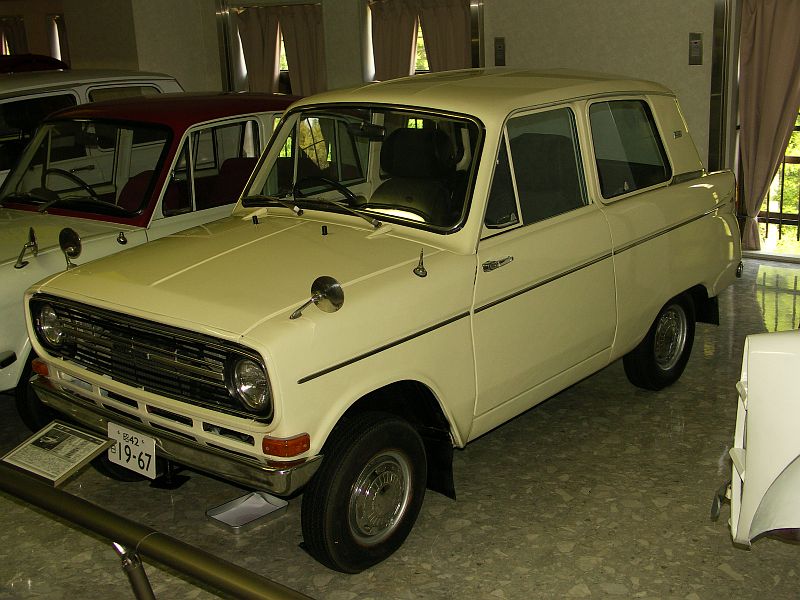
The Mitsubishi Minica LA23 was an early version of Mitsubishi’s compact kei-class passenger car, developed during the 1960s as part of the company’s expanding involvement in the Japanese domestic automobile market. Belonging to the first generation of the Minica family, the LA23 retained the distinctive compact saloon body, front-mounted two-stroke engine and rear-wheel-drive arrangement that characterised Mitsubishi’s earliest kei passenger cars. Designed to provide economical and practical transport within Japan’s strict small-car regulations, the Minica combined modest mechanical specifications with a surprisingly useful passenger compartment. The LA23 represented a development of the original Minica introduced in 1962, incorporating improvements made during the model’s early production life. Although overshadowed by Mitsubishi’s later passenger cars, the Minica LA23 remains an interesting example of Japanese small-car engineering during a period of rapid economic growth and increasing private car ownership.
The origins of the Mitsubishi Minica LA23 can be traced to the development of Japan’s automotive industry during the years following the Second World War. Mitsubishi had previously manufactured the Model A passenger car between 1917 and 1921, but its early automotive activities were primarily concentrated on commercial vehicles, buses and industrial machinery.
Following the war, Mitsubishi resumed civilian vehicle production with products such as the Silver Pigeon motor scooter, introduced in 1946. These relatively simple and economical vehicles provided affordable transport during a period when Japan was rebuilding its economy and industrial infrastructure.
As economic conditions improved during the 1950s, demand for small passenger cars increased. The Japanese government encouraged the development of compact vehicles through the kei-car classification, which provided tax and registration advantages for cars meeting specified dimensional and engine-capacity limits.
By the mid-1950s, the permitted engine capacity for conventional kei cars had increased to 360 cc, establishing the framework within which many early Japanese small cars were designed.
Mitsubishi recognised the potential of this expanding market and began developing vehicles intended to provide affordable personal transport for Japanese families.
The Mitsubishi 500, introduced in 1960, represented the company’s return to passenger-car manufacturing. Although larger than a kei car, it demonstrated Mitsubishi’s growing commitment to the domestic small-car market.
The Mitsubishi 360 light commercial vehicle followed in 1961, providing a compact and economical transport solution for small businesses and delivery operators.
The Minica was developed from the Mitsubishi 360’s mechanical architecture and introduced in October 1962 as Mitsubishi’s first dedicated kei-class passenger car.
The original Minica, designated LA20, employed a compact two-door saloon body with a conventional three-box appearance. Its styling was relatively upright and practical, distinguishing it from some contemporary kei cars that adopted more rounded or unconventional designs.
The Minica LA23 belonged to the subsequent development of this first-generation model, retaining the basic body and mechanical layout while incorporating changes introduced as Mitsubishi refined the range.
The precise production dates and individual specification changes associated with the LA23 designation are not consistently documented in readily available historical references. However, the model formed part of the early Minica family produced during the 1960s, before the introduction of the substantially redesigned second-generation Minica in 1969.
The Minica LA23 retained the steel monocoque construction of the original model, providing a relatively lightweight and economical body structure.
Its compact dimensions were determined by Japan’s kei-car regulations, which restricted both engine capacity and exterior size.
The car measured approximately 2,995 mm in length, with a width of around 1,295 mm and a height of approximately 1,350 mm, although exact measurements could vary slightly according to specification.
These dimensions allowed the Minica to comply with the kei-car regulations while providing accommodation for four occupants.
The body featured a short bonnet, upright passenger compartment and compact rear luggage area, giving it a conventional saloon appearance despite its small size.
Circular headlamps were mounted within the front wings, while a simple grille and modest chrome detailing provided a restrained but distinctive appearance.
The relatively large glass area contributed to good outward visibility, an important advantage when manoeuvring through Japan’s narrow streets and crowded urban environments.
The two-door body configuration helped reduce manufacturing costs and structural complexity while providing access to the front and rear seating areas.
The Minica LA23 retained the traditional front-engine, rear-wheel-drive layout employed by the original Minica and Mitsubishi 360.
This arrangement was relatively straightforward to manufacture and reflected Mitsubishi’s existing experience with small commercial vehicles.
The engine was mounted longitudinally at the front of the car, with power transmitted to the rear wheels through a manual gearbox and propeller shaft.
Although this arrangement required a transmission tunnel and rear differential, it provided a familiar and mechanically simple drivetrain suitable for economical small-car production.
The Minica LA23 was associated with Mitsubishi’s 359 cc air-cooled two-stroke twin-cylinder engine, which had been developed for the company’s early kei vehicles.
The engine employed two cylinders and a relatively simple mechanical layout, with the two-stroke operating cycle providing a power stroke during every crankshaft revolution.
This arrangement allowed a small-capacity engine to produce useful power while remaining compact and lightweight.
Engine output varied among early Minica versions as Mitsubishi introduced improvements to induction, compression and other components.
The original Minica developed approximately 17 bhp, while later versions of the first-generation range offered increased power.
The precise output associated with the LA23 designation should be confirmed against contemporary Mitsubishi technical documentation, as figures quoted for early Minica variants are sometimes combined or attributed inconsistently.
The two-stroke engine provided a distinctive driving character, with relatively lively response at higher engine speeds and the characteristic exhaust note associated with small two-stroke powerplants.
However, it also required careful attention to lubrication and fuel supply, while exhaust emissions were less clean than those of later four-stroke engines.
Fuel was supplied through a carburettor, reflecting the simple induction systems commonly used in Japanese small cars during the 1960s.
The engine’s modest capacity and the car’s lightweight construction contributed to economical fuel consumption, an important consideration for Japanese motorists during the period.
The Minica LA23 employed a manual transmission, allowing the driver to select suitable ratios for different road conditions.
The gearbox was designed primarily for economical operation and reliability rather than sporting performance.
Power was transmitted to the rear wheels, providing a conventional driving arrangement that was familiar to motorists accustomed to larger passenger cars.
The car’s low weight helped compensate for its modest engine output, allowing adequate acceleration for urban driving.
The Minica was intended primarily for local transport and moderate-speed journeys rather than sustained high-speed touring.
Its maximum speed was modest by modern standards, but sufficient for the road conditions and traffic patterns common in Japan during the 1960s.
The suspension was designed to provide a balance between simplicity, durability and acceptable ride comfort.
The front suspension employed an independent arrangement suitable for the car’s compact dimensions, while the rear suspension was designed to accommodate the driven axle and provide stable handling.
The lightweight body and narrow track required careful suspension tuning to maintain predictable road behaviour.
The steering system was mechanically simple and did not employ power assistance.
The Minica’s compact dimensions made it exceptionally manoeuvrable, allowing it to negotiate narrow streets and confined parking areas with relative ease.
The braking system employed conventional drum brakes, reflecting the technology commonly used in small Japanese passenger cars during the early 1960s.
These brakes were adequate for the vehicle’s modest performance but required regular adjustment and maintenance to ensure consistent operation.
The small wheels and relatively narrow tyres helped keep the car compact and economical, although they also limited grip and ride comfort compared with larger vehicles.
Inside, the Mitsubishi Minica LA23 featured a simple and functional cabin designed to provide affordable transport for four occupants.
The dashboard incorporated basic instrumentation, including a speedometer and essential warning indicators.
The seating was relatively upright, reflecting the need to maximise interior space within the restricted exterior dimensions.
The front seats provided access to the rear passenger compartment, while the rear bench accommodated two additional occupants.
Interior trim was modest, with durable materials selected for economy and ease of maintenance.
The car offered little of the comfort or refinement associated with larger passenger cars, but its simplicity was appropriate for its intended market.
The large windows and relatively upright body contributed to good outward visibility, while the compact bonnet made the car easy to position in traffic.
The luggage compartment was small but adequate for everyday shopping and personal belongings.
The Minica LA23 was particularly suited to the Japanese domestic market during the 1960s, when rapid economic growth was making private car ownership increasingly accessible.
The kei-car category played an important role in this transformation by providing tax and registration advantages for compact vehicles.
For many Japanese families, a kei car represented an affordable first step into private motoring.
The Minica offered a practical alternative to motorcycles and scooters, providing enclosed accommodation and improved weather protection.
Its compact dimensions were especially valuable in Japanese towns and cities, where narrow streets and limited parking space made larger cars less convenient.
The Minica competed against established kei cars such as the Subaru 360, Mazda Carol and Suzuki Fronte.
The Subaru 360, introduced in 1958, became one of Japan’s most recognisable early kei cars because of its lightweight construction and distinctive rounded styling.
The Mazda Carol offered a more conventional small-car appearance and, in some versions, a sophisticated four-cylinder engine.
The Suzuki Fronte also developed rapidly during the 1960s, reflecting the increasing competitiveness of Japan’s small-car market.
Against these rivals, the Mitsubishi Minica offered a straightforward combination of economical operation, practical accommodation and conventional mechanical design.
The LA23 formed part of Mitsubishi’s continuing efforts to refine the Minica and improve its competitiveness.
During the 1960s, Japanese manufacturers increasingly focused on improving engine performance, reliability and passenger comfort.
Small cars became more sophisticated as consumer expectations increased and road conditions improved.
Mitsubishi responded by introducing mechanical and styling revisions across the Minica range.
The first-generation Minica’s basic engineering remained consistent, but improvements to the engine, transmission and interior equipment helped maintain its appeal.
The Minica also benefited from Mitsubishi’s growing experience in compact vehicle manufacturing.
Production of the Mitsubishi 360 commercial vehicle and the Minica passenger car provided valuable experience in small engine design, lightweight body construction and economical manufacturing.
These capabilities became increasingly important as Mitsubishi expanded its passenger-car range during the 1960s.
The introduction of the Mitsubishi Colt 600 in 1962 and subsequent Colt models demonstrated the company’s growing ambitions beyond the kei-car market.
The Minica nevertheless remained an important part of Mitsubishi’s domestic range because of the continuing demand for economical small cars.
By the late 1960s, the original Minica’s styling and engineering were becoming increasingly dated.
Japanese competitors were introducing more modern body designs and improved engines, while consumers expected greater refinement and performance.
Mitsubishi therefore developed a substantially revised Minica for introduction in 1969.
The second-generation Minica, known as the Minica 70, adopted more rounded styling and updated mechanical components while retaining the basic rear-wheel-drive arrangement.
The introduction of the Minica 70 marked the end of the first-generation Minica family, including the LA23.
Although the LA23 was not a revolutionary model in its own right, it formed part of the development process that helped establish the Minica as a successful and long-running Mitsubishi nameplate.
The Minica would subsequently evolve through numerous generations, adopting four-stroke engines, front-wheel drive and more modern hatchback body designs.
Later versions would also include sporting derivatives such as the turbocharged Minica Dangan, demonstrating the considerable technological progress achieved within the kei-car category.
The original Minica’s importance therefore extends beyond its modest mechanical specification.
It helped establish Mitsubishi’s reputation for producing practical and economical small cars, contributing to the company’s growth during a period when Japan’s automotive industry was expanding rapidly.
Today, the Mitsubishi Minica LA23 is an uncommon and historically interesting vehicle.
Its rarity reflects both its age and its original purpose as an inexpensive everyday car. Many examples were used intensively and eventually scrapped after reaching the end of their useful service lives.
Unlike sporting or luxury cars, early kei cars were rarely preserved when new, and relatively few were considered valuable enough to restore during the decades following their withdrawal from service.
Consequently, surviving examples of first-generation Minicas have become increasingly significant to collectors and museums interested in the development of Japan’s motor industry.
The LA23 is particularly relevant to enthusiasts studying Mitsubishi’s early passenger-car production and the development of the kei-car category during the 1960s.
Restoring a surviving example can present considerable challenges. Original mechanical components, body panels and trim items may be difficult to locate, particularly outside Japan.
The 359 cc two-stroke engine requires specialist knowledge, especially concerning lubrication, ignition and fuel-system maintenance.
The condition of the body structure is particularly important because corrosion can affect the floor panels, sills, wheel arches and other structural components.
The suspension and braking systems should also be examined closely because worn components can significantly affect the handling and safety of such a lightweight vehicle.
Originality is particularly important for collectors because the LA23 represents an early stage in Mitsubishi’s passenger-car development.
Correct engine identification, body details, badges and mechanical components can help establish whether a surviving vehicle retains its original specification.
Despite the challenges associated with restoration, the Mitsubishi Minica LA23 offers considerable historical interest.
Its compact dimensions, simple engineering and distinctive appearance provide an insight into the practical transport requirements of Japan during the 1960s.
The vehicle also demonstrates the importance of the kei-car regulations in shaping Japanese automotive design.
By encouraging the development of small, economical vehicles, these regulations helped create a market in which manufacturers could experiment with compact engines, lightweight construction and efficient packaging.
The Mitsubishi Minica LA23 was one of the products that emerged from this environment, contributing to Mitsubishi’s growing experience in small-car engineering.
The Mitsubishi Minica LA23 represents an important chapter in the early history of Mitsubishi’s kei-car range. Developed during the 1960s as part of the first-generation Minica family, it combined a compact two-door saloon body, a 359 cc two-stroke twin-cylinder engine and rear-wheel drive within dimensions suited to Japan’s narrow streets and expanding urban economy. Although its performance and equipment were modest, the car provided affordable and economical transport for Japanese motorists and helped establish Mitsubishi’s position in the growing small-car market. Its eventual replacement by the Minica 70 in 1969 reflected the rapid progress of Japanese automotive engineering, but the LA23 remains historically significant as part of the model line that would continue for almost five decades. Today, it is remembered as a rare example of Mitsubishi’s early passenger-car development and an illustration of the practical, lightweight vehicles that helped make private motoring increasingly accessible in post-war Japan.