
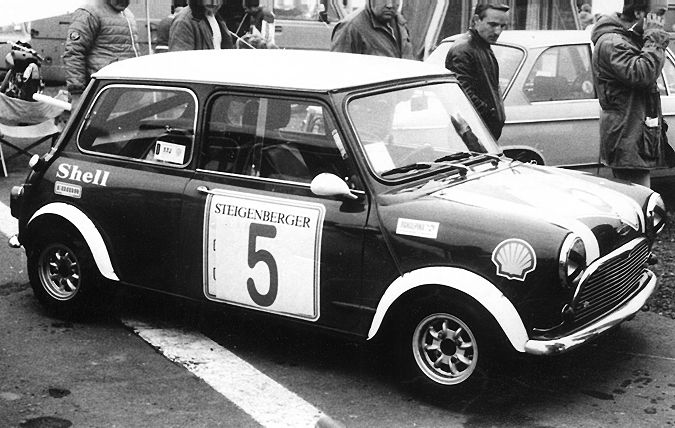
The Mini Austin Cooper S 1275 was one of the most celebrated British performance cars of the 1960s, combining the revolutionary packaging of the original Mini with a powerful 1,275 cc engine, improved braking and exceptional handling. Introduced in March 1964, the 1275 Cooper S represented the ultimate development of the original BMC Mini Cooper concept and became internationally famous through its success in rallying, particularly the Monte Carlo Rally. Developed through the collaboration between the British Motor Corporation and racing car constructor John Cooper, the model demonstrated that a small, lightweight front-wheel-drive saloon could compete successfully against much larger and more powerful machinery. Produced in various forms until 1971, the Cooper S 1275 became one of the most desirable versions of the classic Mini and established a sporting reputation that continues to influence the marque.
The origins of the Austin Cooper S 1275 can be traced to the introduction of the original Mini in August 1959. Designed by Alec Issigonis, the Mini was created in response to the growing demand for economical, compact transport following the Suez Crisis of 1956. Its innovative transverse engine and front-wheel-drive arrangement allowed approximately 80 per cent of the vehicle’s overall length to be devoted to passengers and luggage, creating exceptional interior space within a body measuring little more than ten feet long.
The original Mini was marketed as the Austin Seven and Morris Mini-Minor, reflecting the two principal marques within the British Motor Corporation. Both versions were mechanically similar, employing an 848 cc A-series four-cylinder engine, four-speed manual gearbox and independent suspension.
Although the Mini had been conceived primarily as an economical family car, its low weight, compact dimensions and unusually wide track gave it remarkable handling characteristics. The wheels were positioned close to the four corners of the body, reducing overhangs and providing exceptional agility.
John Cooper, whose racing cars had achieved considerable success in Formula One, quickly recognised the Mini’s potential as a competition vehicle. Cooper had developed a close working relationship with Alec Issigonis and believed that the Mini’s front-wheel-drive layout and responsive chassis could provide the foundation for an outstanding small sports saloon.
The first Austin and Morris Mini Cooper models appeared in 1961, featuring a larger 997 cc engine, twin carburettors, improved brakes and revised transmission ratios. These modifications transformed the Mini into a lively performance car while retaining its practical four-seat body.
The Cooper proved successful in competition, but John Cooper and BMC engineers recognised that further development would be necessary to compete against increasingly powerful rivals. This led to the introduction of the Mini Cooper S in 1963.
The original Cooper S employed a 1,071 cc engine developed specifically for competition homologation. Its strengthened construction, improved cylinder head and increased power output made it significantly faster than the standard Cooper.
A short-stroke 970 cc Cooper S was also introduced in 1964, primarily to satisfy particular competition class requirements. However, the 1,275 cc version became the most successful and enduring of the Cooper S models.
The Austin Mini Cooper S 1275 was introduced in March 1964, replacing the earlier 1071 model as the principal high-performance version. Its larger engine provided improved torque and acceleration while retaining the responsive character that had made the smaller Cooper S so successful.
The 1,275 cc engine was a specially developed version of BMC’s A-series four-cylinder power unit. It employed a cast-iron cylinder block and cylinder head, with overhead valves operated by pushrods and a camshaft mounted within the block.
The engine featured a bore of 70.61 mm and a stroke of 81.28 mm, giving a displacement of 1,275 cc. These dimensions represented a substantial increase in capacity compared with the original 848 cc Mini engine.
The Cooper S engine incorporated numerous modifications intended to improve durability and performance. These included a stronger crankshaft, revised connecting rods, improved pistons and a specially developed cylinder head with larger valves.
The cylinder head was designed to provide improved airflow, allowing the engine to operate efficiently at higher speeds. The compression ratio was approximately 9.75:1, reflecting the engine’s sporting character and the high-octane petrol requirements of the period.
Fuel was supplied through twin SU HS2 carburettors, providing a responsive mixture delivery system suitable for both road use and competition. The carburettors were mounted on a specially developed inlet manifold, while the exhaust system was designed to improve gas flow.
In standard production specification, the 1,275 cc Cooper S engine developed approximately 76 bhp at 5,800 rpm, with maximum torque of around 79 lb ft (107 Nm) at 3,000 rpm.
Although these figures appear modest by modern standards, they represented substantial performance in a car weighing approximately 650 to 700 kg, depending on specification and equipment.
The Cooper S 1275 was capable of reaching approximately 95 to 100 mph (153 to 161 km/h), while acceleration from 0 to 60 mph generally required around 10 to 11 seconds. These figures made it one of the quickest small production saloons available during the mid-1960s.
The engine’s relatively strong torque delivery was particularly important. Compared with the earlier 1071 Cooper S, the 1275 provided improved flexibility at lower engine speeds, making it more suitable for everyday driving while retaining excellent competition potential.
The transverse engine was mounted at the front of the car, with the gearbox positioned beneath the engine in the sump. This compact arrangement allowed the engine and transmission to occupy very little space, preserving the Mini’s exceptional interior packaging.
Power was transmitted to the front wheels through a four-speed manual gearbox. The transmission employed synchromesh on the upper three forward gears in early versions, with first gear remaining unsynchronised.
The gearbox was designed to withstand the increased torque of the Cooper S engine, although competition use could place considerable demands on its components. Close-ratio gearsets and alternative final-drive ratios were available for specialist applications.
The front-wheel-drive arrangement was one of the Cooper S 1275’s greatest advantages. By placing the engine and driven wheels at the front, the Mini achieved excellent traction and predictable handling, particularly on narrow and winding roads.
The Cooper S retained the original Mini’s compact steel monocoque body, which had been designed to maximise interior space while minimising overall dimensions. The car measured approximately 3,054 mm in length, 1,410 mm in width and 1,346 mm in height, with a wheelbase of 2,036 mm.
These dimensions made the Mini considerably smaller than most contemporary family cars. Nevertheless, its efficient packaging provided accommodation for four occupants and a modest luggage compartment.
The exterior styling of the Austin Cooper S 1275 remained closely related to that of the standard Mini. The simple two-box body featured a short bonnet, upright windscreen, compact passenger compartment and nearly vertical rear panel.
The Cooper S was distinguished by its sporting badging, distinctive grille treatment and contrasting roof colours on many examples. The Austin version carried the familiar Austin badge and Cooper S identification, while the Morris version featured its own grille and marque details.
The front incorporated circular headlamps mounted within the wings, together with a relatively narrow radiator grille. Chrome bumpers and brightwork provided a traditional British appearance despite the car’s innovative mechanical layout.
The compact wheel arches housed small 10-inch wheels, which contributed to the Mini’s low stance and responsive handling. The Cooper S employed wider wheels and tyres than the standard Mini, improving grip and stability.
The body was available in a variety of colours, with contrasting roof finishes becoming particularly associated with the Cooper models. Popular combinations included red with a white roof and green with a white roof, although other colours were offered.
The Cooper S retained the external door hinges and sliding side windows characteristic of the original Mini design. These features were primarily intended to reduce manufacturing costs and maximise interior space, but they subsequently became defining elements of the early Mini’s appearance.
Inside, the Austin Cooper S 1275 retained the functional simplicity of the standard Mini while incorporating additional sporting equipment.
The dashboard featured a centrally mounted instrument arrangement on early versions, with a large speedometer and supplementary gauges providing essential information. Cooper S models included additional instrumentation for monitoring engine operation, reflecting their higher-performance specification.
The seats were relatively simple but provided adequate support for the period. The driving position was upright, with a large steering wheel and closely spaced pedals contributing to the Mini’s distinctive character.
The long, relatively upright gear lever emerged from the central floor area, allowing the driver to operate the four-speed transmission. The compact passenger compartment created an intimate driving environment, particularly when compared with larger saloons.
Despite its small dimensions, the Cooper S remained a practical four-seat car. The rear bench could accommodate two passengers, while the boot provided space for everyday luggage.
Additional storage was available through door bins and interior compartments, reflecting Alec Issigonis’s emphasis on practical packaging.
One of the most important features of the Cooper S 1275 was its suspension system. The original Mini employed independent suspension at all four wheels, with compact rubber cone springs developed in conjunction with Alex Moulton.
The rubber cone suspension provided progressive springing characteristics while occupying considerably less space than conventional coil springs. This arrangement allowed the wheels to be positioned close to the corners of the body, contributing to the Mini’s exceptional stability and handling.
During the 1960s, many Mini models adopted the Hydrolastic suspension system, which used interconnected fluid-filled displacer units to improve ride comfort and reduce pitching.
The Cooper S 1275 was produced with different suspension arrangements during its manufacturing life, depending on model year and market. Hydrolastic suspension was fitted to many examples during the mid-1960s, while rubber cone suspension returned on later versions.
The Mini’s relatively wide track, short wheelbase and low centre of gravity contributed to outstanding cornering ability. The car could change direction rapidly, allowing skilled drivers to maintain high average speeds on winding roads.
The steering employed a direct rack-and-pinion system, providing precise feedback and rapid responses. The compact dimensions and front-wheel-drive layout made the Cooper S particularly effective on narrow roads and technical rally stages.
The braking system was substantially improved compared with that of the standard Mini. The Cooper S employed front disc brakes, with larger 7.5-inch discs developed to fit within the 10-inch wheels.
These brakes provided improved stopping performance and greater resistance to fade during demanding driving. Rear drum brakes were retained, offering adequate braking capacity for the relatively lightweight car.
The combination of strong braking, responsive steering and excellent traction made the Cooper S 1275 particularly effective in competition. Its relatively modest engine power was compensated for by its ability to maintain speed through corners and accelerate efficiently on loose surfaces.
The Cooper S became internationally famous through its achievements in rallying. The Mini had already demonstrated considerable potential in competition, but the arrival of the Cooper S transformed it into a genuine international contender.
The Monte Carlo Rally became particularly closely associated with the Mini Cooper S. The event’s demanding mountain roads, snow-covered passes and unpredictable weather conditions favoured compact cars with good traction and responsive handling.
In 1964, Paddy Hopkirk and co-driver Henry Liddon won the Monte Carlo Rally in a Mini Cooper S, achieving one of the most celebrated victories in British motorsport history. Their success demonstrated that the small British car could defeat much larger and more powerful rivals.
That victory was achieved in a 1071 Cooper S, before the 1275 version became the principal competition model. Nevertheless, it established the reputation that the larger-engined Cooper S would subsequently develop.
The 1275 Cooper S continued the Mini’s remarkable rallying success. In 1965, Timo Mäkinen and co-driver Paul Easter won the Monte Carlo Rally, providing BMC with another prestigious international victory.
The following year, the Mini Cooper S appeared to have achieved another remarkable result when three works-entered cars finished in the leading positions on the 1966 Monte Carlo Rally.
However, the cars were controversially disqualified because of technical infringements relating to their lighting equipment. The decision generated considerable publicity and remains one of the most widely discussed incidents in rallying history.
The Mini returned to Monte Carlo in 1967, when Rauno Aaltonen and co-driver Henry Liddon secured another outright victory. This result confirmed the Cooper S as one of the most successful rally cars of the decade.
The Mini Cooper S also achieved considerable success in circuit racing. Its exceptional cornering ability and relatively low weight made it competitive against larger saloons, particularly on circuits with numerous tight corners.
The British Saloon Car Championship provided an important arena for the Mini’s competition achievements. Drivers such as John Rhodes, John Fitzpatrick and others demonstrated the Cooper S’s effectiveness in closely contested touring car races.
The car’s success was not limited to factory-supported competition. Private entrants throughout Britain and Europe adopted the Cooper S for rallying, hill climbs, sprint events and circuit racing.
The availability of specialist tuning components and competition knowledge made the Cooper S particularly attractive to amateur competitors. Engine modifications, close-ratio gearboxes, improved suspension components and lightweight body panels allowed considerable performance improvements.
The 1,275 cc engine proved especially suitable for tuning. With modified cylinder heads, camshafts, carburettors and exhaust systems, competition engines could produce substantially more power than standard road-going versions.
The Cooper S’s success in motorsport contributed significantly to its popularity as a road car. Buyers were attracted by the association with international rally victories and the opportunity to own a compact saloon with genuine sporting credentials.
The Austin Cooper S 1275 underwent several changes during its production life. Early examples belonged to the original Mk I Mini generation, retaining external door hinges, sliding windows and the characteristic early body styling.
In 1967, the Mini range received a significant update with the introduction of the Mk II. The revised models featured a larger rear window, modified grille and various detail improvements.
The Cooper S continued in Mk II form, retaining the 1,275 cc engine and its sporting mechanical specification. The revised bodywork improved visibility and modernised the car’s appearance without fundamentally changing its character.
In 1969, the Mini Mk III was introduced, bringing more substantial body changes. These included concealed door hinges and wind-up side windows, replacing the external hinges and sliding windows of earlier models.
The Mk III Cooper S retained the 1,275 cc engine, but the separate Austin and Morris identities were progressively abandoned as British Leyland consolidated the Mini range under the Mini name.
Production of the original Cooper S continued until 1971, when the model was discontinued as part of a broader rationalisation of the British Leyland range.
The replacement Mini 1275 GT offered sporting styling and reasonable performance at a lower price, but it lacked the full competition-oriented specification and prestigious Cooper S identity.
The discontinuation of the Cooper S marked the end of an important era in British performance car production. Although the Mini remained in manufacture for many years, the original Cooper S became increasingly desirable among enthusiasts.
The 1275 Cooper S was particularly significant because it combined the strongest production engine of the early Cooper S family with the compact dimensions and lightweight construction of the original Mini.
Its success in international rallying established the Mini as a genuine motorsport icon, while its performance and handling influenced the development of small sporting cars throughout the industry.
Today, the Austin Cooper S 1275 is regarded as one of the most collectible versions of the classic Mini. Early Mk I examples are particularly sought after, especially those retaining original mechanical components, correct identification details and documented histories.
The model’s desirability has also led to the creation of numerous replicas and modified cars. Standard Minis have frequently been converted to Cooper S appearance or specification, making careful identification essential when assessing authenticity.
Original Cooper S engines, gearboxes, braking components and body details are important factors in determining a car’s originality and value. Chassis numbers, engine numbers and factory production records can help establish whether a vehicle is a genuine Cooper S.
Restoration requires careful attention to corrosion, particularly around the sills, floor panels, front wings, door bottoms, wheel arches and subframe mounting points. The Mini’s compact monocoque structure can suffer extensive rust damage if moisture becomes trapped within its seams and cavities.
The front and rear subframes should also be inspected for corrosion and structural deterioration. These components carry important suspension and drivetrain loads, making their condition essential for safe operation.
The A-series engine is generally robust and benefits from extensive specialist knowledge and good parts availability. However, original Cooper S components can be expensive, particularly where correct period specifications are required.
The gearbox requires careful maintenance because it shares its lubrication system with the engine. Regular oil changes and correct lubricant selection are important for preserving the transmission and differential.
The cooling system should also be maintained carefully, particularly on tuned engines or cars used in demanding conditions. The compact engine compartment and side-mounted radiator arrangement require efficient airflow and a properly functioning cooling system.
Suspension components, steering joints and braking equipment should be inspected regularly, particularly on vehicles that have been used in competition or modified for higher performance.
The interior presents additional restoration considerations because original seats, instruments, switches and trim components contribute significantly to the authenticity of early Cooper S models.
Despite these considerations, the Austin Cooper S 1275 remains a rewarding classic car to own and drive. Its compact dimensions, responsive engine and exceptional handling provide a driving experience that is fundamentally different from that of larger sports cars.
The Mini Austin Cooper S 1275 represents one of the finest achievements of British small-car engineering during the 1960s. By combining Alec Issigonis’s revolutionary Mini design with John Cooper’s competition expertise and a powerful 1,275 cc A-series engine, BMC created a compact saloon capable of challenging much larger and more expensive cars. Its victories in international rallying, particularly the Monte Carlo Rally, established a reputation that extended far beyond its modest dimensions. The Cooper S 1275 remains one of the most important and desirable classic Minis, celebrated for its exceptional handling, remarkable motorsport achievements and enduring influence on the development of performance-oriented small cars.