
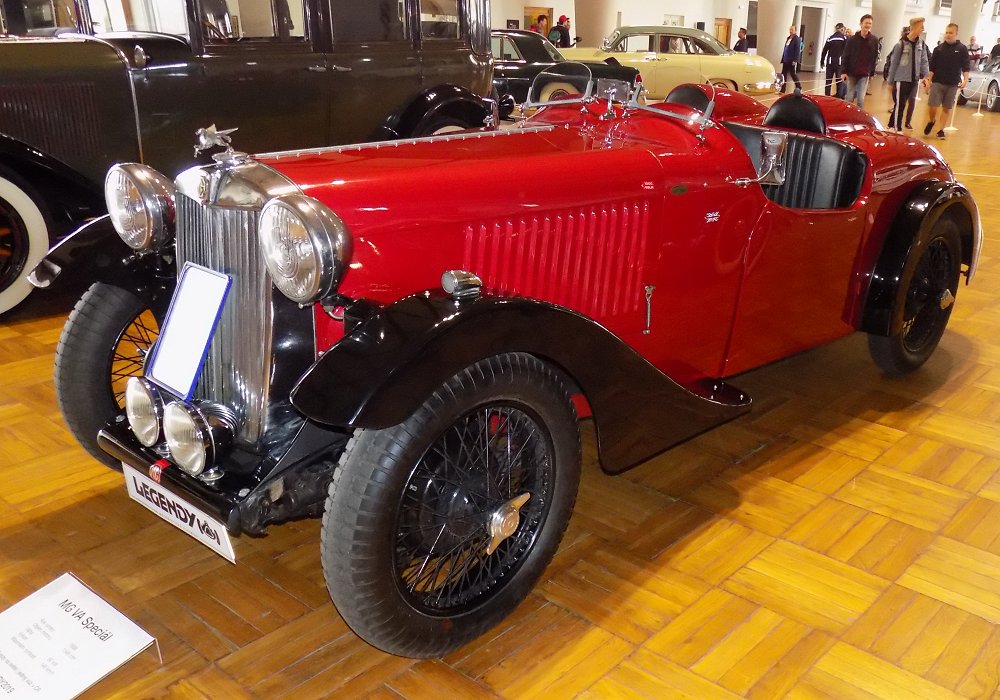
The MG VA Real Demon Special is a rare and distinctive example of British specialist sports car construction, based on the mechanical foundations of the pre-war MG VA. Combining the engineering of MG’s 1½-litre range with individually developed sporting bodywork, the Real Demon Special reflects the tradition of modifying established production cars to create more exclusive and performance-oriented machines. Unlike the standard MG VA, which was manufactured as a saloon, tourer and drophead coupé, the Real Demon Special was not a regular factory production model but an individually constructed vehicle with its own identity.
The MG VA was introduced in 1937 as part of MG’s expanding range of larger sporting cars. Positioned below the six-cylinder SA, it was intended to provide a combination of respectable performance, comfortable accommodation and the sporting character associated with the MG marque. The VA was developed during a period when MG was increasingly using components shared with other manufacturers within the Nuffield Organisation, allowing the company to produce more refined vehicles at competitive prices.
The standard VA was powered by a 1,548 cc inline four-cylinder engine featuring overhead valves operated by pushrods. Derived from established Morris and Wolseley engineering, the engine was adapted for MG applications and developed approximately 55 horsepower. It provided flexible performance and reasonable economy, making the VA suitable for both everyday motoring and longer-distance touring. Although not designed as a dedicated racing engine, its conventional construction offered opportunities for mechanical development.
The engine fitted to the Real Demon Special cannot be assumed to have retained the standard VA specification throughout its life. Individually constructed specials were frequently modified to improve performance, and changes could include revised carburation, altered compression ratios, modified camshafts or replacement power units. Without verified technical records for the individual car, a definitive engine capacity or horsepower output cannot be reliably established.
The standard VA transmitted power to the rear wheels through a four-speed manual gearbox. Its chassis was more sophisticated than those of MG’s smaller T-type sports cars, incorporating independent front suspension using torsion bars and a live rear axle supported by semi-elliptic leaf springs. Hydraulic drum brakes provided stopping power, while the relatively substantial frame was designed to support the larger and heavier bodies of the production VA range.
This chassis provided an interesting foundation for a sporting special. Although originally intended for a comfortable touring car, the independent front suspension offered advantages in wheel control and ride quality. Replacing the standard body with a lighter structure could reduce overall weight and improve the vehicle’s acceleration, braking and handling. Further modifications to the suspension and steering could also be undertaken to suit the intended use of the completed car.
The Real Demon Special belongs to a category of vehicles in which the appearance and construction were determined by the requirements and preferences of the individual builder. British sporting specials often featured long bonnets, low windscreens, compact passenger compartments and lightweight body panels. Aluminium was a popular material because it allowed relatively complex shapes to be produced without the weight associated with traditional steel and timber coachwork. However, the exact body construction and styling details of the Real Demon Special should be established from photographs and documentation of the vehicle rather than inferred from other MG specials.
The designation Real Demon gives the car a particularly individual identity. Names of this kind were sometimes adopted by private builders and competition enthusiasts to distinguish their vehicles from standard production models. Such cars could evolve considerably over time, with modifications introduced to improve performance, address mechanical problems or adapt the vehicle for different forms of competition.
The cockpit of a VA-based special could differ substantially from that of the original production car. The standard VA featured relatively comfortable seating, traditional instrumentation and interior trim appropriate to a sporting touring car. A competition-oriented conversion might instead employ lightweight seats, simplified panels, additional instruments and reduced weather equipment. These changes would reflect an emphasis on driving involvement and mechanical accessibility rather than passenger comfort.
The performance of the Real Demon Special would depend upon its particular engine, transmission, body weight and chassis configuration. A lighter body could provide a significant improvement in the power-to-weight ratio even without substantial engine modifications. If the engine had also been tuned, the resulting vehicle could offer considerably stronger acceleration than the standard VA. Nevertheless, precise performance figures cannot be attributed to the Real Demon Special without reliable evidence of its mechanical specification.
The construction of sporting specials was an established part of British motoring culture during the 1930s and became particularly widespread after the Second World War. Enthusiasts frequently acquired older production cars and adapted them for hill climbs, trials, sprints and club racing. MG vehicles were especially popular because of the marque’s sporting reputation and the availability of mechanical components and specialist expertise.
The VA itself was manufactured between 1937 and 1939, with approximately 2,407 examples produced before civilian car production was interrupted by the outbreak of war. Although less widely recognised than the smaller MG Midget models, the VA represented an important part of the company’s pre-war development, offering a more refined sporting car with advanced front suspension and attractive coachwork.
The Real Demon Special demonstrates how such a chassis could acquire a very different identity through independent construction and modification. Rather than being defined solely by its original factory specification, a special of this kind is characterised by its individual engineering decisions, body design and subsequent history. The identity of its builder, the date of its conversion and any documented competition appearances are therefore central to understanding its historical significance.
Today, the MG VA Real Demon Special is an unusual example of the creativity associated with British specialist motoring. Its appeal lies in its individuality and the relationship between established MG engineering and the work of independent builders. For collectors and historians, documented provenance is particularly important, especially when determining whether a vehicle retains its original special-bodied configuration or has undergone substantial later reconstruction.
Restoration can be more complex than that of a standard MG VA because specialist vehicles may incorporate unique body panels, altered chassis components and mechanical assemblies from several different sources. Preserving historically significant modifications is often preferable to returning such a vehicle to ordinary production specification, particularly when those changes form an essential part of its identity.
The MG VA Real Demon Special represents a fascinating aspect of MG’s pre-war heritage and Britain’s wider tradition of independently constructed sports cars. By adapting the mechanical foundations of the VA to create a distinctive sporting vehicle, its builder demonstrated the versatility of MG engineering and the enthusiasm that surrounded the marque. Although the Real Demon Special was not a standard factory model, its individuality and connection with specialist automotive craftsmanship make it an intriguing part of British motoring history.