
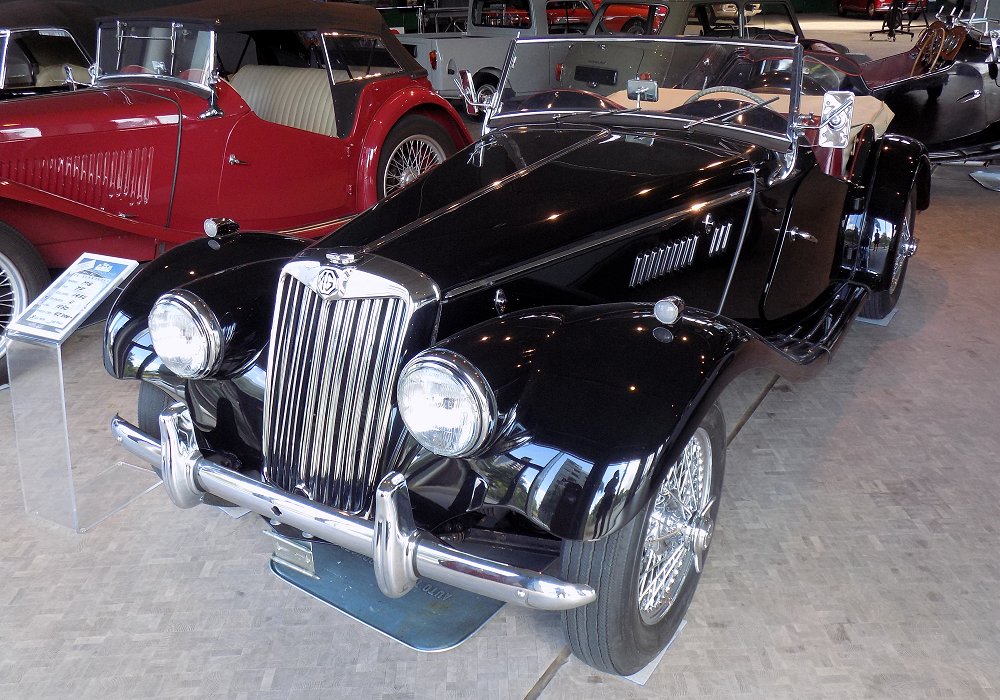
The MG TF Midget was introduced in September 1953 as the final development of MG’s traditional T-type sports car range, succeeding the highly successful MG TD. Produced at the MG factory in Abingdon, Oxfordshire, between 1953 and 1955, the TF combined the established mechanical engineering of its predecessor with revised styling, improved driver accommodation and a more purposeful sporting appearance. Although its underlying design remained rooted in the pre-war MG Midget tradition, the TF represented the most refined expression of the classic upright-bodied MG roadster before the introduction of the radically different MGA in 1955.
The development of the TF took place during a period of increasing competition within the British sports car industry. The MG TD had achieved considerable success, particularly in the United States, but its traditional styling was beginning to appear dated alongside newer sports cars such as the Austin-Healey 100 and Triumph TR2. MG had already explored more modern replacement designs, but delays in bringing a completely new sports car into production resulted in the development of an updated TD as an interim model.
Rather than introducing an entirely new chassis or mechanical layout, MG concentrated on revising the TD’s appearance and improving its practicality. The resulting TF retained the separate chassis, independent front suspension and familiar XPAG engine, but incorporated a lower bonnet line, a more steeply inclined radiator grille and headlamps integrated into the front wings. These changes gave the car a noticeably more modern appearance while preserving the traditional character of the T-type range.
The TF was initially powered by the established 1,250 cc XPAG inline four-cylinder engine, featuring overhead valves operated by pushrods and twin SU carburettors. In TF specification, the engine developed approximately 57.5 horsepower at 5,500 rpm, a modest improvement over the standard TD. The engine retained its cast-iron cylinder block and cylinder head, with a conventional overhead-valve arrangement and a reputation for durability and straightforward maintenance.
The XPAG engine had already proved successful in the MG TB, TC and TD models, and its continued use in the TF reflected the company’s preference for established and reliable engineering. Although its modest displacement limited outright performance, the engine offered responsive throttle characteristics and sufficient flexibility for enjoyable road use. Its relatively simple construction also made it popular among owners interested in maintenance and performance tuning.
Power was transmitted to the rear wheels through a four-speed manual gearbox incorporating synchromesh on the upper three ratios. First gear remained unsynchronised, requiring careful selection, particularly when the vehicle was moving. The gearbox provided a direct mechanical feel and allowed the driver to make effective use of the engine’s available power.
The original 1,250 cc MG TF was capable of reaching approximately 80 mph (129 km/h), depending on vehicle condition and road conditions. Acceleration from 0 to 60 mph generally required around 20 to 23 seconds. Although these figures were modest compared with some contemporary sports cars, the TF’s appeal lay primarily in its balanced handling, compact dimensions and engaging driving characteristics.
The chassis was closely related to that of the MG TD, retaining a substantial ladder-frame construction. Independent front suspension employed coil springs and wishbones, while the rear axle was supported by semi-elliptic leaf springs. Hydraulic shock absorbers controlled suspension movement, and hydraulically operated drum brakes provided stopping power at all four wheels.
Rack-and-pinion steering, introduced with the TD, was retained and contributed to the TF’s precise and responsive handling. The relatively wide track and compact dimensions provided predictable road behaviour, while the independent front suspension improved wheel control over uneven surfaces. Although the chassis was becoming outdated compared with newer sports car designs, it remained capable of delivering an enjoyable and confidence-inspiring driving experience.
Externally, the MG TF was distinguished from its predecessors by its revised front-end styling. The radiator grille was inclined backwards and positioned lower than on the TD, while the headlamps were incorporated into the front wings rather than mounted separately. The bonnet line was also lowered, creating a more streamlined appearance and giving the car a more purposeful stance.
The front wings were reshaped to accommodate the integrated headlamps, while the rear wings and overall body proportions remained closely related to those of the TD. The traditional running boards, cut-down doors and rear-mounted spare wheel were retained, preserving the distinctive appearance of MG’s classic T-type roadsters.
The TF also featured a revised bonnet arrangement, with side panels incorporating ventilation openings and a more integrated appearance. The radiator grille retained the traditional MG vertical slat design, while the lower profile and inclined position helped distinguish the TF from earlier models.
The open two-seat body was constructed using traditional MG methods, with steel panels supported by an ash timber framework and mounted on the separate chassis. A folding fabric hood and detachable side screens provided basic weather protection, while the windscreen could be folded forward for sporting use. The car retained the relatively narrow cockpit and upright driving position characteristic of the T-type range.
Inside, the TF incorporated several improvements over the TD. The dashboard was redesigned, with the principal instruments positioned directly in front of the driver rather than grouped centrally. This arrangement improved visibility and created a more modern driving environment. The seats were also revised to provide improved comfort and support, while the cockpit retained traditional leather upholstery and simple interior trim.
The large steering wheel, floor-mounted gear lever and closely grouped pedals maintained the direct mechanical character of the earlier T-type models. Although the TF offered little in the way of luxury or insulation from the outside environment, its cockpit provided an engaging driving experience and reflected the practical simplicity associated with MG sports cars.
The driving experience of the MG TF was characterised by responsive steering, predictable handling and the distinctive sound of the XPAG engine. The independent front suspension and rack-and-pinion steering provided relatively precise control, while the compact dimensions made the car enjoyable on winding country roads. The firm ride and traditional rear suspension required some driver involvement, particularly on uneven surfaces, but these characteristics formed part of the TF’s sporting appeal.
In 1954, MG introduced the TF 1500, a more powerful version equipped with a 1,466 cc XPEG engine. This enlarged unit developed approximately 63 horsepower and provided improved torque and acceleration. The TF 1500 offered noticeably stronger performance than the original 1,250 cc model and became the final development of the traditional T-type Midget range.
The TF was particularly popular in North America, where MG had established a substantial following through the success of the TC and TD. American buyers appreciated its traditional British styling, compact dimensions and engaging driving characteristics. However, the growing availability of more powerful and modern sports cars meant that the TF faced increasingly strong competition.
Despite its relatively modest performance, the TF continued to attract enthusiastic drivers interested in club motorsport. Its straightforward mechanical construction and established XPAG engine made it suitable for hill climbs, sprints and amateur competition. Owners frequently modified their cars with improved carburation, revised exhaust systems and other performance components to enhance acceleration and engine response.
Production of the MG TF continued until April 1955, when it was replaced by the MGA. A total of 9,602 TF models were manufactured, including approximately 3,400 examples of the original 1,250 cc version and 6,200 TF 1500 models. The relatively short production period reflected the transitional nature of the TF, which had been developed as an interim model while MG prepared its next generation of sports cars.
The introduction of the MGA in 1955 marked a major turning point in MG’s history. With its streamlined body, lower seating position and more modern engineering, the MGA represented a decisive departure from the traditional T-type design. The TF therefore became the final MG sports car to retain the classic upright radiator, separate chassis and pre-war-inspired body construction that had characterised the marque’s Midget models for more than two decades.
Today, the MG TF Midget is regarded as one of the most attractive and desirable members of the T-type family. Its distinctive styling, improved driver accommodation and relatively refined mechanical specification make it particularly appealing to collectors seeking a traditional British roadster with greater usability than the earlier TC and TD models. The TF 1500 is often favoured for its additional performance, while the original 1,250 cc version remains valued for its historical significance and close connection to the XPAG-powered T-type tradition.
Restoration requires careful attention to the separate chassis, ash-framed body structure, steel panels and mechanical components. Corrosion, deterioration of the timber framework and previous accident damage can affect the integrity of the body, while the condition of the engine, gearbox and suspension should be assessed carefully. Originality, documented history and the quality of restoration work are important considerations when evaluating surviving vehicles.
The MG TF Midget represents the culmination of MG’s traditional pre-war-inspired sports car development. By combining the proven mechanical engineering of the TD with more modern styling and improved accommodation, MG created a distinctive and enjoyable roadster that maintained the character of its predecessors while offering greater refinement. Although soon superseded by the more advanced MGA, the TF remains an important chapter in MG history and an enduring symbol of the classic British sports car tradition.