
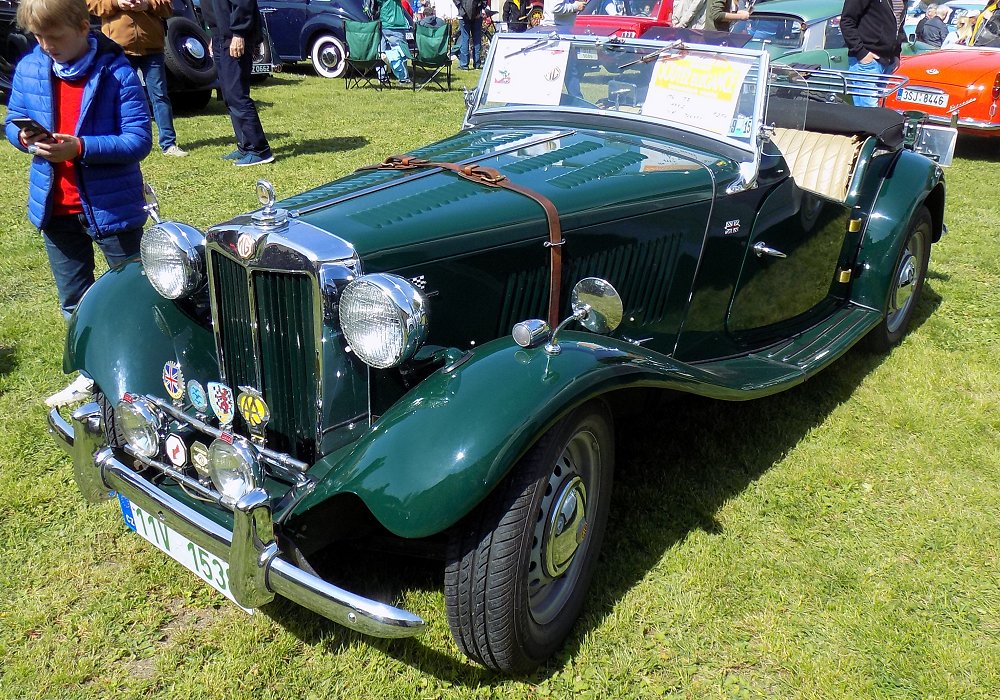
The MG TD Supercharged represents a high-performance interpretation of one of Britain’s most successful post-war sports cars. Based on the MG TD Midget, produced between 1950 and 1953, supercharged examples combined the traditional styling and improved chassis engineering of the standard roadster with the additional power provided by forced induction. Although MG did not manufacture a regular production supercharged TD, specialist tuning companies and private enthusiasts developed conversions that significantly enhanced the performance of the standard 1,250 cc XPAG engine. These modified cars became particularly attractive to drivers seeking improved acceleration, greater engine flexibility and increased competitiveness in sporting events.
The MG TD was introduced in January 1950 as the successor to the MG TC Midget. It represented an important development in MG’s traditional T-type sports car range, incorporating independent front suspension, rack-and-pinion steering and a wider, more comfortable body. These improvements made the TD considerably more refined and practical than its predecessor, although the additional weight meant that its outright performance remained relatively modest. For enthusiastic motorists, supercharging offered an effective means of overcoming this limitation while retaining the car’s distinctive character.
The standard MG TD was powered by a 1,250 cc XPAG inline four-cylinder engine, featuring overhead valves operated by pushrods and twin SU carburettors. Producing approximately 54.5 horsepower at 5,200 rpm, the engine was renowned for its durability, straightforward maintenance and considerable tuning potential. Its cast-iron cylinder block and cylinder head provided a robust foundation for performance modifications, while the relatively simple mechanical design made it accessible to specialist workshops and experienced private owners.
Supercharging was already firmly established within MG’s sporting heritage. During the 1930s, the company had produced several successful supercharged competition cars, including the C-type Midget, J4 Midget and K3 Magnette. These vehicles demonstrated the effectiveness of forced induction in small-capacity engines and helped establish MG’s reputation for extracting impressive performance from relatively modest mechanical packages. Although the TD was not designed as a dedicated competition car, its XPAG engine offered opportunities for similar development.
A supercharger increases engine output by mechanically compressing the intake air before it enters the cylinders. This allows a greater quantity of oxygen and fuel to be burned during each combustion cycle, producing increased torque and horsepower. Unlike a naturally aspirated engine, which relies primarily on atmospheric pressure to fill its cylinders, a supercharged engine can maintain a higher intake charge and deliver stronger performance across much of its operating range.
Several specialist companies developed supercharging equipment suitable for the XPAG engine. Shorrock and Marshall were among the names associated with British forced-induction equipment, while other suppliers and engineering workshops produced individual conversions. The precise design varied according to the equipment used, the intended performance level and whether the vehicle was prepared for road use or competition.
A typical installation incorporated a mechanically driven compressor, revised induction manifolds, suitable carburation and a belt-drive system connected to the crankshaft. Depending on the arrangement, the carburettor could be mounted upstream of the compressor or positioned in a different configuration to suit the installation. Additional pipework and mounting brackets were required, while the engine compartment sometimes needed minor modifications to accommodate the equipment.
The increased cylinder pressures generated by supercharging could place additional demands upon the engine’s internal components. Depending on the boost pressure and intended use, modifications might include lower-compression pistons, revised ignition timing, improved cooling arrangements and strengthened mechanical components. Careful adjustment of the fuel mixture was particularly important to prevent detonation and excessive operating temperatures.
The performance of an MG TD Supercharged varied considerably according to its individual specification. Whereas the standard TD produced approximately 54.5 horsepower, a carefully developed supercharged conversion could raise output into the region of 70 to 90 horsepower, with more highly modified competition engines potentially exceeding these figures. Such outputs were not standardised factory specifications, and the performance of any individual vehicle depended upon its supercharger, boost pressure, compression ratio and engine condition.
The additional power provided a noticeable improvement in acceleration and flexibility. The standard TD required relatively frequent gear changes to maintain brisk progress, particularly on steep gradients or when overtaking. A supercharged engine could deliver stronger torque at lower and intermediate engine speeds, making the car feel more responsive and allowing it to accelerate more confidently without constant use of the gearbox.
Power was transmitted to the rear wheels through the standard four-speed manual gearbox, incorporating synchromesh on the upper three ratios. First gear remained unsynchronised, requiring careful selection, particularly when the car was moving. The increased torque of a supercharged engine placed additional demands upon the clutch, gearbox and rear axle, especially when the vehicle was driven enthusiastically or used in competition.
The TD’s chassis represented a significant improvement over the earlier TC. Its separate ladder-frame construction provided a substantial foundation, while independent front suspension using coil springs and wishbones offered improved wheel control over uneven road surfaces. Rack-and-pinion steering gave more precise handling, and the wider track contributed to greater stability during cornering.
At the rear, the TD retained a conventional live axle supported by semi-elliptic leaf springs, with hydraulic shock absorbers controlling movement. Hydraulically operated drum brakes were fitted to all four wheels, providing adequate stopping power for the standard vehicle. However, the increased performance of a supercharged conversion could make improvements to the braking system and suspension particularly desirable.
Some owners preparing their cars for competition fitted uprated shock absorbers, revised spring settings or improved brake components. These modifications were intended to provide greater control and durability under demanding conditions. Nevertheless, many road-going supercharged TDs retained much of their original chassis equipment, preserving the traditional driving characteristics of the standard model.
Externally, the MG TD Supercharged generally remained very similar to the naturally aspirated TD. The upright radiator grille, separate chrome headlamps, long bonnet and sweeping front wings continued to define its appearance. Running boards, cut-down doors and a rear-mounted spare wheel reinforced the traditional British sports car styling that had become synonymous with MG’s T-type range.
The TD’s smaller 15-inch pressed-steel wheels, introduced in place of the 19-inch wire-spoked wheels used on the TC, contributed to improved handling and road holding. The wider tyres and revised suspension arrangement made the TD a more stable platform for increased engine performance, although its handling remained characteristic of a traditional early-1950s sports car.
Some supercharged examples featured visible modifications to the bonnet or engine compartment to accommodate the compressor and associated pipework. Additional ventilation, revised air filters or exposed induction components could distinguish a modified car from the standard model. Competition-oriented vehicles might also incorporate lightweight windscreens, simplified interior trim or additional instrumentation.
Inside, the TD Supercharged generally retained the familiar cockpit arrangement of the standard roadster. Leather-trimmed seats, a large steering wheel and a traditional dashboard created an attractive and functional environment. The instruments included a speedometer, tachometer, oil-pressure gauge, ammeter and other essential controls. Some modified cars incorporated a boost-pressure gauge or additional temperature instrumentation to help monitor engine operation.
The driving experience of a supercharged TD was noticeably more energetic than that of the standard model. The additional torque improved acceleration, particularly when exiting corners or climbing hills, while the mechanical sound of the compressor added a distinctive character to the engine. The combination of stronger performance and relatively modern front suspension made the TD a capable and enjoyable sporting car, although careful driving remained necessary because of its narrow tyres, drum brakes and traditional rear suspension.
Supercharged TDs were particularly attractive to enthusiasts involved in club motorsport. Hill climbs, sprints, trials and amateur circuit racing provided opportunities to exploit the increased engine performance. The XPAG engine’s straightforward construction and extensive tuning potential made it popular among private competitors, while the TD’s improved chassis offered greater stability than the earlier TC.
The MG TD also played an important role in the expansion of British sports car ownership in North America. The majority of the 29,664 TDs manufactured were exported, with the United States representing the largest market. American enthusiasts appreciated the car’s compact dimensions, distinctive styling and engaging driving characteristics, and many owners modified their vehicles to improve performance.
Supercharging became one of several methods used by American and British enthusiasts to increase the TD’s capabilities. Alongside conventional modifications such as higher-compression pistons, revised carburettors and improved exhaust systems, forced induction offered substantial performance gains without increasing engine displacement. These conversions contributed to the wider development of post-war sports car tuning and competition.
Production of the MG TD continued until 1953, when it was replaced by the MG TF Midget. Because supercharged TDs were produced through specialist and private conversions rather than a dedicated factory production programme, no definitive production figure exists for the configuration. Surviving examples vary considerably in specification, reflecting the different approaches taken by their original builders and subsequent owners.
Today, the MG TD Supercharged is particularly appealing to collectors interested in historic performance modifications and the sporting development of MG’s post-war roadsters. Period conversions with documented histories can be especially desirable, while more recent installations provide an alternative for enthusiasts seeking improved performance without substantially altering the car’s traditional appearance.
Restoration and maintenance require careful attention to the XPAG engine and the additional mechanical demands associated with forced induction. Correct ignition timing, carburettor adjustment, lubrication and cooling are essential for reliable operation. The condition of the supercharger drive system, mounting arrangements and induction components must also be assessed, while the clutch, gearbox, rear axle and braking system should be maintained to a standard appropriate for the increased performance.
The MG TD Supercharged represents a distinctive aspect of the British sports car tuning tradition. By combining the improved chassis engineering and classic styling of the TD with the performance benefits of forced induction, specialist engineers and private enthusiasts created a more powerful and responsive version of an already successful sports car. Although never a regular factory-produced model, the supercharged TD demonstrates the adaptability of MG’s XPAG engine and the enduring appeal of developing traditional British roadsters for greater sporting performance.