
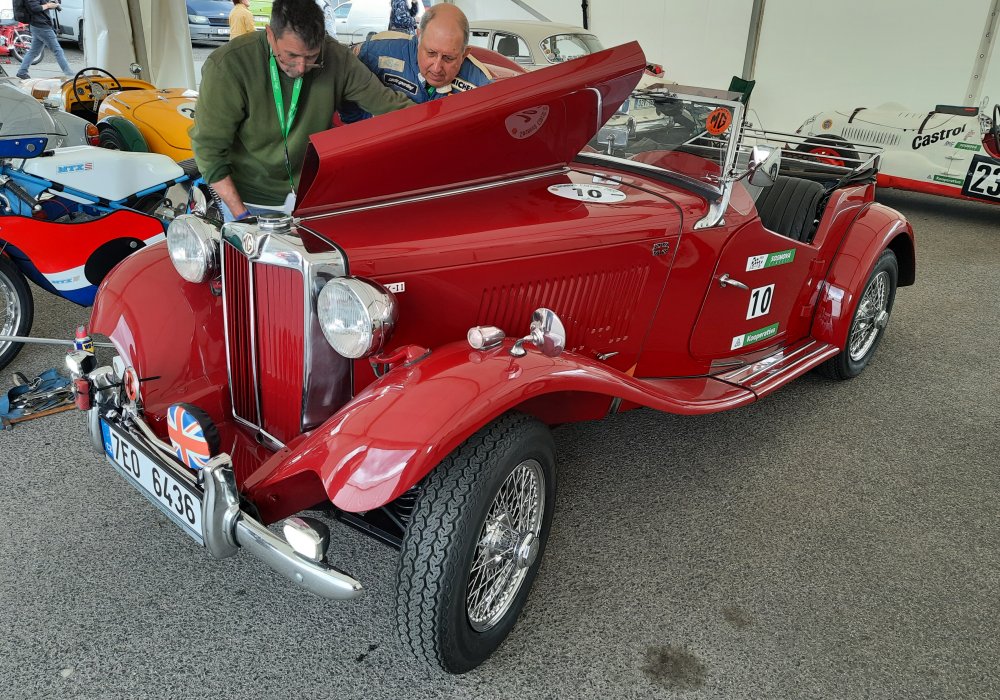
The MG TD Midget was introduced in January 1950 as the successor to the highly successful MG TC, representing a significant step forward in the development of MG’s traditional two-seat sports cars. Produced at the MG factory in Abingdon, Oxfordshire, between 1950 and 1953, the TD combined the familiar styling and mechanical character of the earlier T-type models with substantial improvements in suspension, steering, handling and passenger comfort. Although its appearance remained firmly rooted in pre-war sports car design, the TD incorporated more modern engineering that made it considerably more practical for everyday use and long-distance touring. Its commercial success, particularly in North America, helped establish MG as one of the world’s leading manufacturers of affordable British sports cars.
The development of the TD was strongly influenced by the growing importance of export markets following the Second World War. The MG TC had achieved considerable popularity in the United States despite its traditional chassis, right-hand-drive configuration and relatively basic accommodation. American buyers appreciated its distinctive appearance and engaging driving experience but increasingly expected greater comfort, improved handling and left-hand-drive availability. MG responded by developing a new model that retained the visual identity of the TC while incorporating mechanical components and engineering principles already established within the wider Nuffield Organisation.
One of the most important changes was the adoption of a revised chassis derived in part from the MG Y-type saloon. This provided a stronger and more rigid foundation than the earlier TC frame and allowed the introduction of independent front suspension. The TD also featured a wider track, improved seating accommodation and a more substantial body, making it noticeably more comfortable than its predecessor. These improvements inevitably increased the vehicle’s weight, but they also contributed to greater stability and refinement.
Power was supplied by the familiar 1,250 cc XPAG inline four-cylinder engine, featuring overhead valves operated by pushrods and twin SU carburettors. In standard TD specification, the engine developed approximately 54.5 horsepower at 5,200 rpm, broadly matching the output of the preceding TC. The engine retained its cast-iron cylinder block and cylinder head, with a conventional overhead-valve arrangement and a reputation for durability and straightforward maintenance.
The XPAG engine was particularly well suited to the TD’s intended role as an accessible sporting roadster. Although it lacked the outright power of larger contemporary sports cars, its responsive characteristics and willingness to operate at relatively high engine speeds made it enjoyable to drive. The twin SU carburettors provided progressive throttle response, while the engine’s simple mechanical construction allowed owners to undertake routine maintenance and performance modifications without requiring highly specialised equipment.
Power was transmitted to the rear wheels through a four-speed manual gearbox incorporating synchromesh on the upper three ratios. The transmission was closely related to that used in the TC and provided a direct, mechanical gear-changing experience. First gear remained unsynchronised, requiring careful selection, particularly when the vehicle was moving. The gearbox ratios were selected to make effective use of the engine’s modest output while providing reasonable flexibility for both town driving and open-road touring.
The MG TD was capable of reaching approximately 77 mph (124 km/h), depending on vehicle condition and road conditions. Acceleration from 0 to 60 mph generally required around 22 to 24 seconds, reflecting the increased weight of the new model compared with the TC. Although the TD was not significantly faster than its predecessor, its improved chassis and suspension made it easier and more comfortable to drive at sustained speeds.
The most significant mechanical development was the introduction of independent front suspension using coil springs and wishbones. Derived from the system employed on the MG Y-type saloon, the arrangement replaced the rigid front axle and leaf springs of the earlier T-type models. This provided improved wheel control, reduced the transmission of road shocks to the steering and contributed to more predictable handling over uneven surfaces.
The TD also adopted rack-and-pinion steering, replacing the older steering arrangement used on the TC. This provided more precise control and a more direct response to driver inputs, making the car easier to manoeuvre and more confidence-inspiring on winding roads. The combination of independent front suspension and rack-and-pinion steering represented a major improvement in MG’s sports car engineering and would influence subsequent models.
At the rear, the TD retained a conventional live axle supported by semi-elliptic leaf springs, with hydraulic shock absorbers controlling suspension movement. Hydraulically operated drum brakes were fitted to all four wheels, providing adequate stopping power for the vehicle’s performance. The chassis retained a traditional separate-frame construction, allowing the body to be mounted independently of the principal mechanical components.
Another important change was the adoption of smaller 15-inch pressed-steel disc wheels in place of the 19-inch wire-spoked wheels fitted to the TC. The new wheels allowed the use of wider tyres and contributed to improved road holding and stability. Although some traditional MG enthusiasts initially criticised the change, the smaller wheels were better suited to the TD’s revised suspension and more modern handling characteristics.
Externally, the MG TD retained the distinctive appearance of the earlier T-type Midgets. The upright radiator grille, separate chrome headlamps, long bonnet and sweeping front wings continued to define the car’s traditional British sports car styling. Running boards, cut-down doors and a rear-mounted spare wheel reinforced its connection with the pre-war MG sports car tradition.
Despite these similarities, the TD was noticeably wider and more substantial than the TC. The increased body width provided greater shoulder room for occupants, while the revised seating arrangement improved comfort. The front wings were broader, the wheels were smaller and the overall proportions reflected the more substantial chassis. These changes gave the TD a slightly less delicate appearance than the TC but made it considerably more practical.
The open two-seat body was constructed using traditional methods, with steel panels supported by an ash timber framework. A folding fabric hood and detachable side screens provided basic protection from the weather, although the car remained very much an open sports car. The windscreen could be folded forward for sporting use, while the relatively low doors contributed to the sense of direct contact with the surrounding environment.
Inside, the TD offered improved accommodation compared with the TC. The cockpit was wider, the seats were more comfortable and the driving position was better suited to longer journeys. Leather upholstery, traditional interior trim and a distinctive dashboard maintained the classic MG character. The large steering wheel, floor-mounted gear lever and centrally arranged instruments reflected the practical simplicity of the T-type range.
The dashboard incorporated a speedometer, tachometer, oil-pressure gauge, ammeter and other essential controls. The arrangement was straightforward and functional, providing the driver with the information required to monitor the engine and vehicle systems. Although the TD lacked the refinements of more expensive sports cars, its interior offered an appealing combination of traditional craftsmanship and sporting practicality.
The driving experience was one of the TD’s greatest strengths. Its independent front suspension and improved steering made it considerably more stable and predictable than the TC, particularly on rough or uneven roads. The wider track and lower-profile tyres contributed to improved cornering behaviour, while the relatively compact dimensions retained the agility expected of an MG sports car.
The TD was also more comfortable for extended touring. The improved seating position, greater interior space and reduced steering disturbance made longer journeys less tiring. Although the engine remained relatively modest in output, the car’s balanced handling and responsive controls encouraged enthusiastic driving on winding country roads.
The TD’s appeal was particularly strong in the United States, where British sports cars were becoming increasingly fashionable during the early 1950s. Unlike the TC, the TD was available in left-hand-drive configuration, making it considerably more suitable for American customers. Its distinctive appearance, affordable price and engaging driving characteristics helped establish a loyal following among enthusiasts who wanted an alternative to larger American automobiles.
The TD also became popular in motorsport, particularly in club racing, hill climbs and amateur competition. Its improved chassis made it a more capable sporting platform than the TC, while the XPAG engine offered considerable tuning potential. Owners frequently modified their cars with revised carburettors, higher-compression pistons, improved exhaust systems and other performance components.
In 1953, MG introduced the TD Mk II, a more sporting version of the standard model. The Mk II featured a higher-output XPAG engine developing approximately 57 horsepower, together with modifications intended to improve performance and durability. Additional changes included revised suspension settings and other equipment differences, making it particularly attractive to enthusiastic drivers.
Production of the MG TD continued until 1953, when it was replaced by the MG TF Midget. A total of 29,664 TD models were manufactured, making it one of MG’s most successful sports cars of the period. The majority were exported, with the United States accounting for a substantial proportion of sales. The TD’s commercial success demonstrated the growing international demand for affordable British sports cars and provided an important foundation for MG’s subsequent expansion.
The introduction of the TF in 1953 brought revised styling and further mechanical development, although it retained much of the TD’s basic engineering. The TD therefore occupied an important transitional position in MG history, bridging the gap between the traditional pre-war-inspired T-type sports cars and the more modern designs that would eventually culminate in the MGA of 1955.
Today, the MG TD Midget remains one of the most recognisable and popular classic British sports cars. Its traditional appearance, relatively straightforward mechanical construction and strong international enthusiast community make it particularly attractive to collectors and owners seeking an accessible introduction to pre-war-style motoring. Spare parts and specialist support remain widely available, allowing many surviving examples to be maintained and restored to a high standard.
Restoration requires careful inspection of the separate chassis, ash-framed body structure, steel panels and mechanical components. Corrosion, timber deterioration and previous repairs can affect the structural integrity of the body, while the condition of the XPAG engine, gearbox and suspension should be assessed carefully. Originality, documented history and the quality of restoration work are important considerations when evaluating surviving vehicles.
The MG TD Midget represents a significant milestone in the evolution of MG’s sports cars. By combining traditional British roadster styling with independent front suspension, rack-and-pinion steering and improved passenger accommodation, MG created a vehicle that was more refined and practical than its predecessors without sacrificing their distinctive sporting character. Its outstanding commercial success, particularly in North America, helped establish the international market for British sports cars and ensured that the TD would remain one of the most important and enduring models in MG history.