
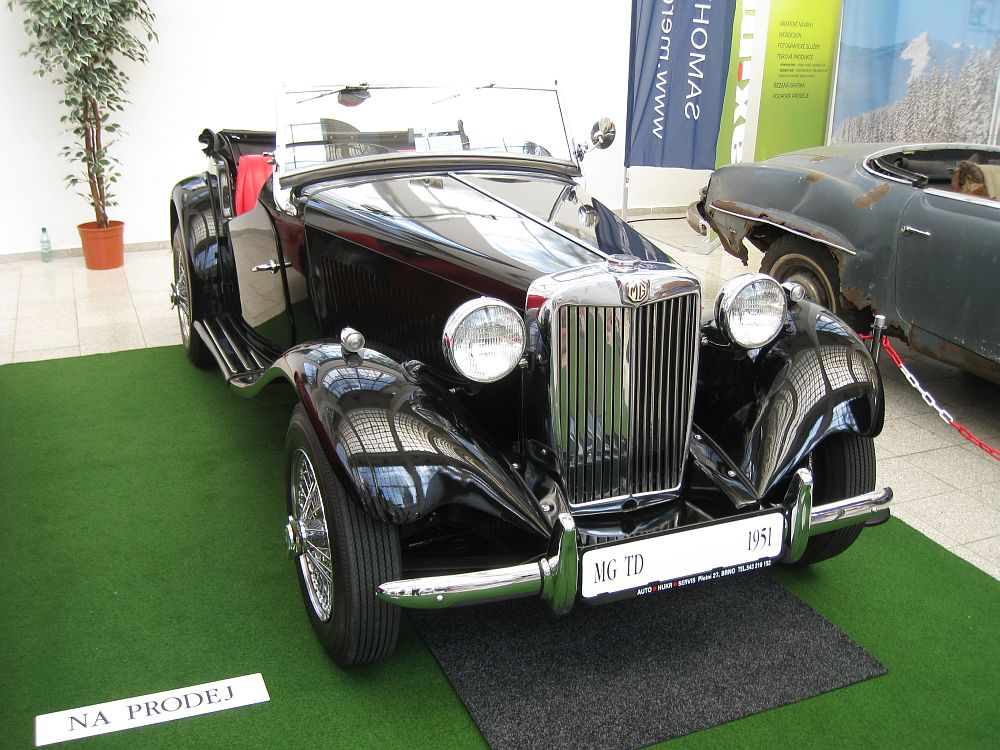
The MG TD Midget Mk II was a higher-performance version of the popular MG TD sports car, developed to appeal to enthusiastic drivers who wanted greater performance and improved sporting capabilities without sacrificing the traditional character of the standard model. Introduced in 1950 and produced until 1953, the Mk II combined the familiar open two-seat body of the TD with a more powerful version of the 1,250 cc XPAG engine, revised suspension settings and a number of mechanical improvements. Although outwardly similar to the standard TD, the Mk II offered a more purposeful driving experience and became particularly popular among motorists interested in competition and spirited road use.
The MG TD had been introduced in January 1950 as the successor to the highly successful TC Midget. It represented a major development in MG’s traditional sports car range, incorporating independent front suspension, rack-and-pinion steering and a wider, more comfortable body. These improvements made the TD more practical and easier to drive than its predecessor, particularly on the roads of North America, where MG was rapidly establishing a substantial export market.
Despite the improvements offered by the standard TD, some enthusiasts felt that its increased weight had reduced the lively performance associated with the earlier TC. The adoption of a stronger chassis, independent suspension and more spacious body had made the TD heavier, while its engine output remained broadly unchanged. MG responded by developing a higher-performance version that would provide improved acceleration and a more sporting character.
The TD Mk II, also known in some markets as the TD Competition Model, incorporated a number of modifications intended to enhance its performance and suitability for enthusiastic driving. Rather than representing a completely separate design, it was a development of the existing TD platform, retaining the same general body construction, chassis layout and traditional styling.
Power was supplied by a modified version of the 1,250 cc XPAG inline four-cylinder engine, featuring overhead valves operated by pushrods. The Mk II engine incorporated higher-compression pistons and revised induction equipment, including larger SU carburettors, to improve breathing and increase output. These changes raised maximum power to approximately 57 horsepower at 5,500 rpm, compared with around 54.5 horsepower for the standard TD.
Although the increase in horsepower was relatively modest, the modifications improved the engine’s response and encouraged operation at higher engine speeds. The XPAG retained its cast-iron cylinder block and cylinder head, with a conventional overhead-valve arrangement and a reputation for durability. Its straightforward construction and considerable tuning potential made it especially attractive to owners interested in competition.
The Mk II engine was identified by its higher-performance specification and associated mechanical details. The larger carburettors and revised compression ratio contributed to improved power delivery, while the basic engine architecture remained closely related to the standard XPAG unit. As with other MG sports cars of the period, individual vehicles could subsequently be modified by owners, making it important to distinguish original factory specifications from later performance upgrades.
Power was transmitted to the rear wheels through a four-speed manual gearbox incorporating synchromesh on the upper three ratios. The transmission retained the familiar direct mechanical feel of the standard TD, with an unsynchronised first gear requiring careful selection. The gearbox ratios were well suited to the engine’s characteristics, allowing the driver to make effective use of the available power.
The Mk II offered slightly improved acceleration and a modest increase in maximum speed compared with the standard TD. Depending on vehicle condition and road conditions, maximum speed was approximately 80 mph (129 km/h). Although the performance gains were not dramatic, the combination of improved engine response and revised chassis settings made the Mk II more engaging to drive, particularly on winding roads.
The chassis retained the separate ladder-frame construction introduced with the standard TD. Independent front suspension employed coil springs and wishbones, while the rear axle was supported by semi-elliptic leaf springs. Hydraulic shock absorbers controlled suspension movement, and hydraulically operated drum brakes provided stopping power at all four wheels.
One of the distinguishing mechanical features of the Mk II was its revised suspension specification. The model incorporated additional or upgraded shock absorbers, intended to improve damping control during enthusiastic driving. These changes helped reduce excessive body movement and provided more consistent handling when cornering at higher speeds.
The TD’s rack-and-pinion steering was retained, offering precise and relatively direct control compared with the older steering arrangement used on the TC. Combined with the wider track and independent front suspension, the system gave the Mk II predictable handling and made it particularly suitable for club-level sporting events.
Externally, the MG TD Mk II was almost identical to the standard TD. It retained the upright MG radiator grille, long bonnet, separate chrome headlamps, sweeping front wings and traditional running boards. The open two-seat body, folding fabric hood and detachable side screens continued to provide the characteristic appearance of the T-type Midget range.
The Mk II could be identified by several subtle details, including distinctive identification badges and additional bonnet ventilation features on certain production examples. The model was also associated with changes to the engine compartment intended to accommodate the revised induction equipment. However, many of these features were relatively discreet, and the Mk II remained visually very similar to the standard TD.
The body was constructed using traditional MG methods, with steel panels supported by an ash timber framework and mounted on the separate chassis. The wider cockpit introduced with the TD provided improved accommodation compared with the earlier TC, while the folding windscreen and open body retained the sporting character expected of an MG roadster.
Inside, the Mk II featured the same basic cockpit arrangement as the standard TD. Leather-trimmed seats, a large steering wheel and a traditional dashboard created an attractive and functional environment. The instruments included a speedometer, tachometer, oil-pressure gauge, ammeter and other essential controls, allowing the driver to monitor the engine and vehicle systems.
The driving position was relatively upright, with a floor-mounted gear lever and closely grouped pedals. Although the cockpit offered limited protection from wind and weather, it provided an engaging and direct connection between the driver and the road. The improved suspension and engine response of the Mk II made this experience slightly more sporting than that of the standard model.
The MG TD Mk II was particularly attractive to drivers interested in club motorsport. Its combination of a relatively lightweight body, responsive engine and improved chassis made it suitable for hill climbs, sprints and amateur circuit racing. The XPAG engine’s tuning potential also allowed owners to develop their cars further, with additional modifications to carburation, compression ratio and exhaust systems.
In the United States, where the majority of TD production was exported, the Mk II appealed to enthusiasts who wanted a more competitive version of the popular British roadster. The growing American sports car movement provided opportunities for owners to participate in organised racing and sporting events, and MG vehicles became a familiar sight at circuits and club meetings.
The Mk II was never intended to compete directly with much larger and more powerful sports cars. Instead, it offered improved performance within the established TD design, preserving the affordability, mechanical simplicity and distinctive styling that had made the standard model successful.
Production of the MG TD Mk II continued until 1953, alongside the standard TD. Approximately 1,700 Mk II examples were manufactured, representing a relatively small proportion of the 29,664 TD models produced overall. This limited production makes the Mk II less common than the standard TD and contributes to its appeal among collectors.
The introduction of the MG TF in 1953 marked the end of TD production. Although the TF retained much of the TD’s mechanical architecture, it introduced revised body styling and further engine development. The TD Mk II therefore represents one of the final sporting developments of the traditional upright-radiator MG roadster design before the arrival of the more streamlined TF.
Today, the MG TD Mk II is highly regarded among collectors of classic British sports cars, particularly those interested in the sporting and competition history of the MG marque. Its relative rarity, enhanced engine specification and distinctive place within the T-type range make it an attractive alternative to the standard TD.
Restoration requires careful attention to the chassis, ash-framed body structure, steel panels and mechanical components. The condition of the XPAG engine and the originality of the Mk II-specific equipment are particularly important. Because standard TDs have sometimes been modified to resemble Mk II models, verification of chassis numbers, engine specifications and factory records is essential when assessing authenticity.
The MG TD Midget Mk II represents an important development in MG’s post-war sports car history. By combining the improved chassis and handling of the TD with a more powerful engine and revised suspension, MG created a model that offered greater sporting appeal while retaining the traditional appearance and mechanical simplicity of the T-type range. Although produced in relatively small numbers, the Mk II remains a distinctive and desirable example of MG’s commitment to accessible, enthusiast-focused motoring during the early 1950s.