
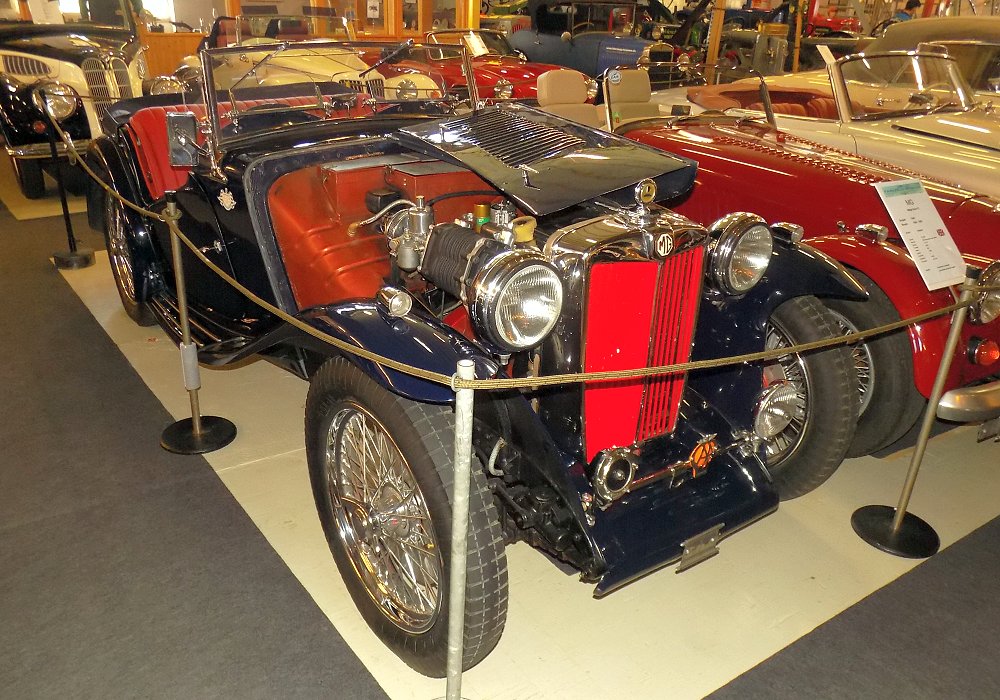
The MG TC Midget Supercharged represents a high-performance interpretation of one of Britain’s most influential post-war sports cars. Based on the MG TC Midget produced between 1945 and 1949, supercharged examples combined the traditional appearance and lightweight construction of the standard roadster with the increased engine output provided by forced induction. Although MG did not offer a regular factory-produced supercharged TC, specialist engineering firms and private enthusiasts developed conversions that substantially improved the performance of the standard 1,250 cc XPAG engine. These modified cars became particularly popular among drivers seeking greater acceleration and improved competitiveness in sporting events.
The MG TC was introduced in September 1945 as the first MG sports car to enter production following the Second World War. Developed from the pre-war MG TB, it retained the familiar upright radiator, separate headlamps, sweeping wings and open two-seat body that had become characteristic of MG’s T-type Midget range. The TC was intended to provide affordable sporting motoring at a time when Britain’s automotive industry was recovering from wartime disruption.
The standard TC was powered by a 1,250 cc inline four-cylinder XPAG engine, featuring overhead valves operated by pushrods and twin SU carburettors. Producing approximately 54.5 horsepower at 5,200 rpm, the engine provided respectable performance for a lightweight sports car of the immediate post-war period. Its robust construction, relatively straightforward maintenance requirements and considerable tuning potential made it especially attractive to sporting motorists.
Supercharging offered one of the most effective methods of increasing the XPAG engine’s output without enlarging its displacement. A mechanically driven compressor forced additional air into the engine’s induction system, allowing a greater quantity of fuel to be burned during each combustion cycle. The resulting increase in cylinder pressure produced additional torque and horsepower, improving acceleration and providing stronger performance throughout much of the engine’s operating range.
The use of superchargers was already well established within MG’s sporting heritage. During the 1930s, the company had developed several successful supercharged competition cars, including the C-type Midget, J4 Midget and K3 Magnette. These vehicles demonstrated the effectiveness of forced induction in small-capacity engines and contributed to MG’s reputation for extracting impressive performance from relatively modest mechanical packages.
Following the Second World War, the availability of specialist tuning equipment encouraged owners to modify their TC Midgets. Companies such as Shorrock and Marshall became associated with supercharging equipment for British sports cars, while other engineering specialists developed individual installations. The precise components and configuration varied according to the conversion, and supercharged TCs were not manufactured to a single standard specification.
A typical supercharger installation required modifications to the engine’s induction system, including the installation of a mechanically driven compressor, revised manifolds and suitable carburation. Depending on the design, the carburettor could be positioned before or after the supercharger, with the compressor driven by a belt connected to the engine’s crankshaft. The arrangement was intended to provide additional intake pressure while maintaining reliable fuel delivery.
Engine modifications were often necessary to accommodate the increased mechanical and thermal stresses associated with forced induction. These could include lower-compression pistons, revised ignition timing, improved cooling arrangements and stronger internal components. The extent of the modifications depended upon the desired boost pressure and whether the car was intended primarily for road use or competition.
The performance of a supercharged MG TC varied considerably according to the particular installation. Well-developed conversions could increase engine output substantially beyond the standard 54.5 horsepower, with some producing approximately 70 to 90 horsepower or more in competition-oriented configurations. These figures should be regarded as representative of possible modified engines rather than a standard specification, as the output of individual cars depended upon boost pressure, compression ratio, engine condition and other modifications.
The additional power transformed the TC’s acceleration and flexibility. Whereas the standard car required relatively frequent gear changes to maintain brisk progress, a supercharged engine could provide stronger torque at lower and intermediate engine speeds. This improved the car’s ability to accelerate out of corners and climb hills, making the conversion particularly attractive for sporting use.
Power continued to be transmitted to the rear wheels through a four-speed manual gearbox, normally retaining the basic transmission arrangement of the standard TC. The gearbox incorporated synchromesh on the upper three ratios, while first gear remained unsynchronised. Increased engine torque placed greater demands upon the clutch, gearbox and rear axle, particularly in cars used for competition.
The chassis retained the traditional ladder-frame construction inherited from the pre-war T-type models. Suspension consisted of rigid front and rear axles supported by semi-elliptic leaf springs, with hydraulic shock absorbers controlling movement. Hydraulically operated drum brakes provided stopping power, while the steering arrangement maintained the direct mechanical character of the standard TC.
Although the chassis was relatively simple, its lightweight construction and compact dimensions made it suitable for sporting driving. However, the increased performance of a supercharged engine could expose the limitations of the original suspension and braking systems. Owners preparing their cars for competition sometimes introduced revised spring settings, improved shock absorbers and modifications to the braking system to provide greater control.
Externally, many supercharged TC Midgets remained almost indistinguishable from standard production cars. The familiar upright MG radiator grille, long bonnet, separate chrome headlamps and sweeping front wings were usually retained. The 19-inch wire-spoked wheels and narrow tyres continued to give the car its distinctive pre-war appearance, while the open two-seat body maintained the traditional character of the T-type range.
Some conversions incorporated visible modifications to accommodate the supercharger and its associated equipment. Depending on the installation, the compressor and induction pipework could require changes to the bonnet side panels or additional ventilation. Competition-prepared cars might also feature lightweight windscreens, revised exhaust systems, additional instruments or simplified interior trim.
The cockpit generally retained the traditional arrangement of the standard TC, with leather-trimmed seating, a large steering wheel and a dashboard containing the principal driving instruments. The speedometer, tachometer and oil-pressure gauge remained essential equipment, while some modified cars incorporated additional instrumentation to monitor boost pressure or engine temperature.
The driving experience of a supercharged TC was noticeably different from that of the standard model. The increased torque and sharper acceleration provided a more urgent sporting character, while the mechanical sound of the compressor added another distinctive element to the engine’s operation. The car retained the relatively firm ride, direct steering and lively handling characteristics of the original TC, requiring the driver to remain attentive on uneven roads and during rapid cornering.
Supercharged TCs were particularly well suited to the growing post-war enthusiasm for club motorsport. Hill climbs, sprints, trials and circuit racing provided opportunities for owners to exploit the increased engine performance. The TC’s straightforward construction made it relatively easy to maintain and modify, while its popularity in Britain and overseas ensured a growing supply of specialist knowledge and tuning equipment.
The MG TC also played an important role in establishing British sports cars in the United States. Approximately 2,000 examples were exported to American buyers, despite being manufactured exclusively in right-hand-drive form. American enthusiasts were attracted by the car’s compact dimensions, responsive handling and mechanical simplicity, and many became involved in the emerging sports car racing movement.
Supercharging was one of several modifications adopted by enthusiastic American owners seeking greater performance. The increased output allowed the small MG to compete more effectively in events where acceleration and power were important. Although the TC remained limited by its traditional chassis and narrow tyres, a carefully prepared supercharged example could offer considerably more performance than the standard road car.
Production of the MG TC continued until November 1949, when it was replaced by the more modern MG TD Midget. A total of 10,001 TCs were manufactured, making the model a substantial commercial success for MG. Because supercharged examples were created through specialist and private conversions rather than a dedicated factory production programme, no definitive production total exists for the MG TC Midget Supercharged.
The introduction of the TD marked a significant development in MG’s sports car engineering, bringing independent front suspension, rack-and-pinion steering and smaller road wheels. Nevertheless, the TC remained popular among enthusiasts who appreciated its traditional appearance and direct driving experience. Supercharged examples continued to attract attention because they combined the character of the original design with substantially improved engine performance.
Today, the MG TC Midget Supercharged is particularly appealing to collectors interested in historic performance modifications and the development of British sports car tuning. Period conversions with documented histories are especially desirable, while more recent installations can also provide an enjoyable interpretation of the TC’s sporting potential. The value and historical significance of an individual car depend upon its originality, mechanical specification, conversion history and overall condition.
Restoration and maintenance require careful attention to the XPAG engine and the additional demands imposed by forced induction. Correct ignition timing, fuel mixture, lubrication and cooling are essential for reliable operation, while the condition of the supercharger drive system and associated components must be regularly assessed. The increased power also makes the condition of the clutch, gearbox, rear axle and braking system particularly important.
The MG TC Midget Supercharged represents an important aspect of the post-war British sports car tuning tradition. By combining the classic styling and lightweight construction of the TC with the performance benefits of forced induction, specialist engineers and private enthusiasts created a more powerful and distinctive version of an already celebrated sports car. Although never a regular factory-produced model, the supercharged TC demonstrates the adaptability of MG’s XPAG engine and the enduring enthusiasm for improving the performance of the company’s traditional sporting machines.