
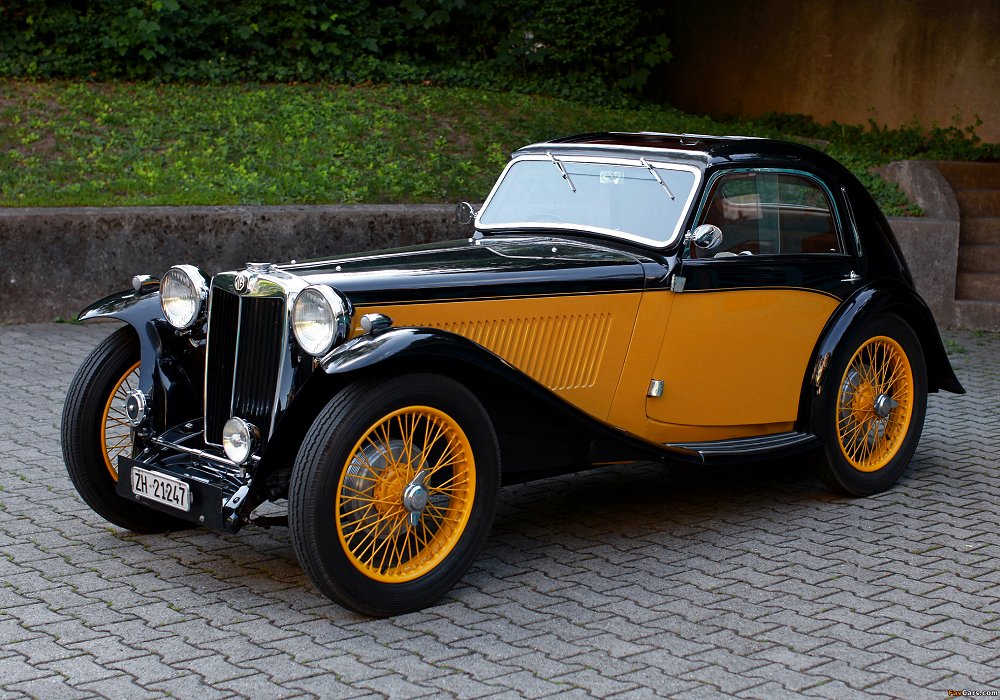
The MG TA Airline Coupé was a rare and distinctive closed-body version of the MG TA Midget, combining the traditional engineering of MG’s early T-type sports cars with the streamlined styling that had become fashionable during the 1930s. Based on the TA chassis introduced in 1936, the Airline Coupé offered an unusual alternative to the familiar open two-seat roadster. Its elegant fixed-roof bodywork, flowing proportions and sporting mechanical specification made it one of the more visually striking interpretations of the pre-war MG Midget.
The Airline design originated during the earlier P-type Midget era, when MG offered distinctive enclosed coachwork for buyers seeking greater refinement and weather protection. The streamlined body style contrasted with the upright, traditional appearance of most British sports cars of the period. Its development reflected the growing influence of aerodynamic principles on automotive styling, although the primary attraction of the Airline body was its appearance and improved touring comfort rather than any substantial increase in maximum speed.
The introduction of the MG TA in 1936 provided a larger and more spacious platform for this style of coachwork. Compared with the earlier PA and PB Midgets, the TA featured a longer wheelbase, wider chassis and more generous passenger accommodation. These changes made it particularly suitable for an enclosed body, allowing the distinctive Airline silhouette to be combined with improved interior space and greater practicality.
Power came from the standard TA’s 1,292 cc inline four-cylinder engine, derived from the Morris Ten. The engine featured overhead valves operated by pushrods, replacing the overhead-camshaft arrangement used in earlier MG Midgets. Equipped with twin SU carburettors, it produced approximately 50 horsepower at 4,500 rpm. Although mechanically conventional, the engine offered useful low-speed torque and relatively flexible performance, making it suitable for both sporting driving and longer-distance touring.
A four-speed manual gearbox transmitted power to the rear wheels, with synchromesh on the upper three ratios. This arrangement made the TA easier to drive than many earlier MG models, particularly in ordinary traffic. The standard open TA was capable of approximately 78 mph (126 km/h), although the additional weight of the enclosed Airline body could influence acceleration and maximum speed. Performance remained respectable for a small British sports car of the late 1930s, with the larger engine providing a useful balance between flexibility and sporting character.
The chassis employed traditional ladder-frame construction, with rigid front and rear axles supported by semi-elliptic leaf springs. Hydraulic shock absorbers helped control suspension movement, while hydraulically operated drum brakes provided improved stopping performance compared with the mechanically operated systems used on earlier Midgets. The TA’s relatively compact dimensions and conventional suspension arrangement gave it predictable handling, although the enclosed body introduced additional weight compared with the standard roadster.
The most distinctive feature of the Airline Coupé was its streamlined coachwork. The fixed roof curved smoothly towards the rear of the car, creating a flowing profile that differed considerably from the upright fabric hoods of conventional MG roadsters. The enclosed passenger compartment incorporated glazed side windows and a compact rear window, providing better protection from the elements while giving the car a more sophisticated appearance.
At the front, the Airline retained the characteristic MG radiator grille, separate headlamps and long bonnet associated with the T-type series. The sweeping wings and running boards preserved the traditional British sports car character, while the rounded roofline and carefully shaped rear bodywork introduced a more modern visual treatment. Wire-spoked wheels completed the appearance, reinforcing the connection between the elegant coupé and its sporting MG origins.
The Airline body was associated with specialist coachbuilding rather than the conventional open bodywork fitted to most TA Midgets. Consequently, individual examples could incorporate variations in exterior trim, interior fittings and body construction. The rarity of the design also means that surviving cars and historical references require careful examination to distinguish original period coachwork from later recreations or modifications.
Inside, the TA Airline Coupé offered a more enclosed and comfortable environment than the standard roadster. The fixed roof and glazed windows reduced exposure to wind and rain, making the car better suited to extended journeys and everyday motoring in the British climate. Leather-trimmed seating, traditional dashboard instruments and period interior fittings contributed to the car’s sporting yet relatively refined character.
The dashboard retained the familiar MG arrangement, with a speedometer, tachometer and gauges for monitoring essential engine functions. The large steering wheel, floor-mounted gear lever and upright driving position remained characteristic of pre-war British sports cars. Although the cabin was compact by modern standards, the TA’s increased dimensions provided more generous accommodation than earlier Midget-based Airline models.
The driving experience combined the mechanical involvement of the standard TA with the additional refinement of enclosed coachwork. The four-cylinder engine delivered flexible performance, while the manual gearbox and direct steering required active participation from the driver. The enclosed body provided improved weather protection, although road noise, mechanical vibration and the relatively firm suspension remained noticeable.
Unlike the open TA Midget, which became popular in club motorsport, the Airline Coupé was primarily suited to sporting road use and touring. Its greater weight and enclosed body made it less attractive for competition, although it retained the same basic mechanical capabilities as the standard model. The car appealed to motorists who appreciated MG’s sporting reputation but preferred a more distinctive and practical alternative to the conventional roadster.
The MG TA Midget was produced between 1936 and 1939, with approximately 3,003 examples manufactured across the model range. Airline-bodied TAs were exceptionally uncommon, and reliable production figures for this particular configuration are difficult to establish. The limited documentation surrounding these cars makes it important to distinguish confirmed period examples from later special-bodied vehicles. The Airline Coupé should therefore be regarded as a rare coachbuilt interpretation of the TA rather than a widely produced factory model.
The TA was replaced by the MG TB Midget in 1939, bringing the introduction of the more advanced 1,250 cc XPAG engine. The subsequent interruption of civilian car production during the Second World War effectively ended the development of pre-war MG Airline-style coachwork. When MG resumed sports car production after the war, the company concentrated on open two-seat models, eventually achieving considerable international success with the TC, TD and TF.
Today, the MG TA Airline Coupé is of particular interest to collectors of unusual pre-war British sports cars. Its distinctive appearance, association with specialist coachbuilding and connection to the early T-type series make it a fascinating part of MG history. Authenticity, documented provenance and the originality of the bodywork are especially important when assessing surviving examples, given the rarity of the design and the possibility of later conversions.
The MG TA Airline Coupé represents an intriguing combination of traditional British sports car engineering and the streamlined styling ambitions of the 1930s. By incorporating an elegant enclosed body onto the capable TA chassis, it offered a distinctive interpretation of MG’s sporting philosophy. Although far less familiar than the standard open Midget, the Airline Coupé illustrates the variety and creativity of pre-war British coachbuilding and remains an unusual chapter in the history of the MG marque.
Create image