
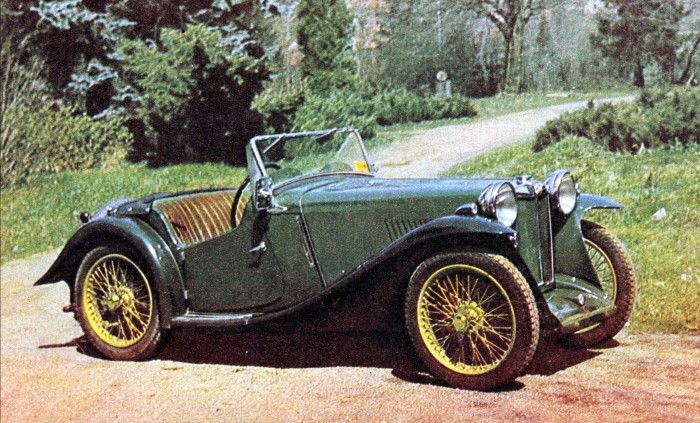
The MG PB Midget was introduced in 1935 as the successor to the successful PA Midget and represented the final development of MG’s celebrated P-type sports car series. Produced until 1936, the PB combined traditional British sports car styling with improved engine performance and mechanical refinement. Although its production life was relatively short, the PB became one of the most desirable small MG sports cars of the pre-war period, valued for its lively character, lightweight construction and engaging driving experience.
The PB Midget was developed to address some of the limitations of the earlier PA while retaining the qualities that had made the P-type popular among sporting motorists. Externally, the two models were very similar, featuring the characteristic upright MG radiator grille, separate headlamps, flowing cycle-style wings and compact open bodywork. The PB was offered primarily as a two-seat roadster, although an attractive Airline Coupé version was also available. Its traditional proportions, long bonnet and low seating position gave it the purposeful appearance associated with MG’s successful competition cars.
The most significant improvement was the introduction of a larger 939 cc four-cylinder engine, replacing the PA’s 847 cc unit. The engine retained its overhead-camshaft configuration but incorporated revised internal dimensions and other refinements to improve performance and flexibility. Producing approximately 43 horsepower at 5,500 rpm, compared with around 36 horsepower for the PA, the PB offered noticeably stronger acceleration and improved pulling power. A four-speed manual gearbox transmitted power to the rear wheels, allowing drivers to make effective use of the engine’s relatively high-revving character.
The PB’s performance was particularly impressive when considered alongside its small engine capacity and lightweight construction. Depending on body style and specification, the car was capable of reaching approximately 75 mph (121 km/h), making it a genuinely sporting machine by mid-1930s standards. Its responsive engine and closely spaced gear ratios encouraged enthusiastic driving, while the modest overall weight contributed to lively acceleration and excellent manoeuvrability.
The chassis followed the established P-type design, employing a conventional ladder-frame structure with rigid front and rear axles supported by semi-elliptic leaf springs. Friction-type shock absorbers helped control suspension movement, while mechanically operated drum brakes provided stopping power. Although relatively simple compared with later sports car designs, the suspension and chassis combination delivered predictable handling and good road feedback. The narrow tyres, direct steering and compact dimensions made the PB particularly enjoyable on winding country roads.
The MG PB Midget was available with traditional open two-seat bodywork featuring cut-down doors, a folding fabric hood and detachable side screens. The design prioritised lightness and sporting character rather than luxury, although the car was sufficiently practical for everyday use in suitable conditions. The PB could also be ordered in the distinctive Airline Coupé configuration, which featured a streamlined fixed roof and more enclosed accommodation. This version offered greater weather protection and a more sophisticated appearance while retaining the mechanical specification of the open sports car.
Inside, the PB Midget featured a compact and functional cockpit with leather-trimmed seating, a simple dashboard and centrally positioned instrumentation. The instruments included a speedometer, tachometer and gauges for monitoring essential engine functions. The large steering wheel and closely positioned controls provided a direct connection between driver and machine. Although accommodation was limited, the interior reflected the sporting expectations of the period, when driver involvement was considered more important than comfort or convenience.
The PB Midget continued MG’s strong association with amateur motorsport. Its lightweight construction, improved engine and responsive handling made it suitable for trials, hill climbs and club racing. Although the model was not developed as a dedicated factory competition car in the manner of the earlier K3 Magnette, private owners frequently used PB Midgets in sporting events. Some examples were subsequently modified with superchargers and other performance equipment to increase their competitiveness.
Production of the MG PB Midget ended in 1936, following a relatively brief manufacturing period. Approximately 526 examples were built, making it considerably rarer than the preceding PA. The introduction of the larger and more modern MG T-type Midget series marked a change in direction for the company, with the TA replacing the P-type as MG’s principal small sports car.
Today, the MG PB Midget is regarded as one of the finest examples of MG’s pre-war small sports car engineering. Its improved 939 cc engine, attractive traditional styling and relatively limited production make it particularly appealing to collectors and vintage motoring enthusiasts. Well-preserved and correctly restored examples are valued for their historical authenticity and distinctive driving character.
As a classic British sports car, the MG PB Midget represents the culmination of MG’s early overhead-camshaft Midget development. Combining modest engine capacity with lightweight construction and an unmistakably sporting personality, it captures the essence of affordable performance motoring during the 1930s. Its enduring appeal lies not in outright speed or sophistication, but in the mechanical simplicity, driver involvement and timeless character that helped establish MG as one of Britain’s most celebrated sports car manufacturers.