
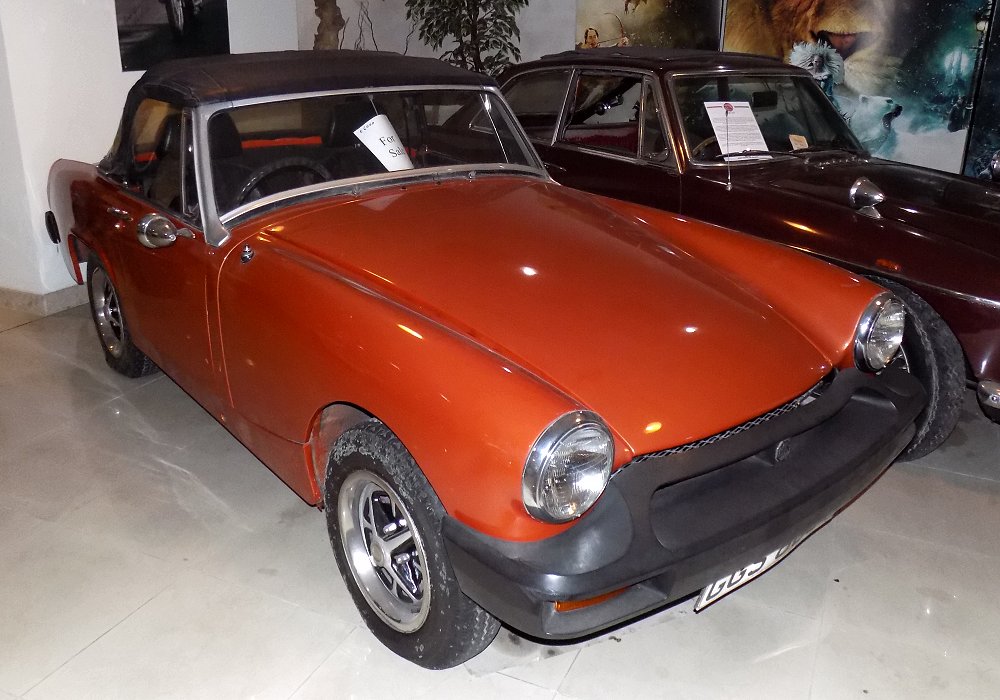
The MG Midget 1500 was the final development of MG’s popular lightweight two-seat sports car, produced between 1974 and 1979 at the company’s Abingdon factory in Oxfordshire. Introduced as a successor to the long-running 1,275 cc Midget Mk III, the new model featured a larger 1,493 cc four-cylinder engine, revised transmission, raised suspension and distinctive black impact-absorbing bumpers. These changes were introduced primarily to satisfy increasingly demanding safety and emissions regulations, particularly in the important North American market. Although the 1500 differed significantly from earlier Midgets in both appearance and mechanical specification, it retained the compact dimensions, traditional rear-wheel-drive layout and engaging driving characteristics that had made the model successful since its introduction in 1961.
The origins of the MG Midget 1500 can be traced to the development of the original Austin-Healey Sprite, introduced in 1958. The Sprite established a successful formula for an affordable British sports car, combining lightweight construction, simple mechanical components and responsive handling. When the second-generation Sprite appeared in 1961, the British Motor Corporation introduced a closely related MG version, reviving the historic Midget name that had been associated with the company since 1929.
The original MG Midget was powered by a 948 cc A-series engine, which was enlarged to 1,098 cc in 1962 and subsequently to 1,275 cc with the introduction of the Mk III in 1966. Throughout these developments, the Midget retained its essential character as a compact, economical and enjoyable two-seat roadster. However, by the early 1970s, changing legislation and increasing competition were placing considerable pressure on traditional British sports car manufacturers.
The United States was one of MG’s most important export markets, and new American regulations concerning crash protection, bumper impact resistance and exhaust emissions required substantial changes to existing models. The Midget’s original low body and chrome bumpers were increasingly difficult to reconcile with these requirements, while the established A-series engine faced growing challenges in meeting emissions standards without sacrificing performance.
The introduction of the Midget 1500 in October 1974 represented MG’s response to these pressures. The new model adopted the 1,493 cc Standard-Triumph four-cylinder engine already used in the Triumph Spitfire 1500. This was a significant departure from the BMC A-series engines fitted to all previous Midgets and reflected the rationalisation of components within British Leyland, which had brought MG and Triumph under common ownership.
The engine featured four cylinders arranged in line, with overhead valves operated by pushrods. It employed a cast-iron cylinder block and cylinder head, with a five-bearing crankshaft and conventional wet-sump lubrication system. The engine had a displacement of 1,493 cc, achieved through a bore of approximately 73.7 mm and a stroke of 87.5 mm.
In British and other less restrictive market specifications, the engine developed approximately 65 horsepower, although output varied according to market and emissions equipment. North American versions generally produced less power because of lower compression ratios, revised carburation and increasingly stringent emissions controls. Despite these differences, the larger engine provided improved torque at lower engine speeds compared with the earlier 1,275 cc A-series unit.
The Triumph-derived engine was designed primarily to provide flexible road performance rather than high-revving sporting characteristics. Its relatively long stroke contributed to useful low-speed torque, making the Midget easier to drive in traffic and reducing the need for frequent gear changes. However, the engine was less enthusiastic at high speeds than the smaller A-series unit, and its greater weight altered the car’s overall balance.
The adoption of the 1,493 cc engine also brought changes to the transmission. The Midget 1500 used a four-speed manual gearbox derived from the Triumph Spitfire, incorporating synchromesh on all four forward gears. This represented a useful improvement over earlier Midgets, which retained an unsynchronised first gear.
The fully synchronised gearbox made the car more convenient in everyday driving, particularly in urban traffic. The relatively close ratios allowed drivers to make effective use of the engine’s available torque, while the conventional floor-mounted gear lever retained the direct mechanical character associated with traditional British sports cars.
Power continued to be transmitted to the rear wheels through a conventional propeller shaft and live rear axle. The drivetrain remained mechanically straightforward, reflecting the Midget’s established emphasis on affordability, durability and ease of maintenance.
The MG Midget 1500 was capable of reaching approximately 100 mph (161 km/h) in favourable specification and conditions, although actual performance varied considerably between markets. Acceleration from 0 to 60 mph generally required around 12 to 14 seconds for higher-output versions. North American models were typically slower because of their emissions equipment and reduced engine output.
Although the larger engine provided stronger low-speed performance, the 1500 was not necessarily a substantial improvement over the earlier 1,275 cc Midget in every aspect of driving. The additional weight, raised suspension and revised engine characteristics altered the car’s handling and responsiveness, making it feel somewhat different from its predecessors.
The chassis retained the unitary body construction introduced with the original Midget in 1961. Rather than employing a separate ladder frame, the body shell incorporated the principal structural members, providing a relatively rigid foundation for the suspension and drivetrain. This lightweight construction remained central to the Midget’s character, although the 1500 was heavier than earlier versions because of its revised engine, bumpers and safety equipment.
At the front, the Midget 1500 retained independent suspension using coil springs and wishbones, with lever-arm hydraulic shock absorbers forming part of the upper suspension arrangement. The basic design was carried over from earlier models, although changes to ride height and suspension settings were necessary to meet contemporary safety requirements.
At the rear, the car retained a live axle supported by semi-elliptic leaf springs, with lever-arm hydraulic shock absorbers controlling suspension movement. The arrangement was simple and robust, although it could produce a relatively firm ride on uneven surfaces.
One of the most significant changes introduced with the 1500 was an increase in ride height. This was required primarily to satisfy American regulations concerning bumper positioning and impact protection. The raised suspension altered the car’s centre of gravity and reduced some of the sharp handling characteristics associated with earlier Midgets.
Although the Midget remained agile and enjoyable on winding roads, the higher ride height contributed to greater body roll and slightly less precise cornering behaviour. Enthusiasts accustomed to the earlier chrome-bumper models sometimes regarded these changes as a compromise, although the 1500 continued to offer an engaging driving experience compared with many conventional passenger cars.
Braking was provided by hydraulically operated front disc brakes and rear drum brakes, an arrangement retained from the earlier Midget range. The system was generally adequate for the car’s modest weight and performance, although the absence of modern braking assistance required greater pedal effort than contemporary drivers might expect.
Rack-and-pinion steering was also retained, providing direct and responsive control. Despite the changes to suspension height and vehicle weight, the Midget continued to offer precise steering and good manoeuvrability, particularly on narrow roads and in urban environments.
Externally, the MG Midget 1500 was immediately distinguishable from its predecessors by its large black polyurethane-covered bumpers. These replaced the traditional chrome bumpers and were designed to provide improved impact protection in accordance with American safety requirements.
The new bumpers extended around the front and rear of the body, giving the car a more substantial appearance. Their introduction represented one of the most controversial styling changes in the Midget’s history, as they altered the delicate proportions of the original design. Nevertheless, the black-bumper treatment became a defining feature of the final generation of Midgets.
The front end retained the familiar low bonnet and headlamps integrated into the wings, although the revised bumper arrangement and grille treatment gave the car a more contemporary appearance. At the rear, the larger bumper similarly altered the visual balance of the short rear deck.
The body retained its traditional two-door roadster configuration, with accommodation for two occupants and a folding fabric hood. The Midget’s compact dimensions remained largely unchanged, ensuring that it continued to offer the close-fitting cockpit and low seating position associated with earlier versions.
The 1500 incorporated improvements to its interior and equipment, reflecting changing customer expectations during the 1970s. The dashboard featured revised instrumentation and controls, while later models received additional safety-related fittings and changes to trim materials.
The cockpit remained relatively narrow, with two individual seats, a large steering wheel and a short floor-mounted gear lever. The driving position was low and intimate, placing the driver close to the road and reinforcing the car’s traditional sporting character.
The folding hood and wind-up side windows provided reasonable weather protection for a small roadster, although wind noise, limited insulation and restricted luggage space remained characteristic features. The Midget was still intended primarily as an affordable sports car rather than a luxurious grand tourer.
The driving experience of the MG Midget 1500 was characterised by improved low-speed torque, direct steering and traditional rear-wheel-drive handling. The larger engine made the car more flexible in everyday conditions, while the fully synchronised gearbox improved convenience. Although the raised suspension and additional weight reduced some of the earlier models’ agility, the 1500 remained enjoyable on winding country roads.
The car was particularly well suited to relaxed open-air touring, where its compact dimensions and responsive controls allowed the driver to enjoy the road without requiring excessive speed. The engine’s stronger torque made it easier to maintain progress on hills and during overtaking, while the relatively simple mechanical layout contributed to manageable running costs.
The Midget 1500 competed in a changing sports car market that included the Triumph Spitfire, Fiat X1/9 and various Japanese sports models. By the mid-1970s, many competitors offered more modern engineering, improved refinement and greater practicality. Nevertheless, the MG retained a loyal following among enthusiasts who appreciated its traditional styling, straightforward construction and engaging driving experience.
North America remained a particularly important market, although increasingly stringent emissions and safety regulations continued to affect the car’s specification. American versions incorporated additional emissions-control equipment and revised engine settings, resulting in lower performance than some European models.
The Midget also remained popular in Britain, where its relatively affordable purchase price and established MG reputation made it attractive to younger motorists and enthusiasts. Its compact dimensions and economical operation continued to distinguish it from larger sports cars, while the availability of specialist servicing and replacement components helped support ownership.
During its production life, the Midget 1500 received a number of minor revisions to its trim, equipment and emissions systems. However, the basic body structure, engine and suspension layout remained substantially unchanged. British Leyland’s financial difficulties and changing market priorities limited opportunities for major redevelopment.
By the late 1970s, the Midget’s fundamental design was approaching two decades old. Although the car retained considerable charm, its limited interior space, traditional suspension and relatively basic construction were increasingly outdated compared with newer competitors.
Production of the MG Midget 1500 ended in December 1979, bringing the long-running Midget series to a close. Approximately 73,900 examples of the 1500 were manufactured, contributing to an overall Midget production total of more than 226,000 cars between 1961 and 1979.
The discontinuation of the Midget marked the end of an important era in MG’s history. For nearly two decades, the model had provided an affordable entry point into British sports car ownership, combining simple mechanical engineering with lively handling and traditional open-air motoring.
Today, the MG Midget 1500 is regarded as an accessible and enjoyable classic British sports car. Although the black bumpers and raised suspension are sometimes less popular with traditionalists than the earlier chrome-bumper models, the 1500 offers several practical advantages, including a more flexible engine and a fully synchronised gearbox.
The model also benefits from extensive specialist support and good availability of replacement components. Many mechanical parts are shared with the Triumph Spitfire, while body panels, suspension components and interior fittings remain available through established MG suppliers.
Restoration requires careful inspection of the unitary body structure, particularly the sills, floor panels, wheel arches, suspension mounting points and lower body panels. Corrosion can seriously affect structural integrity, and extensive repairs may be necessary on neglected examples.
The Triumph-derived 1,493 cc engine also requires particular attention to crankshaft thrust-washer wear, lubrication and cooling-system condition. Excessive crankshaft end float can indicate serious internal wear, while overheating and poor maintenance can contribute to engine problems. Regular servicing and careful mechanical inspection are therefore important considerations when purchasing or restoring a Midget 1500.
The condition of the gearbox, differential, suspension bushes and hydraulic braking system should also be assessed. Although the mechanical design is relatively straightforward, accumulated wear and previous modifications can significantly affect the driving experience.
The MG Midget 1500 represents the final chapter in one of MG’s longest-running and most successful sports car families. By combining the established lightweight roadster design with a larger Triumph-derived engine, improved transmission and revised safety equipment, MG adapted the Midget to the changing demands of the 1970s. Although these changes altered some of the characteristics that had defined the earliest models, the 1500 retained the essential appeal of an affordable, compact and enjoyable British sports car. Its distinctive appearance, mechanical simplicity and continuing popularity among enthusiasts ensure its place as an important part of MG’s sporting heritage.