
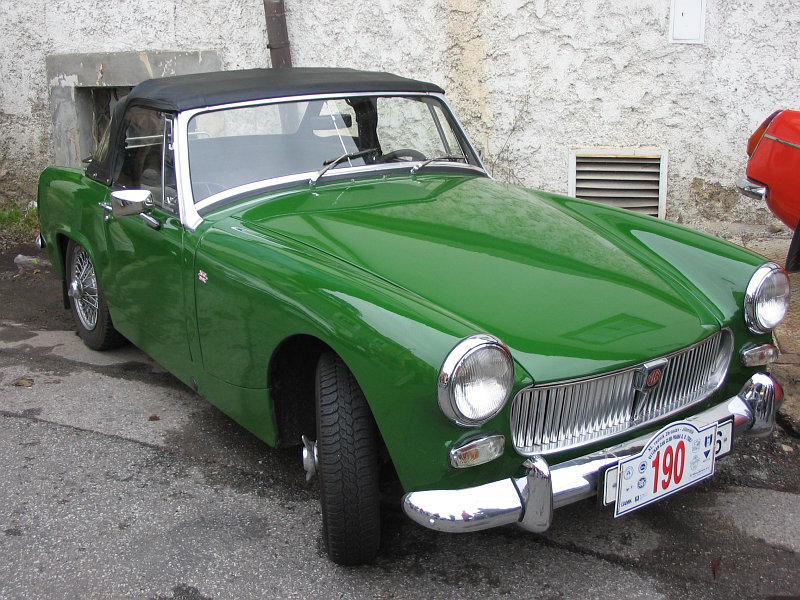
The MG Midget 1300 Mk III was introduced in October 1966 as a substantially improved version of MG’s popular lightweight two-seat sports car. Powered by a larger 1,275 cc BMC A-series four-cylinder engine, the Mk III offered stronger acceleration, improved flexibility and a more relaxed driving experience than the preceding 1,098 cc models. Retaining the compact dimensions, responsive handling and traditional British roadster character of its predecessors, the new Midget also incorporated improvements to its weather equipment, interior and general usability. Produced at MG’s Abingdon factory in Oxfordshire until 1974, the Mk III became one of the most successful versions of the Midget range and helped maintain MG’s position in the affordable sports car market throughout the late 1960s and early 1970s.
The origins of the MG Midget Mk III can be traced to the revival of the Midget name in June 1961. Developed alongside the Austin-Healey Sprite within the British Motor Corporation, the original Midget was intended to provide an inexpensive entry point into MG ownership. Its lightweight construction, simple mechanical components and lively handling made it popular among enthusiasts who wanted the enjoyment of a traditional sports car without the purchase price or running costs associated with larger models such as the MGA and MGB.
The first Midget was powered by a 948 cc A-series engine, which was enlarged to 1,098 cc in October 1962. The introduction of the Mk II in 1964 brought significant improvements to practicality, including wind-up side windows, external door handles and revised rear suspension. However, the increasing performance of competing sports cars highlighted the limitations of the relatively small engine, particularly during motorway driving and when carrying a passenger.
The introduction of the Mk III addressed these limitations through the adoption of the larger 1,275 cc A-series engine. This unit was closely related to the engine used in the Mini Cooper S, although the Midget employed a different specification and produced less power. The increased displacement provided a useful improvement in torque and acceleration, making the car more capable in everyday driving while retaining the simplicity and reliability associated with the A-series family.
The engine featured four cylinders arranged in line, with overhead valves operated by pushrods. A cast-iron cylinder block and cylinder head provided a robust foundation, while twin SU carburettors supplied the fuel-air mixture. The original Mk III engine developed approximately 65 horsepower at 6,000 rpm, with maximum torque of around 72 lb ft (98 Nm) at 3,000 rpm.
The increase in engine capacity was achieved through a larger bore and relatively short stroke, allowing the engine to operate willingly at higher speeds while providing improved torque throughout the rev range. Compared with the earlier 1,098 cc unit, the 1,275 cc engine offered stronger acceleration and greater flexibility, reducing the need for frequent gear changes during normal driving.
Although the Midget’s engine was derived from the same A-series family as the Mini Cooper S, it was not identical to the high-performance Cooper S unit. The Midget used a more conventional engine specification designed to provide a balance of performance, durability and economical operation. Nevertheless, its twin-carburettor arrangement and relatively high-revving characteristics gave it a distinctly sporting character.
The A-series engine was already well established within the British Motor Corporation and had earned a reputation for straightforward maintenance and considerable tuning potential. Its compact dimensions and relatively low weight made it particularly suitable for the Midget, while the widespread availability of related components helped keep servicing and repair costs manageable.
Power was transmitted to the rear wheels through a four-speed manual gearbox incorporating synchromesh on second, third and fourth gears. First gear remained unsynchronised, requiring careful selection when the car was moving. The gearbox retained the direct mechanical feel of earlier Midgets, while the increased engine torque made the car less dependent on frequent changes to maintain progress.
The MG Midget 1300 Mk III was capable of reaching approximately 95 mph (153 km/h), depending on vehicle specification and road conditions. Acceleration from 0 to 60 mph generally required around 13 to 15 seconds, representing a noticeable improvement over the preceding 1,098 cc model. Although still modest compared with larger contemporary sports cars, the additional performance made the Mk III more suitable for motorway journeys and longer-distance touring.
The chassis retained the lightweight unitary body construction introduced with the original Midget. Rather than employing a separate ladder frame, the body shell incorporated the principal structural members, providing a relatively rigid foundation for the suspension and drivetrain. This arrangement contributed to the car’s low weight and compact dimensions, both of which remained central to its sporting character.
At the front, the Mk III retained independent suspension using coil springs and wishbones, with lever-arm hydraulic shock absorbers forming part of the upper suspension arrangement. This provided relatively precise wheel control and responsive handling, particularly on smooth and moderately uneven roads.
At the rear, the car employed a live axle supported by semi-elliptic leaf springs, an arrangement introduced with the Mk II in 1964. Lever-arm hydraulic shock absorbers controlled suspension movement. Although the system was relatively simple, it provided predictable handling and reasonable ride comfort, particularly when compared with the earlier quarter-elliptic arrangement.
Braking was provided by hydraulically operated front disc brakes and rear drum brakes. The front discs offered improved stopping performance and resistance to fade compared with the all-drum system used on the original 948 cc Midget. The braking system was well matched to the Mk III’s increased performance and relatively low weight.
Rack-and-pinion steering was retained, providing direct and responsive control. Combined with the short wheelbase, narrow track and lightweight construction, this gave the Midget exceptional agility on winding roads. The car responded quickly to steering inputs and encouraged an enthusiastic driving style, making it particularly enjoyable on narrow British country lanes.
Externally, the MG Midget 1300 Mk III retained the familiar compact styling of its predecessors. The low bonnet, headlamps integrated into the front wings, traditional MG grille and short rear deck continued to define the model’s appearance. The rounded wings and simple body panels gave the car a purposeful sporting character without unnecessary ornamentation.
One of the most significant improvements introduced with the Mk III was the adoption of a permanently attached folding hood. Earlier Midgets required more effort to erect their weather equipment, while the Mk III’s revised arrangement made it easier to raise and lower the roof. This improvement greatly increased the car’s practicality, particularly in the changeable British climate.
The Mk III also incorporated improvements to the interior and trim, although the overall cockpit layout remained relatively simple. Two individual seats provided accommodation for the driver and passenger, while the dashboard incorporated a speedometer, tachometer, fuel gauge and other essential controls. The large steering wheel and short floor-mounted gear lever maintained the car’s traditional sporting character.
The driving position remained low, with the driver seated close to the road and surrounded by a compact cockpit. The relatively narrow body and limited interior space reinforced the Midget’s character as a small sports car, while the improved hood and wind-up windows made it more practical for everyday use.
During its production life, the Mk III underwent several revisions reflecting changing market requirements and safety regulations. Early examples retained much of the chrome trim and traditional appearance of the preceding models, while later versions incorporated revised grilles, lighting arrangements and interior details.
In 1969, the Midget received a revised exterior treatment that included a black recessed grille and changes to the body trim. These modifications gave the car a more contemporary appearance while retaining its basic proportions. The revised styling reflected the changing tastes of the late 1960s and helped maintain the Midget’s appeal in an increasingly competitive market.
Further changes followed during the early 1970s, including revised wheel designs, interior trim and safety-related equipment. North American export models were particularly affected by increasingly stringent emissions and safety regulations, which required modifications to engine specification, lighting and other components.
The Midget’s popularity in North America remained important to MG’s commercial success. American buyers appreciated its compact dimensions, traditional British styling and enjoyable handling, while the larger 1,275 cc engine provided improved performance compared with earlier versions. Export demand helped sustain production despite increasing competition from more modern sports cars.
The Mk III also remained popular among enthusiasts involved in amateur motorsport. Its lightweight construction, responsive handling and straightforward mechanical layout made it suitable for club racing, hill climbs, sprints and other sporting events. The A-series engine offered extensive tuning potential, and many owners modified their cars with improved carburation, revised camshafts, cylinder-head work and exhaust systems.
The Midget’s relatively simple suspension and drivetrain also made it attractive for competition preparation. Although the standard car was not intended as an outright racing machine, its low weight and balanced handling allowed it to perform effectively in events where agility and driver skill were more important than maximum engine output.
Production of the MG Midget 1300 Mk III continued until 1974, when it was replaced by the substantially revised Midget 1500. The new model adopted a 1,493 cc Triumph-derived engine and incorporated major changes to its bumpers and ride height to satisfy increasingly demanding safety and emissions requirements, particularly in the United States.
Approximately 100,000 MG Midget Mk III models were manufactured during its production life, making it one of the most numerous and successful versions of the Midget range. Its long production period reflected the enduring appeal of the lightweight British roadster concept, even as the wider motor industry moved towards more sophisticated and comfortable vehicles.
Today, the MG Midget 1300 Mk III is widely regarded as one of the most desirable versions of the Midget range. Its combination of the 1,275 cc A-series engine, compact dimensions, chrome-bumper styling and relatively simple mechanical construction makes it particularly attractive to enthusiasts seeking a traditional British sports car. Early examples are valued for their classic appearance, while later versions offer various improvements in equipment and usability.
Restoration requires careful inspection of the unitary body structure, particularly the sills, floor panels, wheel arches and suspension mounting points. Corrosion can seriously affect structural integrity, while the condition of the engine, gearbox and suspension should also be assessed. The A-series engine benefits from extensive specialist support and good parts availability, making mechanical restoration relatively straightforward compared with many other classic sports cars.
The MG Midget 1300 Mk III represents an important chapter in MG’s post-war history. By combining the lightweight construction and responsive handling of the original Midget with a more powerful 1,275 cc engine and improved weather protection, MG created a more capable and practical sports car without sacrificing its essential character. Its long production life, strong export demand and continuing popularity among enthusiasts demonstrate the enduring appeal of the traditional British roadster, ensuring that the Midget 1300 Mk III remains one of the most recognisable and enjoyable MG models of the 1960s and early 1970s.