
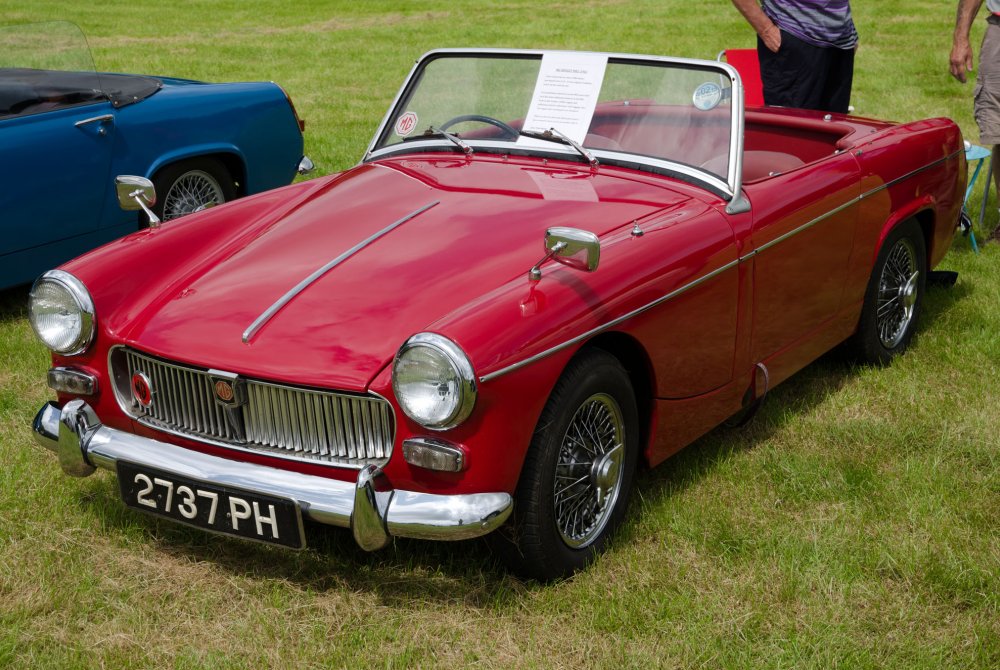
The MG Midget 1100 Mk I was an improved version of MG’s compact two-seat sports car, introduced in October 1962 as the successor to the original 948 cc Midget. Featuring an enlarged 1,098 cc engine, improved braking and revised mechanical components, the 1100 offered stronger performance while retaining the lightweight construction, compact dimensions and traditional British roadster character of the original model. Produced at MG’s Abingdon factory in Oxfordshire until early 1964, it represented an important stage in the development of the revived Midget range and helped establish the model as one of Britain’s most accessible and enjoyable small sports cars.
The MG Midget had been reintroduced in June 1961 as a badge-engineered development of the Austin-Healey Sprite Mk II. Both cars were produced within the British Motor Corporation and shared their basic body structure, chassis engineering and mechanical components. The Midget was intended to provide an affordable entry point into MG ownership, offering the company’s established sporting identity in a smaller and less expensive package than the MGA and, subsequently, the MGB.
The original Midget was powered by a 948 cc BMC A-series engine, which provided lively performance when combined with the car’s relatively low weight. However, the modest engine output limited acceleration, particularly when carrying a passenger or travelling on faster roads. The introduction of the 1,098 cc engine addressed this limitation, providing improved torque and flexibility without requiring major changes to the vehicle’s basic design.
The enlarged engine was closely related to the A-series units already used in other BMC vehicles, including the Austin A40 and Morris Minor. Its adoption reflected the corporation’s policy of sharing proven mechanical components across different models, reducing manufacturing costs while simplifying servicing and maintenance.
Power was supplied by a 1,098 cc inline four-cylinder engine featuring overhead valves operated by pushrods. The engine employed a cast-iron cylinder block and cylinder head, with twin SU carburettors providing fuel delivery. In MG Midget specification, it developed approximately 56 horsepower at 5,750 rpm, representing a useful increase over the 46 horsepower produced by the original 948 cc engine.
The increase in displacement was achieved through changes to the engine’s bore and stroke, with the 1,098 cc unit featuring a longer stroke than its predecessor. This contributed to improved torque at lower and intermediate engine speeds, making the car more flexible during everyday driving. The additional power was particularly noticeable when accelerating from low speeds, climbing hills or overtaking slower traffic.
The A-series engine retained its reputation for mechanical simplicity and durability. Its overhead-valve arrangement, conventional lubrication system and straightforward construction made it relatively easy to maintain, while the widespread use of related engines throughout the BMC range ensured good availability of mechanical components.
The twin SU carburettors contributed to responsive throttle characteristics and helped distinguish the sporting MG engine from more modest single-carburettor versions used in family cars. The engine was also well suited to performance tuning, and enthusiasts frequently experimented with improved cylinder heads, revised camshafts and exhaust systems to increase output.
Power was transmitted to the rear wheels through a four-speed manual gearbox incorporating synchromesh on second, third and fourth gears. First gear remained unsynchronised, requiring careful selection when the vehicle was moving. The transmission retained the direct mechanical feel of the original Midget, while the increased engine torque made the car less dependent on frequent gear changes.
The MG Midget 1100 Mk I was capable of reaching approximately 90 mph (145 km/h), depending on vehicle condition and road conditions. Acceleration from 0 to 60 mph generally required around 16 to 18 seconds, representing a noticeable improvement over the original 948 cc model. Although still modest compared with larger contemporary sports cars, the additional performance made the Midget more capable on open roads and improved its suitability for longer journeys.
One of the most significant mechanical improvements introduced with the 1100 was the adoption of front disc brakes. The original 948 cc Midget had been equipped with drum brakes on all four wheels, which were adequate for its performance but could suffer from reduced effectiveness during repeated heavy braking. The introduction of front discs provided more consistent stopping power and improved resistance to brake fade.
The front braking system employed hydraulically operated disc brakes, while conventional drums were retained at the rear. This arrangement represented a substantial improvement in the car’s braking performance and brought it closer to the standards expected of more powerful contemporary sports cars.
The Midget retained its lightweight unitary body construction, in which the body shell and structural chassis components formed a single integrated assembly. This design eliminated the need for a separate ladder frame and contributed to the car’s low overall weight. The compact structure also provided a relatively rigid foundation for the suspension and drivetrain.
At the front, independent suspension employed coil springs and wishbones, with lever-arm hydraulic shock absorbers forming part of the upper suspension arrangement. This system provided relatively precise wheel control and contributed to the Midget’s responsive handling. Its compact design was well suited to the limited space available within the small engine compartment and front wheel arches.
At the rear, the 1100 Mk I retained a live axle supported by quarter-elliptic leaf springs, with lever-arm hydraulic shock absorbers controlling suspension movement. Although the arrangement was simple, it helped maintain the car’s low weight and provided predictable handling when driven within its limits. The short wheelbase and relatively narrow track gave the Midget a lively character, particularly on winding roads.
Rack-and-pinion steering provided direct and responsive control, allowing the driver to place the car accurately through corners. The relatively low weight over the front wheels contributed to light steering effort, while the compact dimensions made the Midget easy to manoeuvre in towns and on narrow country roads.
Externally, the MG Midget 1100 Mk I remained almost identical to the original 948 cc model. It retained the low bonnet, headlamps integrated into the front wings, traditional MG grille and compact two-seat body. The short rear deck, rounded wings and simple exterior detailing gave the car an attractive and purposeful appearance.
The body was closely related to that of the Austin-Healey Sprite Mk II, although MG-specific badges, grille treatment and trim distinguished the Midget from its BMC stablemate. The styling was deliberately uncomplicated, reflecting the model’s position as an affordable sports car rather than a luxurious grand tourer.
Early Mk I Midgets featured sliding side windows rather than conventional wind-up glass, while the doors lacked external handles. Access was gained through interior catches, an arrangement that reduced complexity and weight but offered limited convenience. The removable hood and detachable side screens provided basic protection from the weather, although fitting them required more effort than the folding roof arrangements used on later models.
The windscreen was relatively upright, while the low doors and compact cockpit contributed to the open-air driving experience. The car’s small external dimensions made it particularly suitable for narrow British roads, while the lightweight body allowed the modest engine to deliver entertaining performance.
Inside, the MG Midget 1100 Mk I offered a simple and functional cockpit designed primarily around the needs of the driver. Two individual seats provided accommodation for the driver and passenger, while the dashboard incorporated a speedometer, tachometer, fuel gauge and other essential controls. The large steering wheel and short floor-mounted gear lever reinforced the car’s direct sporting character.
Interior trim was relatively basic, with limited sound insulation and few luxury features. The cockpit was narrow, and luggage accommodation was modest, although sufficient for short touring journeys. The removable hood and side screens offered only limited weather protection, making the Midget most enjoyable in favourable conditions.
The driving experience was one of the model’s principal attractions. The combination of low weight, responsive steering and improved engine performance created a lively and engaging sports car. The additional torque of the 1,098 cc engine made the car easier to drive in everyday conditions, while the front disc brakes provided greater confidence during enthusiastic motoring.
The Midget was particularly enjoyable on winding country roads, where its compact dimensions and precise steering allowed the driver to maintain momentum through corners. Although the rear suspension could become unsettled on rough surfaces, the car generally offered predictable handling and encouraged an active driving style.
The 1100 Mk I competed in the growing market for affordable British sports cars, alongside models such as the Triumph Spitfire and its closely related Austin-Healey Sprite counterpart. Its relatively low purchase price, economical running costs and established MG identity made it attractive to younger motorists and enthusiasts seeking an accessible introduction to sports car ownership.
The model also enjoyed popularity in export markets, particularly North America, where British sports cars had developed a strong following during the 1950s and early 1960s. The Midget’s compact dimensions, traditional styling and enjoyable handling appealed to buyers seeking an alternative to larger domestic vehicles.
The 1100 Mk I also provided a useful foundation for amateur motorsport. Its lightweight construction, responsive engine and straightforward mechanical layout made it suitable for club racing, hill climbs, sprints and other sporting events. The A-series engine’s extensive tuning potential encouraged owners to develop their cars for competition, while the improved braking system offered advantages over the original 948 cc model.
Production of the MG Midget 1100 Mk I continued until early 1964, when it was replaced by the Midget Mk II. The revised model introduced several important improvements, including wind-up side windows, external door handles and a redesigned rear suspension arrangement. These changes made the Midget more practical for everyday use while retaining its essential sporting character.
The original Mk I generation, encompassing both the 948 cc and 1,098 cc versions, achieved a combined production total of approximately 25,681 cars. The 1100 version represented a significant proportion of this figure, although its relatively short production period makes it less common than many later Midget variants.
Today, the MG Midget 1100 Mk I is regarded as an attractive and historically significant example of the early revived Midget range. Its combination of improved engine performance, front disc brakes and simple body construction makes it particularly appealing to enthusiasts seeking a lightweight British sports car with a relatively direct driving experience.
Restoration requires careful inspection of the unitary body structure, particularly the sills, floor panels, wheel arches and rear spring mounting points. Corrosion can seriously affect structural integrity, while the condition of the engine, gearbox and suspension should also be assessed. Mechanical components benefit from extensive specialist support, although early Mk I body fittings, side screens and trim details can be more difficult to obtain than parts used on later models.
The MG Midget 1100 Mk I represents an important stage in the evolution of MG’s affordable sports car range. By combining the lightweight construction and distinctive styling of the original Midget with a more powerful engine and improved braking system, MG created a more capable and enjoyable roadster without compromising its essential simplicity. Although produced for a relatively short period, the 1100 Mk I helped establish the Midget’s reputation for responsive handling, economical operation and accessible sporting motoring, qualities that would remain central to the model throughout its long production life.