
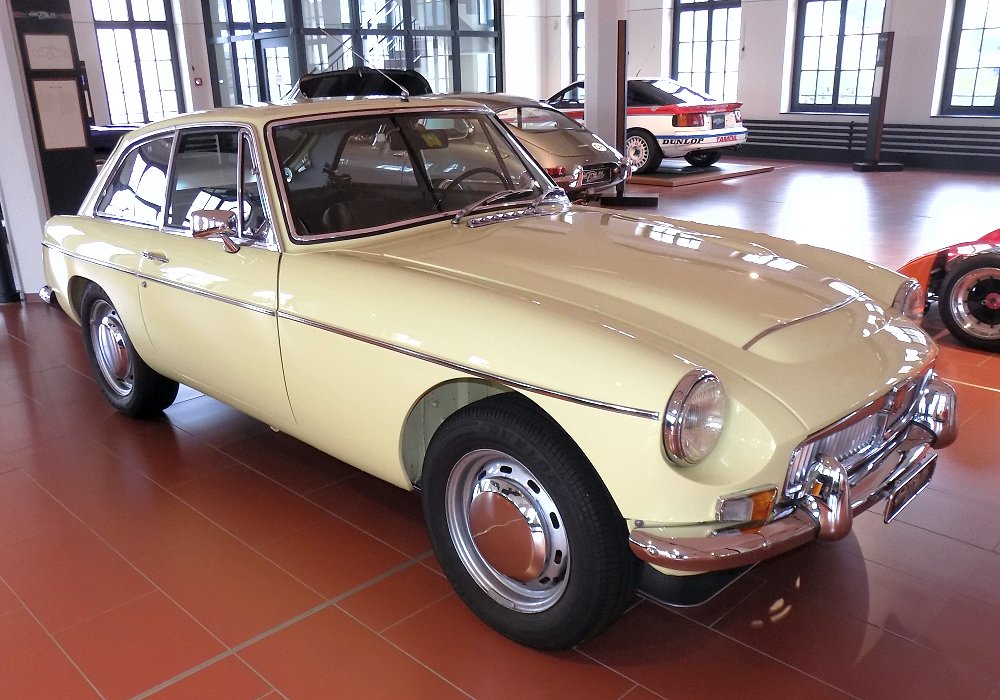
The MG MGB GT V8 was one of the most distinctive and powerful production sports cars manufactured by MG during the 1970s. Introduced in 1973, it combined the elegant fastback body of the established MGB GT with a lightweight 3.5-litre Rover V8 engine, creating a remarkably capable grand touring car with substantially improved performance over the standard four-cylinder model. Despite its larger engine, the aluminium-alloy V8 was relatively light, allowing MG to achieve impressive acceleration without significantly compromising the balanced handling characteristics of the original MGB. Produced until 1976 in comparatively small numbers, the MGB GT V8 has become one of the most sought-after derivatives of the MGB family, admired for its understated appearance, strong performance and unusual place in British sports car history.
The origins of the MGB GT V8 can be traced to the introduction of the original MGB Roadster in 1962 and the subsequent arrival of the MGB GT in 1965. The MGB had been developed as the successor to the MGA, introducing unitary body construction, improved passenger accommodation and a dependable 1,798 cc B-series four-cylinder engine. Its attractive styling and enjoyable driving characteristics quickly established it as one of Britain’s most successful sports cars.
The MGB GT expanded the range by introducing an elegant fixed-head body developed with styling assistance from Pininfarina. Its gently sloping roofline, large rear window and practical rear hatch transformed the open MGB into a compact grand touring car suitable for everyday use and longer-distance travel.
Although the standard MGB GT offered respectable performance, its relatively modest four-cylinder engine limited acceleration compared with more powerful sporting coupés. MG attempted to address this with the introduction of the MGC GT in 1967, which employed a larger 2.9-litre six-cylinder engine. However, the heavier cast-iron engine altered the car’s weight distribution and handling characteristics, and the MGC was discontinued in 1969 after a relatively short production life.
The idea of installing a lightweight V8 engine in the MGB was subsequently developed by independent engineer and racing driver Ken Costello. During the early 1970s, Costello began converting MGB Roadsters and GTs to accept the aluminium-alloy Rover V8 engine, demonstrating that the compact power unit could be installed within the MGB engine compartment without requiring extensive changes to the basic body structure.
Costello’s conversions attracted considerable attention because they offered substantially improved performance while retaining much of the standard MGB’s handling balance. The success of these privately developed cars helped demonstrate the potential of a factory-produced V8-powered MGB.
British Leyland subsequently developed its own version of the concept, incorporating the Rover V8 engine into the MGB GT body. The factory programme was engineered to meet production requirements, with changes to the engine installation, transmission, cooling system and associated mechanical components.
The production MGB GT V8 was officially introduced in August 1973. Unlike Costello’s conversions, which could employ more powerful engine specifications, the factory model used a relatively modestly tuned version of the Rover V8, prioritising smooth power delivery, durability and everyday usability.
The engine was the 3,528 cc Rover V8, originally derived from the Buick aluminium-alloy V8 design developed in the United States during the early 1960s. Rover acquired the rights to the engine and adapted it for British production, introducing it in the Rover P5B in 1967 before employing it in several other vehicles.
The V8 featured an aluminium-alloy cylinder block and cylinder heads, with eight cylinders arranged in a 90-degree configuration. The engine employed overhead valves operated by pushrods through a centrally mounted camshaft, providing a relatively compact and lightweight design.
In MGB GT V8 specification, the engine developed approximately 137 bhp at 5,000 rpm, with maximum torque of around 193 lb ft (262 Nm) at 2,900 rpm. Although these figures were modest compared with some other applications of the Rover V8, they represented a substantial increase over the standard MGB GT’s approximately 95 bhp.
The V8’s greatest advantage was its strong torque delivery. The engine produced considerably more pulling power at low and medium engine speeds than the four-cylinder B-series unit, allowing the car to accelerate rapidly without requiring frequent gear changes.
The aluminium construction also helped keep engine weight relatively low. Despite having almost twice the displacement of the standard MGB engine, the Rover V8 was not substantially heavier than the cast-iron four-cylinder unit it replaced. This was particularly important because it allowed MG to preserve much of the MGB GT’s established handling balance.
The V8 engine was mounted longitudinally at the front of the car, driving the rear wheels through a four-speed manual gearbox. The transmission was strengthened to accommodate the additional torque, while a Laycock overdrive unit was fitted as standard.
The overdrive transmission provided a useful higher cruising ratio, allowing reduced engine speeds during motorway driving. Combined with the V8’s substantial torque, this made the MGB GT V8 particularly suitable for long-distance touring.
The MGB GT V8 was capable of reaching approximately 125 mph (201 km/h), making it one of the fastest production MG road cars of its period. Acceleration from 0 to 60 mph generally required around 7.7 to 8 seconds, representing a dramatic improvement over the standard four-cylinder GT.
The strong acceleration was particularly noticeable during overtaking, where the V8’s torque allowed rapid progress without the need for high engine speeds. The engine’s smoothness and relatively relaxed operating characteristics also contributed to a more refined grand touring experience.
The MGB GT V8 retained the basic unitary steel body structure of the standard MGB GT. This construction eliminated the need for a separate chassis and provided a relatively rigid foundation for the suspension and drivetrain.
Externally, the V8 was deliberately understated. It retained the familiar MGB GT fastback body, including the long bonnet, rounded front wings, recessed headlamps and gently sloping roofline. The large rear hatch and practical luggage compartment also remained unchanged.
Unlike the earlier MGC GT, which featured a distinctive bonnet bulge to accommodate its larger six-cylinder engine, the MGB GT V8 retained a relatively standard bonnet profile. The compact Rover V8 fitted within the engine compartment without requiring the prominent external modifications associated with the MGC.
The V8 could be identified by its distinctive badging and special alloy wheels. The factory model was equipped with 14-inch Dunlop alloy wheels, which provided a more modern appearance than the traditional wire wheels associated with earlier MG sports cars.
The alloy wheels were particularly appropriate for the V8 because they complemented its improved performance and provided a distinctive visual identity without substantially altering the familiar MGB GT styling.
The suspension arrangement remained closely related to that of the standard MGB GT. At the front, independent suspension employed coil springs and wishbones, with lever-arm hydraulic shock absorbers forming part of the upper suspension arrangement.
At the rear, the car retained a conventional live axle supported by semi-elliptic leaf springs, with lever-arm hydraulic shock absorbers controlling suspension movement. The rear axle and associated components were adapted to accommodate the increased torque output of the V8 engine.
Although the basic suspension design was relatively conventional, the lightweight engine helped preserve the car’s balanced handling. The MGB GT V8 therefore avoided some of the front-heavy characteristics associated with the earlier MGC GT.
Rack-and-pinion steering was retained, providing direct and responsive control. The relatively compact dimensions and low seating position contributed to an engaging driving experience, while the additional engine performance gave the V8 a considerably more muscular character than the standard GT.
The braking system employed front disc brakes and rear drums, with components adapted to suit the increased performance. Although the arrangement remained conventional, it provided adequate stopping capability for the car’s weight and intended use.
Inside, the MGB GT V8 retained the practical and relatively comfortable cockpit of the standard GT. Two individual front seats provided accommodation for the driver and passenger, while the dashboard incorporated a speedometer, tachometer and supplementary instruments.
The permanent roof, wind-up side windows and improved weather protection made the GT suitable for year-round use. The large rear hatch provided convenient access to the luggage compartment, while the folding rear seat backrest allowed additional carrying capacity.
The interior was relatively modest compared with more expensive grand touring cars, reflecting MG’s emphasis on affordable sporting motoring. Nevertheless, the combination of comfortable seating, useful luggage space and strong engine performance made the V8 particularly appealing for longer journeys.
The MGB GT V8’s driving experience was characterised by effortless acceleration, strong mid-range torque and relatively balanced handling. Unlike the standard four-cylinder MGB, which required more frequent gear changes to maintain brisk progress, the V8 could accelerate strongly from relatively low engine speeds.
The engine’s distinctive exhaust note also contributed to the car’s character. The smooth and powerful sound of the Rover V8 contrasted with the more traditional four-cylinder exhaust note of the standard MGB, giving the car a more substantial sporting presence.
The V8’s performance placed it in competition with more expensive sporting coupés, including models from Triumph, Datsun and various European manufacturers. Although the MGB GT V8 retained an older basic body and suspension design, its strong acceleration and attractive styling made it a compelling alternative.
The car was particularly well suited to British roads, where its compact dimensions, flexible engine and responsive steering allowed rapid progress on winding routes. The overdrive transmission and enclosed body also made it comfortable during sustained motorway cruising.
Despite its impressive performance, the MGB GT V8 faced difficult commercial circumstances. Introduced during a period of economic uncertainty, it was affected by the international oil crisis of 1973, which increased fuel prices and reduced demand for larger-engined cars.
The V8 was also relatively expensive compared with the standard MGB GT, limiting its appeal among buyers who were primarily attracted to MG’s reputation for affordable sports cars.
Another significant limitation was the decision not to export the factory MGB GT V8 to North America. The United States had traditionally been MG’s most important market, but the V8 was developed primarily for the British market and was not certified for American emissions and safety requirements.
This decision substantially restricted the model’s commercial potential. Although independent V8 conversions were known in North America, the factory-produced MGB GT V8 was not officially marketed there.
The MGB GT V8 was initially produced with traditional chrome bumpers, matching the appearance of the contemporary four-cylinder MGB GT. These early cars are particularly admired for their elegant styling and relatively low ride height.
In 1974, the MGB range underwent significant changes to comply with increasingly stringent safety regulations. The traditional chrome bumpers were replaced by large black polyurethane-covered bumpers, while the suspension ride height was increased.
The MGB GT V8 adopted these changes, resulting in the later rubber-bumper version. Although the revised appearance was less delicate than that of the original chrome-bumper model, the V8 retained its strong performance and practical grand touring character.
The rubber-bumper V8 also reflected the broader changes taking place within British Leyland during the mid-1970s, as the company attempted to balance production costs, regulatory requirements and changing customer expectations.
Production of the MGB GT V8 ended in 1976 after a relatively short manufacturing period. A total of 2,591 factory-built examples were produced, comprising 1,856 chrome-bumper cars and 735 rubber-bumper cars.
The limited production total reflected the model’s relatively high price, restricted export opportunities and difficult market conditions. Nevertheless, the MGB GT V8 demonstrated the considerable potential of combining the established MGB body with a lightweight and powerful engine.
The Rover V8 continued to enjoy a long and successful career in other British vehicles, including Rover saloons, Land Rover models, Range Rovers and various specialist sports cars. Its compact dimensions, relatively low weight and strong torque delivery made it particularly suitable for performance applications.
The MGB GT V8 also helped establish a tradition of V8 conversions among MG enthusiasts. Numerous standard MGB Roadsters and GTs have subsequently been modified to accept Rover V8 engines, often producing considerably more power than the original factory specification.
The concept was revived in the early 1990s with the introduction of the MG RV8, a modernised Roadster based on the original MGB architecture and powered by a larger Rover V8 engine. Although substantially revised, the RV8 reflected the enduring appeal of combining traditional MG styling with V8 performance.
Today, the MG MGB GT V8 is regarded as one of the most desirable and collectible versions of the MGB family. Its limited production, understated styling and strong performance distinguish it from the more numerous four-cylinder models.
Chrome-bumper examples are particularly sought after because of their classic appearance and relatively small production numbers, although the later rubber-bumper cars are also valued for their rarity and distinctive place in MG history.
Restoration requires careful inspection of the unitary body structure, particularly the sills, floor panels, wheel arches, door pillars and suspension mounting areas. Corrosion can affect the structural integrity of the body, and extensive repairs may be required on neglected examples.
The V8 engine is generally robust and benefits from extensive specialist knowledge and good parts availability. However, the cooling system, engine installation, exhaust arrangement and transmission components require careful attention because of the additional heat and torque generated by the larger engine.
Originality is particularly important when assessing a factory MGB GT V8, as numerous standard MGB GTs have been converted to V8 power. Chassis identification numbers, engine numbers and historical documentation should therefore be examined carefully to establish whether a vehicle is an original factory-produced example.
The distinctive alloy wheels, V8-specific mechanical components and interior details can also be important considerations during restoration. Although many parts are shared with the standard MGB GT, certain components unique to the V8 can be more difficult to obtain.
The availability of specialist support and replacement components remains a significant advantage. The extensive MGB enthusiast community and the long production history of the Rover V8 engine provide a strong foundation for maintenance and restoration.
The MG MGB GT V8 represents one of the most successful examples of combining traditional British sports car design with a lightweight, powerful engine. By installing the aluminium-alloy Rover V8 into the elegant MGB GT body, MG created a fast, refined and practical grand touring car that offered substantially improved performance without sacrificing the balanced handling and attractive styling of the original model. Its short production life, limited numbers and distinctive engineering have secured its place among the most desirable British sporting coupés of the 1970s.