
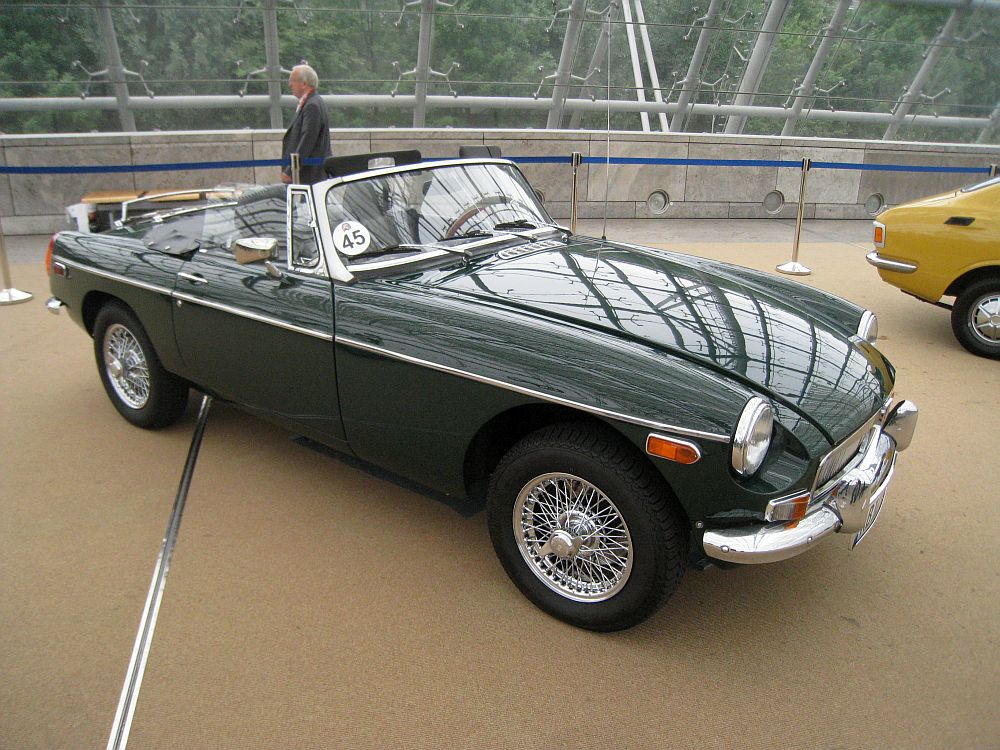
The MG MGB Roadster LC was a low-compression version of MG’s highly successful open two-seat sports car, developed primarily to meet the changing fuel quality and emissions requirements of important export markets during the late 1960s and 1970s. The LC designation referred to the low-compression specification of the established 1,798 cc B-series four-cylinder engine, rather than to a completely separate MGB model or body style. Retaining the attractive styling, unitary body construction and traditional rear-wheel-drive layout of the standard MGB Roadster, the low-compression version offered greater compatibility with lower-octane petrol at the expense of some engine performance. It formed part of MG’s efforts to adapt its popular sports car to increasingly diverse international operating conditions while preserving the essential character that had made the MGB a worldwide success.
The origins of the MGB Roadster LC can be traced to the introduction of the original MGB in 1962. Developed as the successor to the MGA, the MGB represented a substantial advance in MG’s sports car engineering, incorporating unitary body construction, a larger 1.8-litre engine and improved passenger accommodation. Its combination of attractive styling, dependable mechanical components and enjoyable handling quickly established it as one of Britain’s most successful export sports cars.
The original MGB was powered by a 1,798 cc BMC B-series inline four-cylinder engine, featuring overhead valves operated by pushrods. The engine was designed to provide a useful balance between performance, reliability and economical operation, with twin SU carburettors supplying fuel on most early models.
In its original high-compression specification, the MGB engine employed a compression ratio of approximately 8.8:1 and developed around 95 bhp at 5,400 rpm. This provided respectable performance for an affordable sports car of the early 1960s, with a maximum speed of approximately 103 mph (166 km/h).
However, the availability and quality of petrol varied considerably between international markets. While higher-octane fuels were readily available in Britain and some European countries, other markets offered petrol with lower octane ratings, which could cause detonation in engines designed for higher-compression operation.
Detonation, commonly referred to as pinking or knocking, occurs when combustion within the cylinder becomes uncontrolled, producing excessive pressure and potentially damaging engine components. High-compression engines are particularly sensitive to this condition when operated on fuel with an insufficient octane rating.
To address these concerns, MG offered low-compression versions of the B-series engine for markets where suitable high-octane petrol was unavailable or where operating requirements favoured reduced compression. These engines were identified by their lower compression ratios and associated engine specifications.
The low-compression MGB engine generally employed a compression ratio of approximately 8.0:1, compared with the 8.8:1 ratio used on many high-compression versions. This reduction allowed the engine to operate more reliably on lower-octane petrol, although it also reduced thermal efficiency and maximum power output.
The reduction in compression ratio was achieved through changes to the engine’s internal components, particularly the piston crown configuration. The basic cylinder block, cylinder head and valve gear remained closely related to those used in the standard high-compression engine.
The MGB Roadster LC retained the established 1,798 cc B-series engine architecture, with four cylinders arranged in line and overhead valves operated by pushrods. The engine employed a cast-iron cylinder block and cylinder head, providing robust construction and relatively straightforward maintenance.
Fuel delivery was provided by carburettors, with the exact arrangement depending on production year and market specification. Many low-compression MGBs retained twin SU carburettors, while later North American versions employed different carburation and emissions-control equipment.
The power output of the low-compression engine varied according to production period, carburettor specification and emissions equipment. Earlier low-compression versions generally produced somewhat less power than their high-compression equivalents, while later emissions-controlled engines experienced more substantial reductions in output.
The reduced compression ratio altered the engine’s performance characteristics, particularly at higher engine speeds. Although the MGB LC retained the relatively strong mid-range torque associated with the B-series engine, acceleration was generally less vigorous than that of comparable high-compression models.
Nevertheless, the low-compression engine remained well suited to everyday driving. Its relatively flexible torque delivery and straightforward mechanical construction allowed the car to perform comfortably in ordinary road conditions, particularly when operated on the fuels for which it was intended.
The MGB Roadster LC retained the traditional front-engine, rear-wheel-drive layout of the standard MGB. Power was transmitted through a four-speed manual gearbox, with the transmission specification depending on the year of manufacture.
Early low-compression examples could be equipped with the original three-synchromesh gearbox, while later Mk II and subsequent versions benefited from the fully synchromesh four-speed transmission introduced in 1967.
An optional overdrive transmission was available on many MGB models, providing reduced engine speeds during sustained cruising. This was particularly useful for longer-distance touring and motorway driving, where the additional gearing improved refinement and fuel economy.
The MGB Roadster LC retained the unitary steel body structure introduced with the original MGB. This construction eliminated the need for a separate chassis and allowed the passenger compartment to be positioned more efficiently within the vehicle.
The body featured a long bonnet, short rear deck and integrated front wings, creating an attractive and balanced design. The front end incorporated recessed headlamps and a distinctive radiator grille, while the rear featured compact tail lamps and a relatively short boot lid.
The Roadster retained the traditional open two-seat configuration, with a folding fabric hood and conventional wind-up side windows. These features provided better weather protection and greater everyday practicality than the removable side screens used on the earlier MGA.
The body was constructed primarily from steel panels welded into a unitary structure, providing adequate rigidity while maintaining relatively compact external dimensions. The MGB’s wheelbase measured approximately 2,312 mm, while overall length was around 3,886 mm in early chrome-bumper specification.
The suspension arrangement remained largely unchanged from the standard MGB. At the front, independent suspension employed coil springs and wishbones, with lever-arm hydraulic shock absorbers forming part of the upper suspension arrangement.
At the rear, the car retained a conventional live axle supported by semi-elliptic leaf springs, with lever-arm hydraulic shock absorbers controlling suspension movement. Although relatively simple, this arrangement provided predictable handling and reasonable ride comfort for a lightweight sports car.
Rack-and-pinion steering was retained, offering direct and responsive control. Combined with the relatively low seating position and balanced chassis, this gave the MGB Roadster LC an engaging driving character that appealed to enthusiasts.
The braking system employed front disc brakes and rear drums, providing effective stopping performance for the car’s weight and engine output. The front disc brakes offered improved resistance to brake fade compared with the all-drum arrangements used on earlier MG sports cars.
The MGB Roadster LC was available with steel disc wheels as standard, while traditional centre-lock wire wheels were offered as an option on many versions. Wire wheels remained popular among enthusiasts because of their classic sporting appearance and association with earlier MG models.
Externally, the low-compression MGB was generally indistinguishable from the corresponding high-compression version of the same production year. The LC designation referred primarily to the engine specification rather than to a distinctive styling package.
As the MGB evolved during the late 1960s and 1970s, low-compression versions incorporated the same general body and equipment changes as other models. These included revised radiator grilles, updated interior trim and changes to lighting and safety equipment.
One of the most significant changes occurred in 1974, when the MGB was modified to comply with increasingly stringent United States safety regulations. The traditional chrome bumpers were replaced by large black polyurethane-covered bumpers designed to meet low-speed impact requirements.
The new bumpers altered the MGB’s appearance considerably, giving the car a more substantial front and rear profile. The suspension ride height was also increased to help satisfy American headlamp height regulations, affecting the car’s handling characteristics.
Although these changes were not directly related to the low-compression engine, they formed part of the broader development of the MGB during the period when emissions and fuel requirements were becoming increasingly important.
The North American market played a particularly significant role in the evolution of low-compression MGB engines. Increasingly stringent emissions regulations required manufacturers to modify carburation, ignition timing and exhaust systems to reduce harmful emissions.
During the 1970s, American-market MGBs received a range of emissions-control equipment, including air-injection systems, evaporative-emissions controls and revised ignition arrangements. Some later models also employed catalytic converters and a single Zenith-Stromberg carburettor.
These modifications, combined with reduced compression ratios, resulted in lower power output than that of the original high-compression MGB engine. By the later 1970s, some North American specifications produced substantially less power than the early 95 bhp models.
Despite the reduction in performance, the MGB retained its fundamental mechanical layout and traditional sports car character. The relatively simple B-series engine continued to provide dependable service, while the compact dimensions and responsive steering preserved much of the car’s driving appeal.
Inside, the MGB Roadster LC offered the same general accommodation as the standard Roadster. Two individual seats provided space for the driver and passenger, while the dashboard incorporated a large speedometer, tachometer and supplementary instruments.
Interior specifications varied according to production year and market requirements. Early examples retained the traditional painted metal dashboard, while later models incorporated revised trim, additional safety equipment and more modern instrumentation arrangements.
North American versions increasingly featured padded dashboards and other safety-related modifications, reflecting changing regulations and customer expectations.
The MGB’s conventional wind-up windows and folding fabric hood provided reasonable weather protection for an open sports car. The boot offered useful luggage accommodation, while the relatively economical engine and optional overdrive transmission made the car suitable for longer-distance touring.
The driving experience of the MGB Roadster LC was characterised by responsive steering, predictable handling and relatively flexible engine performance. Although the lower-compression engine generally produced less power than the high-compression version, the difference was often less noticeable during ordinary driving than during maximum acceleration.
The reduced compression ratio could also provide an advantage in regions where petrol quality was inconsistent. By reducing the likelihood of detonation, the low-compression engine offered greater tolerance of lower-octane fuels and potentially improved durability under unsuitable operating conditions.
However, the lower compression ratio did not automatically make the engine more powerful or more economical. The reduction in thermal efficiency generally resulted in slightly lower performance and could increase fuel consumption under certain driving conditions.
The MGB Roadster LC remained particularly enjoyable on winding country roads, where its relatively compact dimensions and direct controls encouraged smooth driving. The suspension provided a reasonable compromise between ride comfort and sporting handling, although the live rear axle could become unsettled on rough surfaces.
The low-compression engine specification also reflected the increasingly complex international market in which MG operated. Different countries imposed varying requirements concerning fuel quality, emissions, safety equipment and vehicle certification, requiring manufacturers to offer multiple specifications of essentially the same model.
For MG, the ability to adapt the established B-series engine to different operating conditions was an important commercial advantage. Rather than developing an entirely new engine for each market, the company could modify compression ratios, carburation and ignition systems while retaining the basic mechanical architecture.
The MGB Roadster LC therefore represented a practical response to changing international requirements rather than a fundamentally different sports car. Its significance lay in demonstrating the adaptability of the MGB design and the durability of the B-series engine.
The MGB continued in production until 1980, when British Leyland ended manufacture at the MG factory in Abingdon. The closure marked the end of an important chapter in British sports car manufacturing and brought production of the traditional MGB to a close.
Across its eighteen-year production life, approximately 387,000 MGB Roadsters were manufactured, with total production of the wider MGB family exceeding half a million vehicles. Low-compression examples formed part of this overall production, although they were not consistently recorded as a separate model throughout the entire manufacturing period.
Today, the MG MGB Roadster LC is regarded as an interesting variation of one of Britain’s most successful sports cars. Its lower-compression engine specification reflects the changing fuel and emissions requirements of the 1960s and 1970s, while its attractive styling and straightforward mechanical engineering retain the appeal of the standard MGB.
Restoration requires careful inspection of the unitary body structure, particularly the sills, floor panels, wheel arches, door pillars and suspension mounting areas. Corrosion can affect the structural integrity of the body, and extensive repairs may be required on neglected examples.
The B-series engine is generally robust and benefits from extensive specialist knowledge and good parts availability. When assessing a low-compression example, it is important to establish the original engine specification, as many MGBs have undergone engine replacements, rebuilds or modifications during their working lives.
Engine identification numbers, piston specifications and historical documentation can help determine whether a particular vehicle retains its original low-compression configuration. Carburettor and emissions equipment should also be assessed, particularly on North American examples that may have been modified or converted to alternative specifications.
The gearbox, rear axle, suspension and braking system are relatively straightforward to maintain, while the extensive availability of replacement parts makes the MGB one of the more practical classic British sports cars to own.
The MG MGB Roadster LC represents an important aspect of the MGB’s long and successful production history. By adapting the established 1.8-litre B-series engine to operate with lower compression, MG was able to accommodate different fuel qualities and changing international requirements while preserving the attractive styling, dependable engineering and enjoyable driving characteristics of the original Roadster. Although less powerful than comparable high-compression versions, the LC remains a distinctive example of the adaptability that helped the MGB achieve worldwide success and maintain production for nearly two decades.