
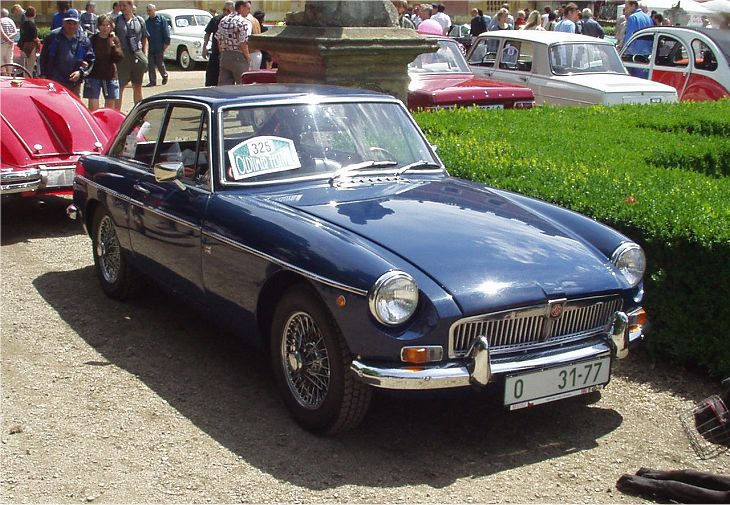
The MG MGB GT was one of the most successful and recognisable British sporting coupés of the twentieth century. Introduced in October 1965 and produced until 1980, the MGB GT combined the established mechanical engineering and enjoyable driving characteristics of the MGB Roadster with an elegant fixed-head body, improved weather protection and greater luggage capacity. Its distinctive fastback styling, developed with assistance from the Italian design house Pininfarina, transformed the open MGB into a practical grand touring car without sacrificing its traditional sporting character. Powered by the dependable 1,798 cc B-series four-cylinder engine, the MGB GT offered an attractive combination of performance, comfort and affordability, making it particularly popular among motorists seeking a classic British sports car suitable for everyday use.
The origins of the MGB GT can be traced to the introduction of the MGB Roadster in 1962. Developed as the successor to the MGA, the MGB represented a significant advance in MG’s sports car engineering, incorporating unitary body construction, improved passenger accommodation and a larger 1.8-litre engine. Its attractive styling, robust mechanical components and responsive handling quickly established it as an international success.
Although the Roadster was particularly popular in North America, MG recognised that some customers wanted the same sporting character with greater practicality and improved weather protection. The company therefore began developing a fixed-head version that would appeal to motorists who wanted a sports car capable of comfortable year-round use.
The resulting MGB GT was introduced at the Earls Court Motor Show in October 1965. Its distinctive bodywork was developed with styling assistance from Pininfarina, whose involvement helped create one of the most elegant and enduring fastback designs of the period.
The GT retained the MGB Roadster’s basic front-end styling, including its long bonnet, rounded wings, recessed headlamps and traditional chrome radiator grille. Behind the windscreen, however, the body was substantially redesigned to incorporate a permanent roof, large side windows and a gently sloping rear section.
The roofline flowed smoothly into the rear bodywork, creating a balanced fastback silhouette that complemented the MGB’s compact proportions. The relatively slender roof pillars and generous glazing provided good visibility, while the enclosed body gave the car a more substantial and refined appearance than the open Roadster.
One of the GT’s most important features was its large rear hatch, which provided convenient access to the luggage compartment. Unlike conventional sports coupés with small boot openings, the MGB GT allowed larger items to be loaded through the rear, making it considerably more practical for touring and everyday use.
The rear compartment incorporated a small occasional seat, although accommodation was extremely limited and better suited to children or additional luggage than to adult passengers. The rear seat backrest could be folded to increase carrying capacity, giving the GT a useful degree of versatility.
The MGB GT retained the unitary steel body structure introduced with the original MGB. This construction eliminated the need for a separate chassis and allowed the passenger compartment to be positioned efficiently within the vehicle.
The permanent roof contributed additional structural rigidity, giving the GT a more substantial feel than the open Roadster. The enclosed body also reduced wind buffeting and provided improved protection from the elements, making the car particularly suitable for longer-distance touring.
The MGB GT’s wheelbase measured approximately 2,312 mm, while overall length was around 3,886 mm in early chrome-bumper specification. Its relatively compact dimensions made it easy to manoeuvre and contributed to its responsive handling.
Power was supplied by the established 1,798 cc BMC B-series inline four-cylinder engine, featuring overhead valves operated by pushrods. The engine employed a cast-iron cylinder block and cylinder head, with twin SU carburettors providing fuel delivery on most early British-market examples.
In its original specification, the MGB engine developed approximately 95 bhp at 5,400 rpm, with maximum torque of around 110 lb ft (149 Nm) at 3,000 rpm. This provided a useful balance between performance and everyday flexibility, making the GT suitable for both enthusiastic driving and longer-distance touring.
The B-series engine was already well established within the British Motor Corporation and had earned a reputation for durability and straightforward maintenance. Its robust construction and relatively simple overhead-valve arrangement made it particularly suitable for a sports car intended for regular road use rather than exclusively for competition.
The engine’s relatively strong mid-range torque allowed the MGB GT to accelerate smoothly without requiring constant gear changes. This characteristic distinguished it from smaller-capacity sports cars that relied more heavily on high engine speeds to deliver their performance.
The original MGB GT was equipped with a four-speed manual gearbox, with synchromesh on second, third and fourth gears. First gear remained unsynchronised, requiring careful selection when the vehicle was moving.
In 1967, the introduction of the Mk II brought a revised gearbox with synchromesh on all four forward gears. This made the car easier to drive, particularly in urban traffic and during frequent low-speed manoeuvres.
An optional overdrive transmission was available on many MGB GT models, allowing reduced engine speeds during sustained cruising. This was particularly useful for motorway driving and longer-distance touring, where the additional gearing improved refinement and fuel economy.
The MGB GT was capable of reaching approximately 105 mph (169 km/h), depending on specification and road conditions. Acceleration from 0 to 60 mph generally required around 12 to 13 seconds, reflecting the GT’s slightly greater weight compared with the open Roadster.
The GT’s enclosed body and relatively aerodynamic shape helped compensate for the additional weight at higher speeds. Its permanent roof also provided greater comfort during sustained cruising, making it particularly suitable for longer-distance touring.
The suspension arrangement was closely related to that of the MGB Roadster. At the front, independent suspension employed coil springs and wishbones, with lever-arm hydraulic shock absorbers forming part of the upper suspension arrangement.
At the rear, the car retained a conventional live axle supported by semi-elliptic leaf springs, with lever-arm hydraulic shock absorbers controlling suspension movement. Although relatively simple, this arrangement provided predictable handling and reasonable ride comfort for a compact sporting coupé.
Rack-and-pinion steering was retained, offering direct and responsive control. Combined with the relatively low seating position and balanced chassis, this gave the MGB GT an engaging driving character that appealed to enthusiasts.
The braking system employed front disc brakes and rear drums, providing effective stopping performance for the car’s weight and engine output. The front disc brakes offered improved resistance to brake fade compared with the all-drum arrangements used on earlier MG sports cars.
The MGB GT was initially offered with steel disc wheels as standard, while traditional centre-lock wire wheels were available as an option. Wire wheels remained popular among enthusiasts because of their classic sporting appearance and association with earlier MG models.
Inside, the MGB GT offered a more refined and practical environment than the open Roadster. The permanent roof, wind-up side windows and improved weather sealing provided greater protection from wind, rain and road noise, making the GT particularly suitable for everyday driving.
The cockpit featured two individual front seats, a large steering wheel and a dashboard incorporating a speedometer, tachometer and supplementary instruments. Early British-market models retained a traditional painted metal dashboard, while later versions incorporated revised trim and additional safety equipment.
The driving position remained relatively low, with the driver seated close to the road and surrounded by a compact cockpit. The large steering wheel and conveniently positioned gear lever reinforced the traditional MG sports car environment.
The GT’s enclosed body also allowed improved interior trim and greater protection from the elements. The permanent roof and wind-up windows made the car considerably more convenient in poor weather, while the large rear window provided good rearward visibility.
The MGB GT underwent several important developments during its fifteen-year production life. In 1967, the introduction of the Mk II brought a fully synchromesh four-speed gearbox, revised transmission components and an alternator charging system.
These improvements enhanced driving convenience and reliability while retaining the established body design and mechanical layout. The stronger Salisbury-type rear axle, already used on the GT, continued as standard equipment.
In 1970, the MGB range received further styling and equipment changes, including a revised radiator grille and updated interior details. The traditional chrome grille was replaced by a recessed black grille on certain versions, reflecting contemporary styling trends.
The early 1970s also brought changes to the interior, with revised dashboards, seats and safety equipment. These modifications varied according to market requirements, particularly between British and North American models.
One of the most significant changes occurred in 1974, when the MGB was modified to comply with increasingly stringent United States safety regulations. The traditional chrome bumpers were replaced by large black polyurethane-covered bumpers designed to meet low-speed impact requirements.
The new bumpers altered the MGB GT’s appearance considerably, giving the car a more substantial front and rear profile. The suspension ride height was also increased to help satisfy American headlamp height regulations, affecting the car’s handling characteristics.
Although the rubber-bumper MGB GT was less visually delicate than the earlier chrome-bumper models, it remained mechanically robust and continued to attract buyers who valued its traditional sports car character.
Engine specifications also changed during the 1970s as emissions regulations became increasingly demanding. North American models received revised carburation, ignition systems and emissions equipment, resulting in reduced power output compared with earlier versions.
Some later American-market MGBs employed a single Zenith-Stromberg carburettor rather than the twin SU arrangement used on earlier models. These changes reduced performance but allowed MG to continue selling the car in important export markets.
British-market MGB GTs generally retained stronger engine performance, although changes to fuel quality, emissions requirements and production specifications also influenced output during the later years.
Despite these modifications, the MGB GT retained its fundamental mechanical layout throughout production. The 1,798 cc B-series engine, rear-wheel-drive transmission, independent front suspension and live rear axle remained central to its character.
The MGB GT’s driving experience was characterised by responsive steering, predictable handling and strong mid-range engine torque. The car was particularly enjoyable on winding roads, where its relatively compact dimensions and direct controls encouraged smooth driving.
The GT’s additional body weight gave it a slightly different driving character from the Roadster. Although acceleration was marginally slower, the enclosed body provided greater refinement and comfort, particularly during longer journeys.
The suspension provided a reasonable compromise between ride comfort and sporting handling, although the live rear axle could become unsettled on rough surfaces. The relatively low seating position and enclosed cockpit contributed to a distinctive grand touring character.
The MGB GT competed in a growing market for affordable sporting coupés, alongside models such as the Triumph GT6, Ford Capri and various European grand touring cars. Although some competitors offered greater engine capacity or outright performance, the MGB GT distinguished itself through its elegant styling, manageable dimensions and practical rear hatch.
North America remained an important export market for the MGB range, although the open Roadster was generally more popular than the fixed-head GT. British and European buyers often appreciated the GT’s greater practicality and suitability for year-round use.
The MGB GT also benefited from the sporting reputation established by MG’s competition activities. Modified MGBs appeared in club racing, rallies, endurance events and hill climbs, while factory-supported competition cars achieved notable results in international motorsport.
The GT’s enclosed body and relatively aerodynamic shape made it particularly suitable for certain forms of competition, including endurance racing and rallying. Its robust mechanical construction and balanced handling also made it attractive to private competitors.
The B-series engine offered considerable scope for performance modifications, including improved carburation, revised camshafts, cylinder-head work and exhaust systems. The availability of competition components and specialist knowledge encouraged enthusiasts to develop the MGB GT for a wide range of sporting activities.
In addition to the standard four-cylinder GT, MG introduced more powerful fixed-head derivatives. The MGC GT, produced between 1967 and 1969, employed a 2,912 cc six-cylinder engine, offering greater performance and a more relaxed grand touring character.
In 1973, MG introduced the MGB GT V8, powered by a lightweight 3,528 cc Rover V8 engine. This model provided substantially improved acceleration while retaining much of the standard GT’s appearance and practicality.
Although the MGC GT and MGB GT V8 were distinct models, they demonstrated the adaptability of the original MGB GT body and chassis design. The successful fastback configuration provided a suitable foundation for a range of engine specifications.
Production of the MGB GT continued until 1980, when British Leyland ended manufacture at the MG factory in Abingdon. The closure marked the end of an important chapter in British sports car manufacturing and brought production of the traditional MGB range to a close.
Approximately 125,000 four-cylinder MGB GTs were manufactured during the model’s fifteen-year production life. Together with the Roadster and related derivatives, total production of the MGB family exceeded half a million vehicles, establishing it as one of the most successful British sports car ranges ever produced.
The MGB GT’s commercial success was remarkable given its relatively conventional mechanical engineering and the increasingly difficult market conditions faced by British sports car manufacturers during the 1970s. Its longevity reflected the strength of the original design and the enduring appeal of affordable sporting motoring.
Today, the MG MGB GT is regarded as one of the most accessible and enjoyable classic British sporting coupés. Its attractive styling, dependable mechanical engineering and extensive parts availability make it particularly appealing to enthusiasts seeking a classic car suitable for regular use.
Restoration requires careful inspection of the unitary body structure, particularly the sills, floor panels, wheel arches, door pillars and suspension mounting areas. Corrosion can affect the structural integrity of the body, and extensive repairs may be required on neglected examples.
The GT’s fixed roof and rear hatch introduce additional restoration considerations, particularly concerning the roof structure, hatch alignment, window seals and interior trim. Although many mechanical components are shared with the Roadster, certain GT-specific body and trim parts can be more difficult to obtain.
The B-series engine is generally robust and benefits from extensive specialist knowledge and good parts availability. The gearbox, rear axle, suspension and braking system are also relatively straightforward to maintain, although careful inspection is essential when assessing a vehicle that has been unused for an extended period.
The availability of replacement parts and specialist support remains one of the MGB GT’s greatest advantages. Numerous suppliers continue to provide mechanical components, body panels, interior trim and weather equipment, allowing surviving cars to be maintained and restored to a high standard.
The MG MGB GT represents one of the defining achievements of the MG marque. By combining elegant fastback styling, practical hatchback accommodation, dependable mechanical engineering and enjoyable handling, MG created a sporting coupé that appealed to generations of enthusiasts around the world. Its long production life, international commercial success and enduring popularity have secured its place among the most significant British grand touring cars of the twentieth century.