
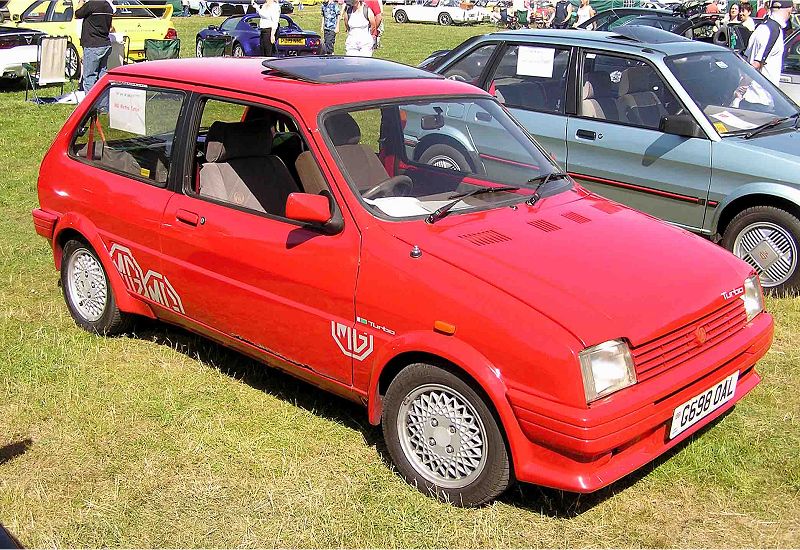
The MG Metro Turbo was a high-performance version of the Austin Metro supermini, introduced in 1983 as part of British Leyland’s efforts to revive the sporting reputation of the MG marque. Combining the compact dimensions and practical front-wheel-drive layout of the standard Metro with a turbocharged 1,275 cc A-series four-cylinder engine, the MG Metro Turbo offered lively acceleration, distinctive styling and an engaging driving experience. Developed during a period when turbocharging was becoming increasingly popular among European manufacturers, the car represented an important departure from MG’s traditional rear-wheel-drive sports cars. Produced until 1990, the MG Metro Turbo became one of the most recognisable British hot hatchbacks of the 1980s and helped introduce the MG name to a new generation of motorists.
The origins of the MG Metro Turbo can be traced to the introduction of the Austin Metro in October 1980. Developed by British Leyland as a modern replacement for the ageing Mini, the Metro was intended to compete in the increasingly important European supermini market against cars such as the Ford Fiesta, Volkswagen Polo and Renault 5.
The Metro was designed to provide economical motoring, compact dimensions and practical interior accommodation. Its transverse engine and front-wheel-drive layout followed the principles established by the original Mini, while its more modern bodywork and improved passenger space made it better suited to contemporary customer expectations.
Although the standard Metro was primarily intended as an economical small car, British Leyland recognised the potential for sporting versions that could appeal to younger drivers and help strengthen the model’s image. The company therefore revived the MG name for a performance-oriented version of the Metro, introducing the naturally aspirated MG Metro 1300 in 1982.
The MG Metro 1300 featured a more powerful version of the established A-series engine, together with revised suspension settings, distinctive exterior trim and a sportier interior. Its success encouraged British Leyland to develop a more powerful turbocharged derivative capable of competing with the growing number of European hot hatchbacks.
The MG Metro Turbo was introduced in 1983, offering substantially improved performance while retaining the practical five-door? No, the Metro Turbo used the three-door hatchback body of the standard MG Metro. Its compact dimensions, relatively low weight and turbocharged engine gave it a distinctive position within the British small-car market.
The development of the turbocharged engine was undertaken with assistance from specialist engineering companies, including Lotus, which contributed to aspects of the engine’s development. The objective was to increase power significantly without requiring a larger or more expensive engine installation.
The resulting power unit was based on the familiar 1,275 cc A-series inline four-cylinder engine, which had been used in numerous BMC and British Leyland vehicles since the 1950s. The engine featured a cast-iron cylinder block and cylinder head, with overhead valves operated by pushrods.
For the Metro Turbo, the A-series engine was modified to accommodate forced induction. The compression ratio was reduced, while strengthened internal components and revised fuel delivery arrangements were introduced to cope with the increased cylinder pressures generated by the turbocharger.
The engine employed a Garrett T3 turbocharger, which compressed the incoming air before it entered the combustion chambers. By increasing the amount of air available for combustion, the turbocharger allowed the relatively small engine to produce substantially more power than its naturally aspirated equivalent.
Fuel delivery was provided by a specially adapted SU carburettor designed to operate with the turbocharging system. The carburettor and associated pressure-control arrangements were developed to maintain suitable fuel delivery under boost conditions.
The turbocharger operated at a relatively modest boost pressure, reflecting the limitations of the A-series engine and the need to maintain acceptable reliability in everyday use. The system was designed to provide strong acceleration without placing excessive stress on the engine and transmission.
In standard production specification, the MG Metro Turbo developed approximately 93 bhp at 6,130 rpm, with maximum torque of around 85 lb ft (115 Nm) at 2,650 rpm. This represented a substantial increase over the naturally aspirated MG Metro 1300, which produced approximately 72 bhp.
The turbocharged engine’s greatest advantage was its improved mid-range performance. Once the turbocharger began producing boost, the engine delivered noticeably stronger acceleration, giving the small Metro a lively and energetic character.
However, the turbocharging system also introduced a degree of turbo lag, particularly at lower engine speeds. Drivers often needed to maintain suitable engine revs to obtain the strongest acceleration, creating a distinctive driving experience associated with early turbocharged cars.
Power was transmitted to the front wheels through a four-speed manual gearbox. The transmission was based on the traditional Mini-derived arrangement, with the gearbox positioned beneath the engine and sharing its lubrication system.
This compact transmission layout allowed the engine and gearbox to occupy relatively little space within the Metro’s short engine compartment, helping maximise passenger accommodation. However, the arrangement also imposed limitations on the amount of torque that could be transmitted reliably.
The MG Metro Turbo was capable of reaching approximately 112 mph (180 km/h), depending on specification and road conditions. Acceleration from 0 to 60 mph generally required around 8.9 seconds, making it one of the quicker British superminis of its period.
These performance figures placed the Metro Turbo in competition with established hot hatchbacks such as the Volkswagen Golf GTI, Ford Fiesta XR2 and Renault 5 Alpine Turbo. Although the Metro was smaller than some of its rivals, its relatively low weight and turbocharged engine provided impressive acceleration for its class.
The MG Metro Turbo retained the basic front-wheel-drive layout and unitary steel body structure of the standard Metro. The compact three-door hatchback body provided practical passenger accommodation and a useful luggage compartment while maintaining the small external dimensions that made the Metro suitable for urban driving.
The body featured a short bonnet, upright passenger compartment and relatively large glass area, providing good visibility and efficient use of interior space. Its compact proportions reflected the Metro’s origins as a practical supermini rather than a purpose-built sports car.
Externally, the MG Metro Turbo was distinguished from the standard Metro by a series of sporting styling features. These included a deeper front air dam, distinctive side graphics, wheel-arch extensions and a rear roof spoiler.
The front spoiler helped give the car a more aggressive appearance while contributing to aerodynamic stability at higher speeds. The wheel-arch extensions and side skirts emphasised the Metro Turbo’s wider sporting stance.
The rear roof spoiler was another distinctive feature, helping identify the car as the flagship performance model of the Metro range. Together with the bold Turbo graphics, these additions gave the car a recognisable 1980s hot hatchback appearance.
The MG Metro Turbo was fitted with distinctive alloy wheels, typically measuring 13 inches in diameter. These wheels were combined with relatively low-profile tyres, providing improved grip and a sportier appearance compared with the standard Metro.
The suspension arrangement was based on the Hydragas system used throughout the Metro range. Developed from earlier British Leyland interconnected suspension technology, Hydragas employed fluid-filled displacer units incorporating gas springs and hydraulic damping.
The system connected the front and rear suspension units on each side of the vehicle, allowing fluid movement to help control pitching and improve ride comfort. Although originally developed for passenger cars, the system could be adapted to provide relatively firm and controlled handling.
For the MG Metro Turbo, the suspension was tuned to provide improved stability and cornering performance. Revised springing and damping characteristics, together with wider tyres, helped the car cope with its increased engine output.
The Metro Turbo’s handling was characterised by responsive steering, strong front-end grip and relatively predictable behaviour. Its compact dimensions and low weight made it particularly enjoyable on winding roads, where rapid changes of direction were possible.
However, the combination of front-wheel drive and turbocharged power could produce torque steer under hard acceleration, particularly on uneven road surfaces. This characteristic was common among powerful front-wheel-drive cars of the period.
The braking system employed front disc brakes and rear drums, with components selected to provide adequate stopping performance for the car’s increased speed. Although relatively conventional, the system was effective when properly maintained.
Inside, the MG Metro Turbo featured a distinctive sporting interior intended to distinguish it from the standard Austin Metro. The seats offered improved lateral support, while the dashboard incorporated additional instrumentation and trim details associated with the MG performance range.
The instrument panel included a tachometer, speedometer and supplementary gauges, allowing the driver to monitor engine operation. A turbo boost gauge was also provided, reflecting the car’s forced-induction engine and adding to its sporting character.
The seats were trimmed in distinctive fabrics, often incorporating contrasting colours and patterns typical of 1980s performance cars. The steering wheel and gear lever were also styled to reinforce the car’s sporting identity.
Despite its performance-oriented character, the MG Metro Turbo retained the practical accommodation of the standard Metro. The rear seats could accommodate passengers, while the hatchback body provided convenient access to the luggage compartment.
The compact external dimensions made the Metro Turbo easy to manoeuvre and park, while its relatively economical engine allowed it to serve as a practical everyday car. This combination of performance and usability was central to the appeal of the hot hatchback market.
The MG Metro Turbo’s driving experience was characterised by lively acceleration, responsive steering and the distinctive behaviour of its turbocharged engine. The relatively small A-series engine required enthusiastic use of the gearbox to maintain performance, while the turbocharger provided a noticeable increase in power as boost developed.
The car was particularly entertaining on narrow country roads, where its compact dimensions and agile handling allowed it to maintain momentum through corners. The front-wheel-drive layout provided good traction in ordinary conditions, although aggressive acceleration could overwhelm the front tyres.
The turbocharged engine also produced a distinctive mechanical character, with the sound of the turbocharger and the increased urgency of the A-series engine contributing to the driving experience.
The MG Metro Turbo entered a highly competitive market for small performance cars. During the early 1980s, European manufacturers were increasingly offering sporting versions of ordinary hatchbacks, combining practical accommodation with improved engines and suspension.
The Volkswagen Golf GTI had already established the hot hatchback concept, while the Ford Fiesta XR2, Peugeot 205 GTI and Renault 5 Turbo-related models contributed to the growing popularity of compact performance cars.
Although the Metro Turbo was smaller and mechanically less sophisticated than some of its rivals, it offered strong acceleration and distinctive British character at a relatively affordable price.
The model also played an important role in the revival of the MG name. Following the closure of the MG factory at Abingdon in 1980 and the end of MGB production, the marque faced an uncertain future.
The introduction of the MG Metro in 1982 and the subsequent Turbo version demonstrated British Leyland’s intention to reposition MG as a sporting brand within its modern passenger car range.
This strategy was later extended to other models, including the MG Maestro and MG Montego, which also received performance-oriented versions. The MG Metro Turbo therefore formed part of a broader effort to maintain the MG identity during a period of major change within the British motor industry.
The Metro Turbo’s engineering also influenced later developments within the Rover Group. Turbocharging became an increasingly important means of improving performance without substantially increasing engine capacity, particularly as fuel economy and emissions requirements became more demanding.
Although the MG Metro Turbo was primarily intended as a road car, the Metro name also became associated with international motorsport through the development of the MG Metro 6R4 rally car.
The Metro 6R4 was a completely different vehicle, developed for Group B rallying and powered by a naturally aspirated V6 engine mounted behind the passenger compartment. Its four-wheel-drive layout and purpose-built competition structure bore little mechanical resemblance to the front-wheel-drive Metro Turbo.
Nevertheless, the association with the Metro 6R4 helped strengthen the sporting image of the Metro range and reinforced MG’s involvement in high-performance motoring during the 1980s.
The MG Metro Turbo remained in production throughout much of the decade, receiving various detail improvements and equipment changes as the Metro range evolved. These included revisions to interior trim, exterior graphics and mechanical components.
The basic turbocharged A-series engine and four-speed manual transmission remained central to the model’s character, although production refinements were introduced to improve reliability and everyday usability.
Production of the MG Metro Turbo ended in 1990, when the original Metro range underwent a major redevelopment and was relaunched with Rover branding and newer K-series engines. The MG Metro Turbo was not directly replaced by an equivalent turbocharged version of the revised car.
The end of production marked the conclusion of an important chapter in MG’s history. The Metro Turbo had helped maintain the marque’s sporting identity during a period when traditional MG sports car production had ceased.
Today, the MG Metro Turbo is regarded as a distinctive and increasingly collectible British hot hatchback. Its compact dimensions, turbocharged engine and unmistakable 1980s styling make it particularly appealing to enthusiasts interested in the development of small performance cars.
Surviving examples are relatively uncommon, partly because many cars were used extensively as everyday transport and subsequently suffered from corrosion, mechanical wear or accident damage.
Restoration requires careful inspection of the unitary steel body structure, particularly the sills, floor panels, wheel arches, suspension mounting areas and lower body panels. Corrosion can be extensive, and structural repairs may require significant work.
The A-series engine is generally well understood and benefits from extensive specialist knowledge, but the turbocharged version requires particular attention to its induction system, cooling arrangements and lubrication.
The Garrett turbocharger should be inspected for excessive shaft play, oil leakage and signs of overheating. The carburettor, boost-control system and associated pipework also require careful maintenance to ensure correct fuel delivery and reliable operation.
The gearbox and differential can suffer from wear, particularly on cars that have been driven aggressively or modified to produce additional power. Because the transmission shares the engine’s lubrication system, regular oil changes and correct maintenance are particularly important.
The Hydragas suspension also requires attention, as ageing displacer units and hydraulic components can affect ride height and handling. Specialist knowledge may be necessary to restore the system to its original operating condition.
Originality is particularly important when assessing an MG Metro Turbo, as many surviving examples have undergone modifications to the engine, suspension, wheels or exterior trim. Original turbocharger components, interior fabrics, body graphics and other model-specific parts can be difficult to obtain.
The MG Metro Turbo represents an important stage in the evolution of the MG marque. By combining the established Metro supermini with a turbocharged A-series engine, revised suspension and distinctive sporting styling, British Leyland created a lively and practical performance car that appealed to a new generation of enthusiasts. Although it differed considerably from the traditional rear-wheel-drive MG sports cars of earlier decades, the Metro Turbo preserved the marque’s emphasis on accessible sporting motoring. Its combination of compact dimensions, turbocharged performance and distinctive 1980s character has secured its place among the most memorable British hot hatchbacks of its era.