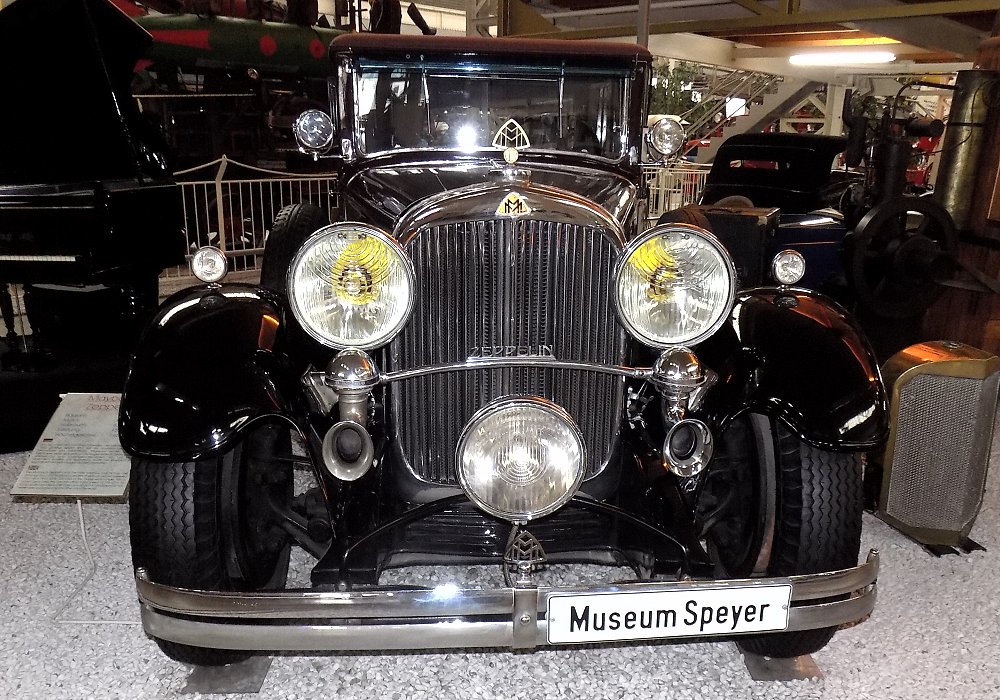
The Maybach DS 7 Zeppelin, introduced in 1930, was one of the most extraordinary luxury automobiles of the pre-war era and a defining expression of Germany’s ambition to build the most sophisticated car in the world. It was the first of Maybach’s famed “Zeppelin” series, named in honour of the company’s long-standing connection to airship engineering and symbolising both technical grandeur and national prestige. As one of the most imposing and mechanically advanced cars of its time, the DS 7 represented the absolute pinnacle of German automotive luxury during the early 1930s.
The heart of the DS 7 was its monumental 7.0-litre V12 engine. This was a masterpiece of precision engineering, conceived with the same meticulous standards that Maybach applied to its aircraft engines. Producing around 150 horsepower in its earliest form, the V12 delivered immense torque, silky smoothness and effortless power, characteristics that made the DS 7 one of the most refined and capable luxury cars of its generation. The engine ran with near-silent precision, and its torque-rich delivery allowed the car to glide forward with very little effort, even when fitted with large, heavy coachwork.
To complement this magnificent engine, Maybach designed an advanced transmission using the company’s early dual-range system. This arrangement essentially provided a high and low range within the gearbox, giving the DS 7 remarkable flexibility in both city traffic and long-distance touring. Although not yet equipped with the later torque-converter Wandler system, the DS 7’s transmission was still far ahead of most contemporary designs, offering smooth shifting and reducing the physical effort required from the driver. This was especially important in a car that often served wealthy owners who valued seamless refinement above all else.
The chassis was built on a massive ladder-style steel frame, engineered to support even the largest formal body styles with complete rigidity. Suspension used robust semi-elliptic leaf springs at both ends, tuned for comfort and long-distance stability. The DS 7 was never intended as a sporting car; instead, it prioritised unmatched ride smoothness, quietness and dignified road manners. On the road it delivered a sense of calm, steady authority, maintaining high touring speeds with very little vibration or mechanical intrusion inside the cabin.
As with all Maybachs, the DS 7 was delivered primarily as a bare chassis to the leading coachbuilders of the period. Spohn of Ravensburg produced many of the most famous bodies, including stately Pullman limousines, sweeping cabriolets, formal town cars and elegant touring sedans. Each example was a unique, handcrafted creation tailored to the buyer’s preferences. Body styles varied widely, but all shared the same extraordinary level of craftsmanship: hand-formed steel panels, chrome detailing of exceptional quality, deep lustrous paint finishes and interior appointments crafted with the finest woods, leathers and fabrics.
Inside, the DS 7 embodied the pinnacle of bespoke luxury. Chauffeur-driven Pullman models offered lavishly upholstered armchairs or full-width rear benches trimmed in the softest leather or tailored wool cloth. Polished hardwood veneers, finely machined metal controls, thick carpeting and beautifully crafted cabinetry were standard. Many examples included amenities such as smoking sets, writing tables, long-distance intercoms, interior lighting arrangements, vanity compartments and other bespoke details. Every car was fitted according to the buyer’s desires, making no two DS 7s alike.
On the road, the DS 7 Zeppelin delivered the stately, unhurried refinement expected from a true top-tier luxury car. The enormous V12 allowed the car to accelerate smoothly and maintain pace without strain, while the long wheelbase and compliant suspension gave the DS 7 a dignified, floating ride. Steering was steady and reassuring, appropriate for a chauffeur-driven limousine, and braking — handled by large mechanical drums — was strong for the period. The overall driving experience emphasised quietness, composure and an effortless sense of power.
Production of the DS 7 was extremely limited and aimed at only the wealthiest clientele in Germany and beyond. It was soon followed by the even larger and more powerful DS 8 Zeppelin, but the DS 7 remains historically significant as the first Maybach V12 and the originator of the Zeppelin name.
Today, the Maybach DS 7 Zeppelin is regarded as one of the most important luxury cars of the pre-war era. Majestic, technically advanced and exquisitely crafted, it stands as a testament to Maybach’s mastery of engineering and bespoke automotive artistry. Rare, regal and deeply evocative of its period, it remains one of the greatest achievements in the history of German motoring.