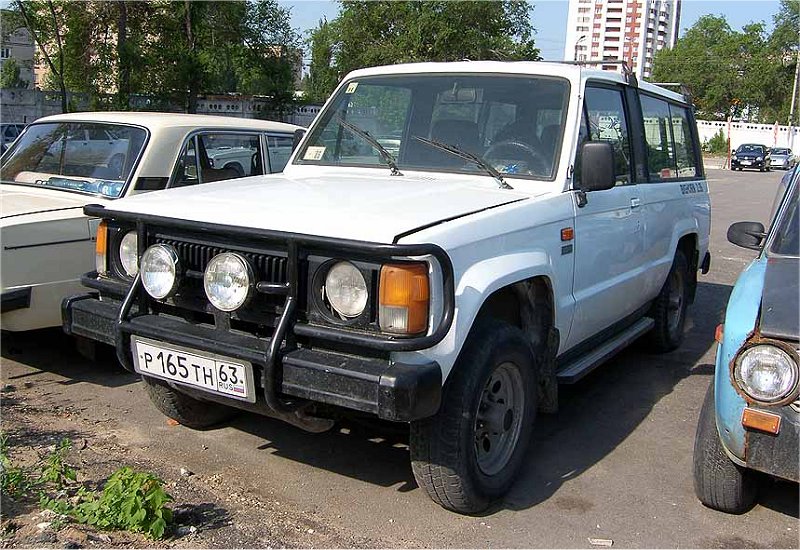
Isuzu Trooper Bighorn 2.3
The Isuzu Trooper Bighorn 2.3 was the early-generation version of Isuzu’s now-legendary sport utility vehicle, representing the company’s transition from rugged utility engineering to a more refined, globally capable 4WD design. Introduced in 1981 for the Japanese domestic market, the Bighorn 2.3 (known internationally as the Isuzu Trooper) embodied the essence of Isuzu’s philosophy: strong, reliable mechanicals wrapped in a clean, functional design, equally suited to work, travel, and adventure. It was the beginning of a model line that would come to define Isuzu’s reputation for building some of the toughest off-road vehicles in the world.
The Bighorn’s design was simple, upright, and unmistakably purposeful. Its shape was defined by straight lines, flat panels, and near-vertical glass surfaces — all contributing to excellent visibility and easy maintenance. The proportions were perfectly balanced for a practical 4×4: short overhangs for approach and departure angles, a tall roofline for generous headroom, and a wide stance that gave stability both on and off the road. In its earliest form, the Bighorn 2.3 had a distinctive utilitarian charm: steel bumpers, round headlamps set in a square grille, and minimal ornamentation. It looked like a tool built for serious use, yet it carried a quiet sophistication that reflected Isuzu’s precise engineering standards.
The “2.3” designation referred to its 2,255 cc inline-four petrol engine, part of Isuzu’s G-series family. This engine, the G200Z derivative enlarged to 2.3 litres, was an overhead-cam design that produced around 110 horsepower and 174 Nm of torque. While not powerful by modern standards, it was known for its smoothness, reliability, and tractable torque delivery — qualities essential for both off-road climbing and highway cruising. Its simplicity and durability made it particularly well suited to the varied conditions of Japan’s mountainous terrain and to export markets where maintenance simplicity was highly valued.
The powertrain was paired with a robust five-speed manual gearbox in most models, with a four-speed manual or three-speed automatic offered in some markets. The four-wheel-drive system was a manually selectable part-time setup, allowing drivers to switch between 2WD and 4WD as conditions required. A low-range transfer case provided the gearing necessary for steep inclines, deep mud, or heavy towing. The 2.3-litre engine’s torque characteristics matched this configuration well, allowing steady progress over rough terrain without constant gear changes.
Underneath, the Bighorn 2.3 featured a traditional ladder-frame chassis — the backbone of its strength and longevity. The suspension combined independent double wishbones with torsion bars at the front and a live rear axle with leaf springs, later upgraded to coils on some variants. This layout gave the vehicle impressive durability and load-carrying ability while maintaining decent ride comfort. Ground clearance was generous, and with short overhangs and a boxy body, the Bighorn was ideal for navigating narrow trails or rugged countryside roads.
Inside, the early Bighorn 2.3 was functional but thoughtfully designed. The dashboard was simple, with large, legible instruments and sturdy switchgear built to withstand hard use. The upright seating position offered excellent visibility — a signature strength of the Trooper series — and the tall cabin provided ample headroom for passengers. The seats were firm but comfortable, trimmed in durable fabrics or vinyl depending on the specification. In typical Japanese fashion, even the utilitarian interior was well assembled, free from squeaks or rattles, and designed to last for decades. The rear seats could fold flat to expand the cargo area, creating a long, level load floor ideal for tools, luggage, or camping equipment.
Driving the Bighorn 2.3 was an experience defined by solidity and predictability rather than outright speed. The steering was steady and light for its class, the clutch smooth, and the gearbox mechanical but precise. On the road, it cruised comfortably at highway speeds, though its boxy aerodynamics and short gearing limited its efficiency at higher velocities. Off-road, however, the Bighorn excelled — the combination of a torquey engine, low-range gearing, and excellent visibility made it feel composed and capable in the roughest conditions. Whether tackling snow-covered trails, rocky ascents, or muddy farmland, the 2.3’s simplicity proved an advantage, minimizing the chances of mechanical trouble far from home.
The Bighorn’s design philosophy reflected Isuzu’s background in commercial vehicles and diesel engineering. It was built for endurance, not glamour — an honest machine whose strength lay in the purity of its purpose. The body panels were thick and well protected from corrosion, the drivetrain over-engineered, and the frame designed to handle years of abuse. Many early Bighorns became staples of rural Japanese life, used by farmers, contractors, and outdoor enthusiasts. Export models soon followed, reaching markets across Asia, Oceania, and Europe, where the Trooper name would become synonymous with dependability.
The 2.3-litre petrol model sat alongside Isuzu’s 2.2-litre diesel variant in the domestic lineup, giving customers a choice between smoother petrol refinement and the economy of diesel power. The petrol engine appealed especially to private owners who valued smoother acceleration and quieter operation — and in regions with colder winters, the easier cold starting compared favorably to diesels of the era.
By the mid-1980s, the Bighorn 2.3 had evolved with minor styling updates, improved interiors, and the introduction of optional features such as air conditioning, radio systems, and two-tone paintwork. These refinements didn’t dilute the vehicle’s utilitarian character but added a touch of comfort that broadened its appeal.
Today, the Isuzu Trooper Bighorn 2.3 is recognized as one of the foundational models that set the standard for reliable Japanese 4x4s. Its combination of mechanical simplicity, structural integrity, and everyday usability gave it a reputation for longevity that persists decades after production. Enthusiasts value it for its classic boxy styling, analog driving feel, and the sense of engineering honesty that modern SUVs often lack.
The Bighorn 2.3 was more than an early SUV — it was a declaration of purpose. Built to endure and engineered with care, it proved that utility could coexist with civility, and that strength could be achieved through simplicity. It laid the groundwork for Isuzu’s future dominance in off-road and diesel technology, standing as one of the most authentic expressions of the company’s philosophy: practical, precise, and built to last.
