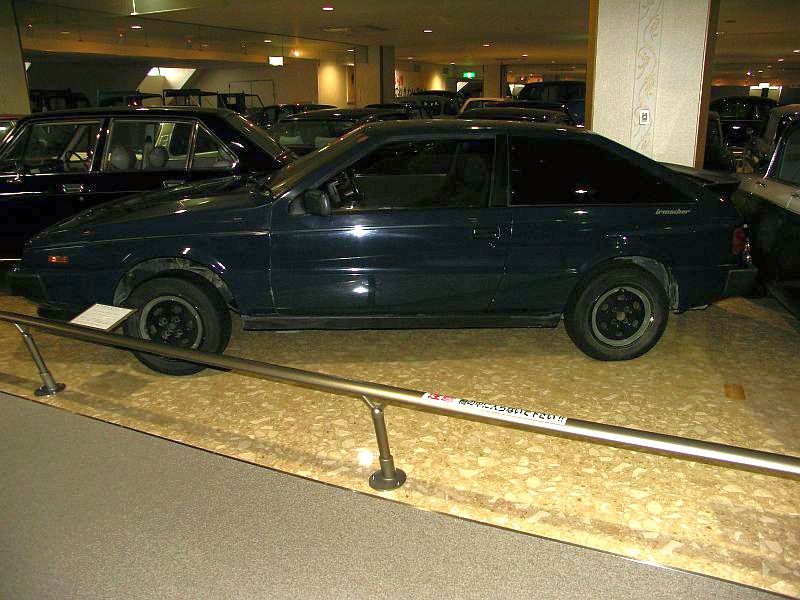
Isuzu Piazza 2000
The Isuzu Piazza 2000 was one of the most distinctive and artistically realized Japanese cars of the 1980s — a grand touring coupé that combined Italian design flair with Japanese engineering precision. Introduced in 1981, it was the production version of the celebrated Isuzu Piazza concept car, first unveiled at the 1979 Geneva Motor Show. Known as the Isuzu Impulse in export markets, the Piazza 2000 embodied a spirit of elegance and innovation, offering a futuristic vision of what a driver-focused, high-performance personal car could be.
The Piazza was born out of Isuzu’s long-standing collaboration with the Italian design house Italdesign and its founder, Giorgetto Giugiaro. Following their earlier success with the 117 Coupé, Isuzu once again turned to Giugiaro to shape a car that would define the company’s image for the new decade. The result was one of Giugiaro’s most accomplished works: a wedge-shaped, aerodynamic form that was both restrained and beautiful. The car’s design language was part of his “folded paper” era — clean, crisp, and geometrically precise. The proportions were near-perfect for a two-door grand tourer: a long bonnet, low waistline, and sharply tapered tail that gave the car a poised, athletic stance.
Every surface of the Piazza was shaped with purpose. The glass area was expansive, the lines uninterrupted, and the detailing minimal. The door handles were flush, the window frames integrated seamlessly into the body, and the headlights recessed beneath slim covers. The drag coefficient, at just 0.34, was excellent for the time, reflecting both its aerodynamic efficiency and Giugiaro’s mastery of modern form. The Piazza was not just a car but an architectural object — a moving sculpture that expressed the optimism of the early 1980s.
Underneath its striking exterior, the Isuzu Piazza 2000 was based on a development of the Isuzu Gemini platform, re-engineered for rear-wheel drive to suit its grand touring intent. It was offered with two main engine options: a naturally aspirated 1,949 cc G200Z SOHC four-cylinder and, in higher-performance variants, a turbocharged version of the same engine, the G200Z-T. In the standard Piazza 2000 configuration, the twin-carburetor G200Z produced around 120 horsepower and 167 Nm of torque, giving the car brisk performance and smooth power delivery.
The engine was mated to either a five-speed manual or a three-speed automatic transmission, with power sent to the rear wheels. In manual form, the Piazza 2000 could accelerate from 0 to 100 km/h in roughly 9.5 seconds and reach a top speed of around 190 km/h. While not a pure sports car in the European sense, it offered an ideal blend of performance and refinement. The long gearing and torquey engine made it effortless to drive at speed, while its light weight — just over 1,100 kilograms — gave it agility and responsiveness.
The chassis and suspension were key to the Piazza’s dynamic character. The front employed independent MacPherson struts with coil springs, while the rear used a four-link live axle with coil springs and a Panhard rod — a setup tuned for balance and comfort rather than raw cornering grip. The steering was rack-and-pinion, light yet direct, and disc brakes were fitted at the front with drums at the rear, later upgraded to discs all around on the turbo models. For its time, the Piazza’s ride and handling balance was remarkably refined, delivering a composed and stable driving experience even at high speeds.
The interior of the Piazza 2000 was every bit as futuristic as its exterior. Giugiaro’s influence extended to the cabin, which was designed with a focus on driver ergonomics and visual innovation. The dashboard was a wraparound cockpit, angled toward the driver and filled with digital instrumentation in higher trims. Depending on the model year and market, the dashboard could feature either analog dials or a full digital display — complete with futuristic bar-graph tachometer and computer-like speed readouts. The center console housed neatly grouped controls for climate and audio systems, while the seats were deeply contoured, providing both support and comfort for long-distance driving.
Materials were of high quality, with soft-touch plastics, textured fabrics, and metallic accents giving the cabin a distinctly modern feel. In Japan, the Piazza 2000 DX and XE trims offered varying levels of luxury, with the top versions featuring power windows, cruise control, air conditioning, and high-grade audio systems — amenities that reflected the car’s positioning as a premium grand tourer rather than a simple sports coupé.
On the road, the Piazza 2000 excelled at combining comfort with control. The naturally aspirated engine was smooth and tractable, with enough power to make full use of the car’s well-tuned chassis. The ride was supple, the cabin quiet, and the overall driving experience relaxed but engaging. The car’s long wheelbase and rear-drive balance gave it a planted, confident feel through sweeping bends, while the precision of its steering and the predictability of its suspension made it enjoyable on winding roads. The turbocharged versions added a livelier edge, but the 2000’s charm lay in its effortless composure and the sense of refinement that set it apart from its rivals.
When it was launched, the Piazza 2000 was celebrated both in Japan and abroad for its style and advanced engineering. It was marketed internationally under several names — including the Isuzu Impulse in North America and the Holden Piazza in Australia — but regardless of market, it was universally recognized as one of the most beautiful Japanese cars of its generation.
Although production numbers were modest, the Piazza established Isuzu as a serious player in the world of grand touring cars. It showcased the company’s ability to blend cutting-edge design with strong mechanical engineering, much like the 117 Coupé had done a decade earlier.
Today, the Isuzu Piazza 2000 is regarded as one of the high points of Isuzu’s history as a passenger car manufacturer. Its design remains timeless, its engineering solid, and its character unique — a fusion of Italian artistry and Japanese precision that few cars have ever captured so perfectly.
The Piazza 2000 stands as a symbol of an era when Isuzu built cars guided not by convention but by vision. Elegant, aerodynamic, and advanced, it remains one of the purest expressions of what the company could achieve when it combined design brilliance with mechanical integrity — a true grand tourer for those who valued sophistication over spectacle.
