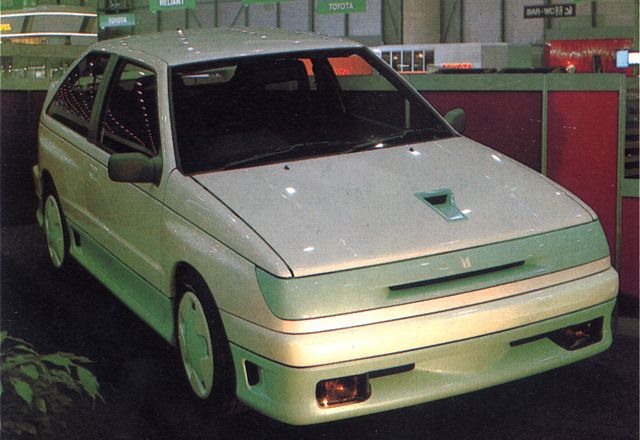
Isuzu Gemini Aero Sport
The Isuzu Gemini Aero Sport was one of the most distinctive and dynamic expressions of Isuzu’s compact car engineering during the late 1980s and early 1990s, representing a perfect balance between Japanese precision and Italian design flair. Developed during a period when Isuzu was deeply influenced by its collaboration with Giorgetto Giugiaro’s Italdesign, the Aero Sport combined aerodynamic sophistication, spirited performance, and sharp handling into a package that gave the humble compact sedan genuine sporting character.
The Gemini name had long been associated with reliability and practicality since its debut in the 1970s, but by the late 1980s, Isuzu sought to give the model a stronger emotional identity. The Aero Sport version achieved that goal — not through excessive power or flash, but through elegant design, aerodynamic efficiency, and well-balanced engineering. It was a car that expressed movement even when standing still, and one that reflected Isuzu’s confidence in blending form and function.
The exterior of the Gemini Aero Sport was shaped with both wind-cheating efficiency and aesthetic precision in mind. Its bodywork followed the “folded paper” design philosophy refined by Giugiaro, characterized by crisp edges, clean lines, and subtle surface changes that caught the light beautifully. The Aero Sport was distinguished by its integrated aerodynamic body kit, including a low-profile front spoiler, side skirts, a discreet rear lip spoiler, and sometimes flared wheel arches that gave it a grounded stance. The nose was low and sleek, with flush headlamps and a slim horizontal grille designed to reduce drag. The rear featured smooth contours that enhanced airflow, contributing to a drag coefficient of around 0.32 — impressive for a small sedan or hatchback of its era.
Under the bonnet, the Gemini Aero Sport was typically powered by Isuzu’s 4XE1 engine, a 1.6-litre four-cylinder with double overhead camshafts and 16 valves. In naturally aspirated form, it produced around 120 horsepower, while in some markets, a turbocharged version offered up to 150 horsepower. These engines were smooth, free-revving, and engineered for efficiency as much as performance. With electronic fuel injection and a light overall body weight (around 950 kilograms), the Aero Sport was quick and responsive — capable of 0–100 km/h in roughly 8.5 seconds for the 1.6 DOHC version and a top speed approaching 200 km/h.
Power was sent to the front wheels through a close-ratio five-speed manual gearbox, though a four-speed automatic was available for certain trims. The manual transmission was widely praised for its precise, short-throw shifts, complementing the engine’s lively nature. The suspension — independent MacPherson struts at the front and a semi-trailing arm setup at the rear — was tuned for agility and control. Isuzu engineers achieved an ideal balance between comfort and handling, giving the car a supple yet planted feel. The steering was sharp and communicative, allowing the driver to position the car confidently through corners, while the brakes — ventilated front discs and solid rears — provided dependable stopping power.
The chassis of the Aero Sport was one of its strongest assets. Its rigidity and lightness gave it a crisp, eager character that felt sophisticated compared to many rivals. In spirited driving, it displayed neutral balance and progressive breakaway, inspiring confidence in both novice and experienced drivers. This handling finesse made the Gemini Aero Sport a favorite among enthusiasts who appreciated precision over brute force.
Inside, the Aero Sport carried over the clean, modern design ethos of its exterior. The dashboard was straightforward and driver-focused, with clear analog instruments and intuitive control placement. Sportier trims added features such as contoured seats with enhanced lateral support, a leather-wrapped steering wheel, and contrasting fabric inserts. The driving position was well judged — low, supportive, and perfectly aligned with the pedals and gear lever — giving the driver a sense of connection to the car. Despite its compact size, the cabin was comfortable for four adults, and the build quality reflected Isuzu’s emphasis on durability and refinement.
Equipment levels were generous for a performance-oriented compact of its time. Depending on market and specification, the Aero Sport could include power windows, central locking, air conditioning, alloy wheels, and a premium AM/FM cassette stereo system. The sound insulation was improved over earlier models, allowing for quieter cruising, yet the car retained a pleasingly mechanical note from its twin-cam engine when revved.
The Gemini Aero Sport was not merely about performance — it was about balance. It embodied a philosophy of intelligent engineering where every element served a purpose: aerodynamic efficiency reduced fuel consumption and wind noise; the high-revving engine provided both economy and excitement; and the chassis delivered composure on both winding backroads and city streets. It was, in essence, a driver’s car — compact, communicative, and beautifully engineered.
On the open road, the Aero Sport rewarded smooth, precise inputs. The twin-cam engine loved to rev, its power delivery linear and engaging, while the light, accurate steering gave the driver confidence to explore its limits. The suspension absorbed rough surfaces without losing its poise, and the car’s compact dimensions made it agile and easy to place. It was as enjoyable threading through traffic as it was attacking a twisting mountain road.
In an era when Isuzu was increasingly focused on trucks and SUVs, the Gemini Aero Sport stood out as a reminder of the company’s talent for building sophisticated, enthusiast-friendly cars. It also showcased Isuzu’s ongoing relationship with Italdesign, which gave the car its unmistakable European flair. Although its production numbers were modest, the Aero Sport left a lasting impression on those who drove it, symbolizing the final golden age of Isuzu’s passenger car innovation before the company shifted entirely to commercial vehicles.
Today, the Isuzu Gemini Aero Sport is admired as one of the most complete and underrated compact sports sedans of its generation. Its combination of crisp design, advanced aerodynamics, and mechanical finesse make it a collectible for enthusiasts who value purity of design and driving engagement over raw power.
The Gemini Aero Sport was a car that expressed Isuzu’s philosophy at its finest: intelligent engineering, timeless design, and driving enjoyment born from balance and precision. It remains a compelling reminder of a time when small cars were not just practical — they were beautifully made, perfectly judged, and deeply rewarding to drive.
