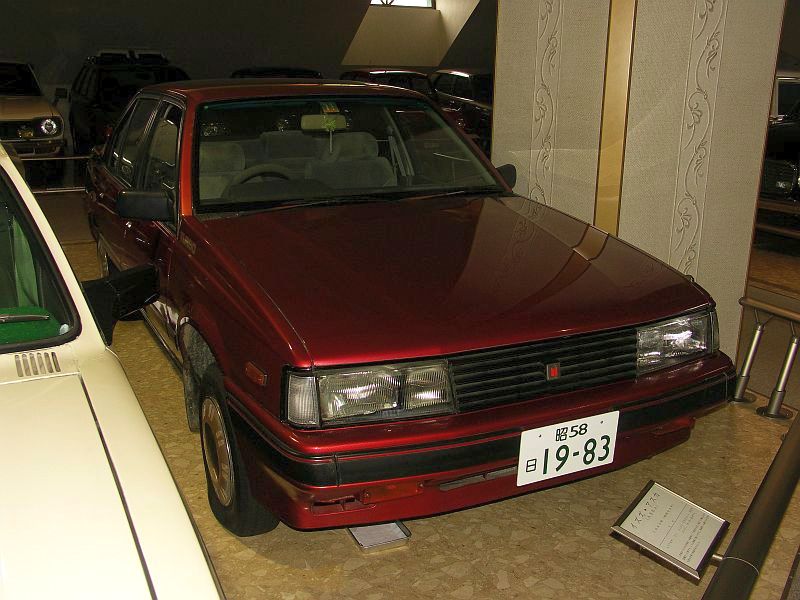
Isuzu Florian Aska 2000 Turbo
The Isuzu Florian Aska 2000 Turbo marked a striking transformation in Isuzu’s long-running mid-size sedan lineage, representing both a modernization of the venerable Florian name and a bold step into the turbocharged performance era of the early 1980s. Introduced in 1983, the Aska 2000 Turbo was the flagship of the newly developed Florian Aska range — a car that combined the practicality of a four-door sedan with the excitement of forced induction, refined aerodynamics, and the sophistication of Isuzu’s engineering partnership with General Motors. It symbolized Isuzu’s determination to redefine its image as more than a builder of rugged diesels and commercial vehicles, positioning the company squarely within the realm of advanced, technology-driven passenger cars.
The “Florian Aska” name linked the new model to the earlier Florian sedan, but in reality, this was an entirely different car. Built on the front-wheel-drive platform jointly developed with GM, it shared some components with the second-generation Opel Ascona and the Chevrolet Cavalier, though its design and tuning were distinctly Japanese. The Florian Aska’s body was sleek and contemporary, featuring clean, aerodynamic lines that reflected the early 1980s fascination with efficiency and precision. The front end carried a narrow, horizontally slatted grille integrated into a low, wedge-like nose, flanked by rectangular halogen headlamps. Its side profile was smooth and uncluttered, with flush glass, modest wheel arches, and discreet badging — a clear move toward the understated high-technology aesthetic that was defining the decade.
The Aska 2000 Turbo distinguished itself with subtle but purposeful touches. Alloy wheels, a deeper front air dam, and a small rear spoiler hinted at its performance capability without resorting to excess. The proportions were taut, with a long bonnet and short overhangs giving the car a dynamic stance. Aerodynamic efficiency was central to its design: a drag coefficient of around 0.36 was impressive for a sedan of its time, improving both fuel economy and high-speed stability.
Beneath the clean bodywork lay Isuzu’s most sophisticated powertrain to date — the G200W-T engine, a 1,994 cc inline-four with double overhead camshafts, four valves per cylinder, and a single turbocharger. This engine was derived from the highly regarded naturally aspirated G200W unit used in the Isuzu 117 Coupé and Piazza, itself a development of the earlier G-series engines that had powered Isuzu’s finest models since the 1960s. The addition of turbocharging transformed the character of the engine, boosting power output to approximately 150 horsepower and torque to 200 Nm.
Power delivery was smooth yet potent, with the turbocharger providing a progressive surge rather than the abrupt rush typical of early forced-induction systems. The car’s performance figures were impressive for the period: 0 to 100 km/h in around 8.5 seconds and a top speed close to 200 km/h. This placed the Aska 2000 Turbo among Japan’s more capable sports sedans, rivaling the Toyota Corona GT-T, Nissan Bluebird Turbo SSS, and Mazda Capella Turbo.
The transmission options included a close-ratio five-speed manual gearbox, which allowed precise control of the engine’s broad torque band, or a three-speed automatic for customers who preferred comfort over engagement. Front-wheel drive was standard, and the powertrain layout gave the car excellent packaging efficiency, freeing interior space while keeping the centre of gravity low.
The chassis and suspension were engineered for stability and precision. The front used MacPherson struts with coil springs, while the rear employed a semi-independent torsion beam setup. Isuzu tuned the suspension to provide a firm but compliant ride, emphasizing both handling control and long-distance comfort. Front disc brakes and rear drums were standard, with ventilated rotors on turbo models, and the steering — a rack-and-pinion system with hydraulic assistance — was light yet accurate. The result was a car that felt poised and predictable, combining brisk acceleration with quiet, stable cruising.
Inside, the Florian Aska 2000 Turbo projected a distinctly modern atmosphere. The dashboard was dominated by clean horizontal lines, with a large, clearly marked instrument cluster and, on higher trims, digital displays that reflected Japan’s fascination with electronic sophistication during the early 1980s. Turbo-specific models often featured sportier trim, including contoured bucket seats, a three-spoke steering wheel, and metallic accents on the instrument panel. Equipment levels were generous for the time: air conditioning, power windows, power mirrors, and a premium AM/FM stereo were typically standard. Materials were of high quality, and the fit and finish reflected Isuzu’s precision manufacturing standards.
Driving the Aska 2000 Turbo was a distinctly contemporary experience. The turbocharged engine combined the refinement of Isuzu’s twin-cam architecture with the muscular torque that made overtaking and hill climbing effortless. Boost came on smoothly, with minimal lag, and the engine pulled strongly from mid-range revs all the way to the redline. The handling was neutral and composed, with mild understeer at the limit, while the ride comfort remained excellent for a car with such capable performance. At highway speeds, the Aska felt secure and quiet, benefiting from both aerodynamic efficiency and Isuzu’s focus on NVH (noise, vibration, and harshness) control.
The Aska 2000 Turbo was also a showcase for Isuzu’s growing technical alliance with General Motors, which helped the company access global resources while maintaining its engineering independence. The car was marketed not only in Japan but also in select export markets under different names, including the Holden Camira in Australia and the Chevrolet Aska in certain regions, though not all variants received the turbocharged engine.
In Japan, the Florian Aska served as a bridge between Isuzu’s heritage of solid, rear-wheel-drive engineering and its future as a manufacturer of advanced, efficient, and performance-oriented vehicles. It demonstrated that Isuzu could build a front-wheel-drive sedan that was as technologically impressive as it was refined.
Today, the Isuzu Florian Aska 2000 Turbo is remembered as one of the most distinctive and ambitious cars in Isuzu’s history. Though its production run was relatively short, it encapsulated the company’s transition into the high-tech, turbocharged age of the 1980s. With its blend of Italian-influenced design, Japanese precision, and turbocharged performance, it remains a fascinating example of Isuzu’s engineering confidence at its peak.
The Florian Aska 2000 Turbo was more than a nameplate revival — it was a declaration that Isuzu could combine practicality, efficiency, and excitement in one machine. Subtle in appearance but advanced in every respect, it stood as a quiet yet forceful statement of technological maturity — an elegant close to the Florian legacy and a bold opening to Isuzu’s modern era.
