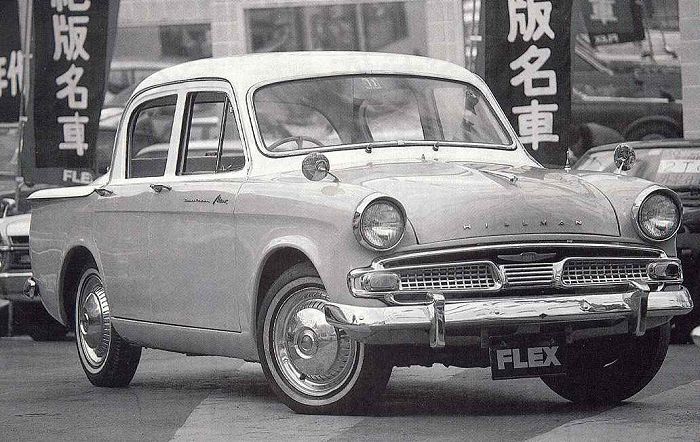
Isuzu Hillman Minx III
The Isuzu Hillman Minx III was a pivotal model in the evolution of Japan’s postwar car industry and the last major chapter in Isuzu’s partnership with the British Rootes Group. Produced from 1959 to 1964, the Minx III marked the point at which Isuzu had almost completely localized production of the Hillman Minx — building not just the body and chassis but also the engine, gearbox, and most ancillary components entirely in Japan. It was also the most refined and capable of all the Japanese-built Minxes, combining the dependable engineering of the Rootes design with the precision and reliability of Isuzu craftsmanship.
The Minx III was based on the British Hillman Minx Series III, introduced in the UK in 1958. Rootes had completely redesigned the Minx a few years earlier with the “Audax” series, styled under the direction of Raymond Loewy’s design studio. The new body was far more modern and elegant than the upright designs of the early 1950s Minxes that Isuzu had first built. When Isuzu adopted the design for Japanese production, it created a car that appeared thoroughly contemporary — sleek, low-slung, and far more in keeping with the tastes of the rapidly modernizing Japanese middle class.
Stylistically, the Isuzu Hillman Minx III reflected the optimistic international aesthetic of the late 1950s. The Audax body featured gently curved lines, an expansive glass area, and subtle tail fins that hinted at American influences without excess. The wide horizontal grille with its chrome bars gave the car a friendly, dignified expression, and the proportions — long bonnet, short boot, and balanced roofline — gave it a sense of grace and lightness. For Japan, where most cars were still small and functional in appearance, the Minx III looked sophisticated and aspirational.
The car was built as a four-door saloon, though estate and convertible versions were offered in other markets. Its overall dimensions made it well-suited to Japan’s narrow roads while still offering generous interior space. The cabin was airy and comfortable, with seating for five adults. The dashboard followed Rootes’ rational layout, featuring a large central speedometer flanked by fuel and temperature gauges, and a bank of simple toggle switches. Trim quality was high, with Isuzu’s assembly standards ensuring tight panel fit, durable upholstery, and a level of refinement that compared favorably with imported European cars of the time.
Under the bonnet, the Isuzu Hillman Minx III was powered by a 1,494 cc inline-four overhead-valve engine, fully manufactured by Isuzu in Japan to Rootes’ specification. This robust engine produced around 55 horsepower, allowing for a top speed of approximately 125 km/h (78 mph). The engine was renowned for its smoothness, reliability, and ease of maintenance — qualities that made the Minx a favorite among taxi operators and long-distance drivers. Power was sent to the rear wheels through a four-speed manual gearbox with a floor-mounted or column-mounted shifter, depending on trim level.
The Minx III’s suspension retained Rootes’ proven formula: independent front suspension with coil springs and wishbones, and a live rear axle on semi-elliptic leaf springs. The chassis, constructed from pressed-steel sections, was strong and durable, offering a supple ride even on rough surfaces. Hydraulic drum brakes on all four wheels provided adequate stopping power, while the recirculating ball steering system gave a light but precise feel. These qualities made the car stable and comfortable both in urban driving and on Japan’s newly expanding network of highways.
Performance was modest but confident. The Minx III could cruise comfortably at 100 km/h and handled predictably thanks to its balanced weight distribution and long-travel suspension. More than outright speed, it was admired for its refinement — quiet, vibration-free, and steady, traits that reflected Isuzu’s meticulous assembly and quality control.
One of the most important aspects of the Minx III’s story lies in its industrial significance. By the time this model entered production, Isuzu had achieved near-total independence from imported components. Only a few specialized parts, such as carburetors and electrical items, were still sourced from Britain. Everything else — the engine, transmission, axles, bodywork, and interior — was made in Japan. This represented a remarkable transformation from 1953, when the original Isuzu-built Minx (PH10) had been assembled almost entirely from British kits. The Minx III was proof that Japan had learned not just to copy foreign technology, but to master and refine it.
The car’s market role was equally important. It provided middle-class Japanese buyers with a true family saloon at a time when choices were limited. The Minx III was larger and more comfortable than the compact cars being produced by Toyota and Nissan in the late 1950s, yet it was less expensive and easier to maintain than imported European sedans. Many were used as taxis, government vehicles, or private family cars, and they gained a reputation for reliability that strengthened Isuzu’s public image.
By 1961, the Minx III was nearing the end of its life as a licensed product. That year, Isuzu introduced the Isuzu Bellel, its first completely home-grown car, designed and engineered in Japan from the ground up. However, production of the Minx III continued alongside it until 1964 to meet demand and maintain continuity for existing customers. After that, Isuzu’s collaboration with Rootes officially ended, and the company’s focus shifted entirely to its own designs and diesel engine development — areas in which it would later achieve global success.
Today, the Isuzu Hillman Minx III is an exceptionally rare sight. Few examples survived Japan’s rapid modernization in the 1960s and 1970s, and those that do are cherished by enthusiasts for their historical significance. While unassuming by modern standards, the Minx III stands as a symbol of Japan’s emergence as an independent industrial power — a car that began as a licensed copy and ended as a proud, fully realized product of Japanese skill.
The Isuzu Hillman Minx III was, in essence, the end of an era. It represented the final step in Isuzu’s apprenticeship under Rootes and the beginning of its independent identity as a manufacturer. Handsome, dependable, and quietly dignified, it carried British heritage in its design and Japanese precision in its execution — a fitting conclusion to one of the most formative partnerships in automotive history.
