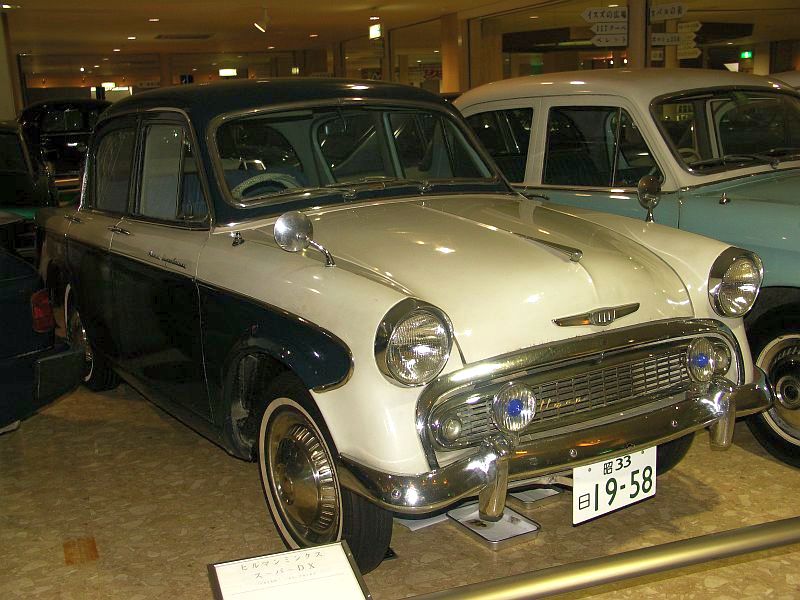
Isuzu Hillman Minx PH200
The Isuzu Hillman Minx PH200 was the final and most advanced generation of the Hillman Minx series built under license by Isuzu Motors in Japan. Introduced in 1957 and produced until 1964, it represented the culmination of a decade-long collaboration between Isuzu and the British Rootes Group. While earlier models like the PH10 and PH100 were effectively British Hillman Minxes assembled in Japan, the PH200 was the point at which Isuzu fully mastered independent production. By this stage, nearly every component was made domestically, marking Japan’s graduation from licensed assembler to full-fledged automobile manufacturer.
The PH200 was based on the British Hillman Minx Series I, which had debuted in the UK in 1956. It retained the same fundamental mechanical layout but was locally adapted for Japanese roads, climate, and customer preferences. More refined and modern in design than its predecessors, the PH200 became a familiar sight in late-1950s Japan and a symbol of postwar progress. It bridged the gap between the imported aesthetic of early licensed cars and the new wave of Japanese-designed automobiles that would soon define the nation’s industry.
Stylistically, the PH200 was a product of Rootes’ mid-1950s design language, characterized by clean, modern lines and restrained elegance. The body was lower and wider than that of the earlier PH100, with integrated front fenders and a one-piece curved windscreen replacing the split design of earlier Minxes. The front end featured a broad chrome grille flanked by circular headlamps, while the rear gained modest fins that gave the car a contemporary, American-influenced appearance. Isuzu’s Japanese-built bodies were notable for their fine panel fit and improved corrosion resistance, reflecting the company’s growing expertise in metallurgy and production techniques.
The interior of the PH200 was functional but comfortable. The dashboard design was simplified and modernized, with a large centrally mounted speedometer and a neat horizontal arrangement of secondary gauges. The bench seats were upholstered in durable vinyl, and the car could seat five adults comfortably. While it lacked luxury embellishments, the PH200’s interior quality surpassed that of most domestic Japanese cars at the time. Its build quality, smooth engine, and quietness made it particularly appealing to taxi operators and middle-class families who valued reliability over glamour.
Under the bonnet, the Isuzu Hillman Minx PH200 used a 1,494 cc overhead-valve inline four-cylinder engine, which was a major improvement over the earlier 1,265 cc side-valve design. Producing around 55 horsepower at 4,400 rpm, it offered significantly better performance and efficiency. The engine was manufactured entirely in Japan under Rootes’ supervision, and by this point Isuzu had localized both casting and machining. Power was transmitted to the rear wheels through a four-speed manual gearbox with synchromesh on the upper three gears. Top speed was approximately 120 km/h (75 mph), and fuel consumption averaged around 11 to 12 km per litre — impressive figures for a family saloon of the era.
Mechanically, the PH200 continued to employ Rootes’ proven formula: front independent suspension with coil springs and wishbones, a live rear axle on semi-elliptic leaf springs, and hydraulic drum brakes on all four wheels. Steering was by recirculating ball, offering a light but direct feel. The car’s road manners were notably refined, especially compared to the early 1950s Minx derivatives. The suspension provided a supple ride, while the longer wheelbase and lower stance improved both stability and comfort. Japanese owners praised the PH200 for its reliability and ease of maintenance, and its robust chassis made it particularly well suited to the rougher roads that were still common in Japan at the time.
The Isuzu Hillman Minx PH200 also marked a milestone in the localization of automotive manufacturing. By the late 1950s, Isuzu had achieved a remarkable degree of domestic content: nearly 95 percent of each car was made in Japan, including the engine, transmission, bodywork, and electrical components. Rootes provided technical support and oversight, but the PH200 was very much an Isuzu-built product, reflecting Japan’s growing industrial capability. This model served as a vital training platform for Isuzu’s engineers, who would soon develop the company’s first original passenger car, the Isuzu Bellel, introduced in 1961.
On the road, the PH200 combined the smoothness of British engineering with the precision of Japanese assembly. The engine was quiet and tractable, delivering a steady surge of torque that made city driving easy and hill climbing effortless. The gearbox shifted cleanly, and the clutch was light, while the car’s suspension soaked up rough surfaces with ease. The Minx was never a sports car, but it had a poise and composure that won over its drivers. It was ideal for Japan’s developing transport network — a dependable and well-mannered companion for a nation on the move.
Production of the PH200 continued until the early 1960s, overlapping with Isuzu’s development of its own domestically designed models. It was the final iteration of the Hillman Minx series to bear the Isuzu name and the last car the company produced under a foreign license. By 1964, Isuzu had fully transitioned to its own vehicles, ending the decade-long partnership with Rootes that had begun with the PH10.
Today, the Isuzu Hillman Minx PH200 is remembered as a landmark in Japanese automotive history. Though unassuming in appearance, it marked the moment when Japan’s car industry came of age — when local manufacturers no longer merely assembled cars from imported kits, but built them from raw materials to finished machines with their own skill and precision. Surviving examples are rare, but they hold deep historical value as symbols of industrial transformation.
The Isuzu Hillman Minx PH200 was the last of its line, but also the first car to show what Japan could achieve independently. It carried forward British engineering heritage and blended it with Japanese craftsmanship, creating a car that stood quietly at the threshold of a new era — the dawn of Japan’s rise as one of the world’s leading car-producing nations.
