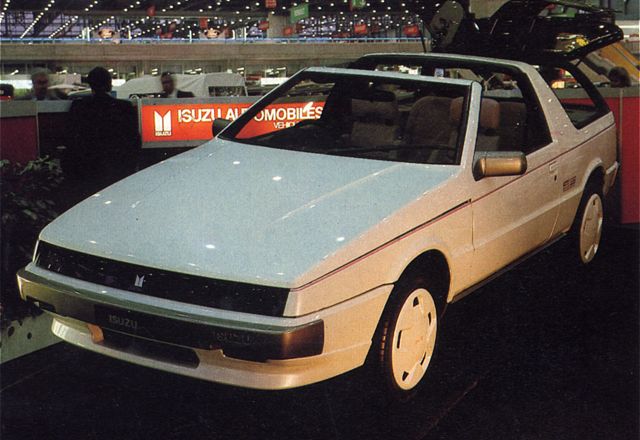
Isuzu Piazza Space Sport
The Isuzu Piazza Space Sport was one of the most distinctive and exclusive evolutions of Isuzu’s iconic grand touring coupé — a model that fused Italian style, Japanese precision, and 1980s optimism into one unforgettable form. Introduced in the mid-1980s as a special high-specification variant of the Piazza (known internationally as the Isuzu Impulse), the Space Sport represented the peak of the model’s refinement and luxury, combining the elegance of Giorgetto Giugiaro’s design with a more sophisticated interior and advanced features that reflected the era’s fascination with technology and comfort.
When the original Isuzu Piazza was launched in 1981, it stunned the automotive world with its crisp, aerodynamic shape, penned by Giugiaro at Italdesign. The Space Sport version built upon that timeless foundation, giving the already striking coupé a more exclusive, upscale character. It was aimed at drivers who wanted the distinctive style and performance of the Piazza but with greater comfort and a sense of grand touring luxury.
Externally, the Piazza Space Sport retained the graceful wedge profile that made the model famous. Its long bonnet, low beltline, and gently tapering tail gave it a sleek, almost architectural appearance — one that looked just as futuristic in the mid-1980s as it had when first revealed in 1979 as a concept car. For the Space Sport edition, subtle refinements set it apart: a deeper front air dam, integrated side skirts, and specific alloy wheel designs that emphasized width and stance. The body was often finished in distinctive metallic colors with understated badging, while tinted glass and a panoramic rear hatch gave the car a unique, cohesive look that was as elegant as it was purposeful.
Under the bonnet, the Space Sport was powered by Isuzu’s G200Z engine family — most often the turbocharged G200Z-T, a 1,994 cc inline four-cylinder with single overhead camshaft and electronic fuel injection. Equipped with a single turbocharger and intercooler, the engine produced approximately 150 horsepower and 225 Nm of torque, giving the car lively, flexible performance. Power delivery was smooth and progressive, with the turbocharger providing strong mid-range acceleration and relaxed high-speed cruising. In some markets, naturally aspirated versions were offered, but the turbo variant defined the Space Sport’s character — powerful enough for spirited driving while maintaining refinement and efficiency.
Transmission options included a five-speed manual gearbox for drivers seeking engagement and a four-speed automatic for those preferring effortless long-distance touring. Both were paired with rear-wheel drive, preserving the balanced handling dynamics that made the Piazza so enjoyable to drive. The suspension used independent MacPherson struts at the front and a four-link rear axle with coil springs and a Panhard rod — a layout designed for comfort and composure at speed. Steering was rack-and-pinion, with power assistance providing a light, precise feel. The car’s ride quality was supple and stable, making it well suited to motorway travel while retaining poise through sweeping bends.
What distinguished the Space Sport most, however, was its interior. The cabin combined advanced 1980s design with genuine craftsmanship and attention to detail. The dashboard — already futuristic in the standard Piazza — featured digital instrumentation, touch-sensitive controls, and a wraparound cockpit layout that enveloped the driver. In the Space Sport, materials were upgraded to include soft-touch plastics, richer fabrics or optional leather upholstery, and additional sound insulation for a quieter ride. The seats were deeply contoured for comfort and finished with elegant patterns that echoed contemporary Italian fashion influences.
Equipment levels were generous, often including automatic climate control, power windows and mirrors, a high-fidelity stereo system, cruise control, and, on some versions, an electronically adjustable suspension system that allowed the driver to switch between comfort and sport modes. These features gave the Space Sport a level of sophistication normally reserved for more expensive European GT cars. The panoramic rear hatch and folding rear seats made the interior surprisingly practical, enhancing its appeal as a genuine touring coupé rather than a purely style-driven sports car.
Driving the Piazza Space Sport was an experience defined by smoothness, control, and quiet confidence. The turbocharged engine delivered strong, usable power without harshness, and the long gearing made highway cruising relaxed and efficient. The suspension absorbed rough surfaces gracefully, yet the car remained stable and predictable when driven with enthusiasm. Steering response was direct, and the rear-drive balance gave the car a sense of connection that rewarded precise driving. It was a refined, engaging grand tourer — not a raw sports machine, but a car for those who appreciated finesse over aggression.
The Space Sport’s appeal lay in its dual nature. It was futuristic yet understated, sporty yet comfortable — a car equally at home on winding mountain roads or long expressway journeys. Its design, both inside and out, captured a uniquely Japanese interpretation of European grand touring values: minimalist, elegant, and technologically advanced.
Although production numbers were limited, the Piazza Space Sport became one of the most admired and collectible variants of the model. It represented the final flowering of Isuzu’s commitment to creating passenger cars that combined artistry and engineering — before the company shifted its focus toward trucks and SUVs in the 1990s.
Today, the Isuzu Piazza Space Sport is revered among enthusiasts as one of the most complete and desirable versions of the Piazza line. Its blend of Giugiaro styling, turbocharged performance, and luxury appointments make it a standout example of 1980s Japanese design excellence. Few cars of its era achieved such harmony between technology, comfort, and aesthetic purity.
The Space Sport remains a fitting tribute to Isuzu’s ambition during a time when the company pursued perfection in both form and function. It stands as one of the most elegant grand touring coupés ever produced by a Japanese manufacturer — sleek, intelligent, and quietly brilliant, a car that captured the essence of modernity and the enduring beauty of precision design.
