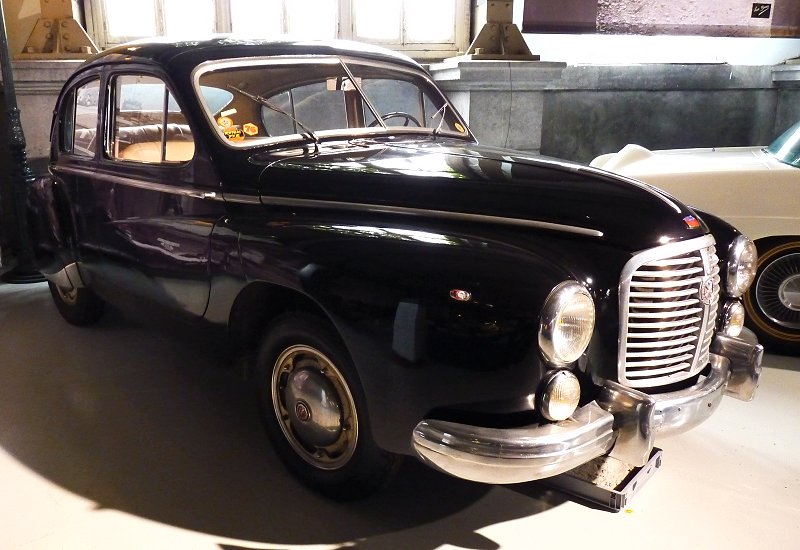
Hotchkiss Grégoire Berline
The Hotchkiss Grégoire Berline was one of the most technically advanced and forward-thinking French automobiles of the early 1950s—a bold attempt by the venerable Hotchkiss company to reinvent itself for the modern age. Introduced in 1950, the car was named after its designer, Jean-Albert Grégoire, a visionary engineer and early pioneer of front-wheel-drive and lightweight alloy construction. The Grégoire represented a radical departure from the conservative, hand-built luxury cars for which Hotchkiss was traditionally known, combining innovative engineering with a streamlined, aerodynamic design that looked toward the future rather than the past.
At its heart, the Hotchkiss Grégoire featured a 2.2-litre flat-four (boxer) engine, mounted longitudinally ahead of the front axle. This air-cooled, overhead-valve unit produced around 75 horsepower—modest by luxury car standards, but sufficient for the lightweight construction and aerodynamic body design. The use of a flat engine allowed for a low bonnet line, improving visibility and contributing to the car’s distinctive modern silhouette. Power was transmitted to the front wheels through a four-speed manual gearbox, reflecting Grégoire’s long-standing advocacy of front-wheel-drive layouts, which offered improved traction and interior space compared to conventional rear-wheel-drive systems.
The chassis was equally revolutionary. The Grégoire employed an all-aluminum monocoque structure—a remarkable achievement at the time—offering both rigidity and weight savings. This was a major innovation in an era when most cars still relied on separate steel frames. The suspension was fully independent, using torsion bars at both the front and rear, which provided a smooth and comfortable ride even on rough surfaces. Combined with the car’s low center of gravity and precise steering, the result was a remarkably composed and agile driving experience. The Hotchkiss Grégoire handled with a level of sophistication far ahead of most of its contemporaries.
The bodywork, designed in collaboration with Jean-Albert Grégoire and produced by Chausson, reflected a postwar vision of modernity. The Berline (sedan) featured a sleek, aerodynamic profile with smooth, flowing lines, an integrated grille, and minimal chrome trim. The gently sloping roofline and fully enclosed fenders gave the car a distinctly streamlined appearance, contrasting sharply with the more traditional styling of the Hotchkiss Anjou. The design was both elegant and functional, optimized for aerodynamic efficiency at a time when such considerations were still relatively novel in production cars.
Inside, the Grégoire Berline carried through its theme of modern simplicity. The cabin was spacious thanks to the front-wheel-drive layout, which eliminated the need for a large transmission tunnel. The seating was comfortable and trimmed in quality materials, with generous headroom and excellent visibility through large windows. The dashboard design was clean and functional, with clearly arranged instruments and controls reflecting the car’s modern engineering ethos. Though understated in appearance, the interior quality remained true to Hotchkiss standards, combining practicality with refinement.
On the road, the Hotchkiss Grégoire Berline was a revelation. The combination of its lightweight aluminum structure, advanced suspension, and low-drag design allowed it to achieve excellent fuel efficiency and impressive performance for its displacement. The car could reach around 145 km/h (90 mph) and cruise comfortably at highway speeds, with smooth handling and strong road-holding. Drivers praised its stability, precise steering, and supple ride quality—characteristics that would not become widespread in European cars until many years later.
However, while the Grégoire was a technical triumph, it struggled commercially. Its advanced aluminum construction and front-wheel-drive drivetrain made it expensive to produce, especially in a postwar economy where steel was cheaper and production simplicity was crucial. At a time when French buyers were gravitating toward more conventional cars from Peugeot, Citroën, and Renault, the Hotchkiss Grégoire’s engineering sophistication came at a price few were willing to pay. As a result, only a few hundred examples were built between 1950 and 1953, making it one of the rarest and most distinctive postwar French sedans.
The Grégoire was intended to usher Hotchkiss into a new era, but instead, it marked the end of the company’s automobile production. Its combination of innovation and low sales mirrored the struggles of other small luxury marques facing industrial giants. Despite this, the car earned lasting respect among engineers and enthusiasts as a bold, forward-looking design that anticipated technologies which would become standard decades later.
Today, the Hotchkiss Grégoire Berline is recognized as a remarkable achievement in automotive history—a car that married visionary engineering with refined execution. Collectors prize it not for its power or prestige, but for its originality and its role as a symbol of postwar French ingenuity. It remains a testament to Jean-Albert Grégoire’s brilliance and to Hotchkiss’s willingness, even in its twilight years, to innovate fearlessly. The Grégoire Berline stands as one of the most technically sophisticated and historically significant vehicles ever to bear the Hotchkiss name.
