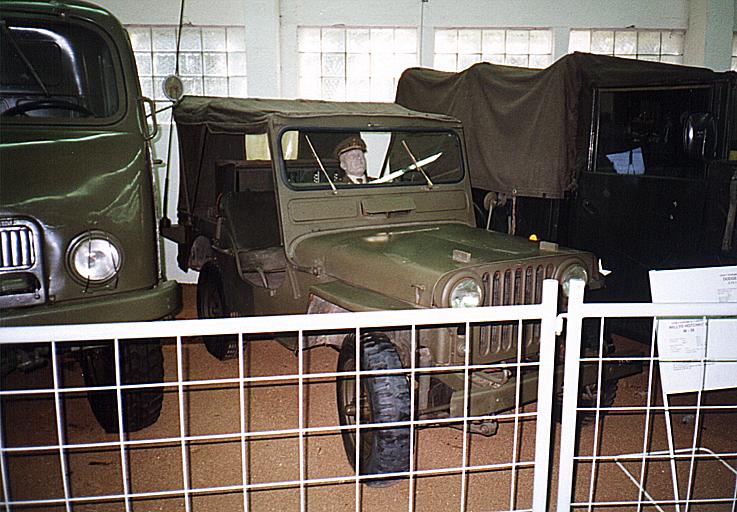
Hotchkiss Willys M38
The Hotchkiss Willys M38 was a French-built military vehicle derived from the American Willys Jeep, produced under license during the early 1950s. It represented the continuation of the rugged, utilitarian Jeep lineage that had proven itself indispensable during the Second World War. Manufactured by Hotchkiss et Cie, the M38 marked the company’s transition from building luxury automobiles to focusing primarily on military and industrial vehicles, a move that reflected the needs of postwar France and the country’s rearmament programs under NATO.
Following the liberation of France, thousands of American Jeeps remained in service with the French Army, and their reliability made them the natural foundation for continued military use. By the late 1940s, however, these wartime vehicles were aging and difficult to maintain. To address this, Hotchkiss acquired the license from Willys-Overland to produce parts and eventually complete vehicles in France. The result was the Hotchkiss Willys M38, often referred to locally as the Jeep Hotchkiss, which combined the proven American design with French manufacturing precision and incremental refinements.
The M38 was based on the U.S. military’s Willys M38 (or MC) model, itself an evolution of the wartime MB. It retained the same fundamental mechanical layout: a ladder-type steel chassis, four-wheel drive, and compact open-body design. Power came from the familiar Willys “Go-Devil” L-head four-cylinder engine, a 2.2-litre unit producing around 60 horsepower. Known for its dependability and simplicity, the engine was mated to a three-speed manual gearbox with a two-speed transfer case, giving the M38 true off-road capability and rugged versatility.
The Hotchkiss-built version adhered closely to the American specifications but with subtle improvements in finish and durability. The French military demanded high standards, and Hotchkiss, with its background in precision engineering, delivered a product that met them. The M38 featured a 24-volt electrical system, improved waterproofing, and enhanced reliability under harsh conditions. The suspension employed leaf springs and solid axles front and rear, giving it the toughness needed for rough terrain while remaining simple to maintain in the field.
Visually, the Hotchkiss Willys M38 carried the same unmistakable Jeep profile that had become iconic by the 1950s. Its flat front grille with vertical slats, fold-down windshield, exposed fenders, and utilitarian bodywork were instantly recognizable. Designed for function above all else, the M38 was practical, compact, and adaptable, able to serve as a reconnaissance vehicle, light transport, or command car. The interior was spartan, with simple metal seats, minimal instrumentation, and a focus on durability rather than comfort. Everything was built to be easily repaired or replaced in the field, continuing the Jeep’s wartime tradition of mechanical simplicity.
Hotchkiss production of the Willys M38 began in the early 1950s at the Saint-Denis factory near Paris. Initially, many of the components were imported from the United States, but over time French production became increasingly localized. This experience paved the way for the later and more famous Hotchkiss M201, an improved and fully French-built version of the Jeep that would go on to serve in the French military for decades. The M38 thus occupies an important transitional role, bridging the gap between the American wartime Jeeps and France’s domestically produced military vehicles.
In service, the M38 proved every bit as capable as its American predecessor. Its rugged design allowed it to tackle the roughest terrain, from mountain passes to muddy fields. It was used extensively by the French Army during the early years of the Cold War and in colonial operations, including service in North Africa and Indochina. Its reliability, ease of repair, and off-road ability made it a favorite among soldiers and mechanics alike.
Today, the Hotchkiss Willys M38 is a prized collector’s vehicle among military enthusiasts. It represents not only a piece of French industrial history but also the enduring legacy of one of the most famous military vehicles ever built. Combining the proven design of the American Jeep with the precision craftsmanship of Hotchkiss, the M38 stands as a symbol of postwar reconstruction and cooperation between American and European engineering traditions.
The Hotchkiss Willys M38 remains celebrated for its blend of rugged simplicity and historical significance—a vehicle that carried forward the Jeep spirit into a new era, keeping alive the tradition of reliability and versatility that had defined the original wartime legend.
