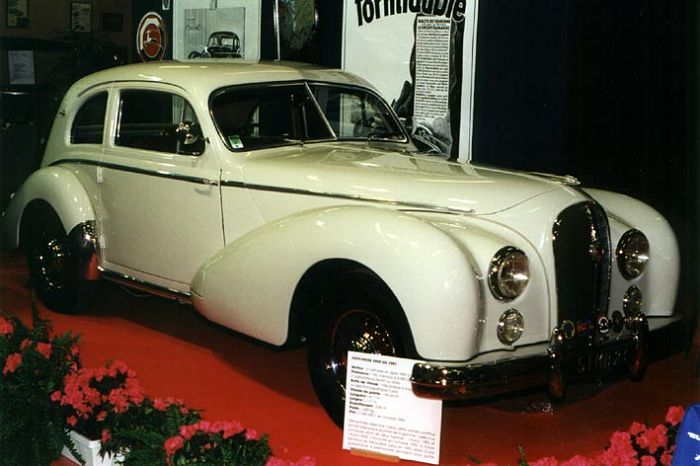
Hotchkiss Anjou 20.50 Grand Sport
The Hotchkiss Anjou 20.50 Grand Sport was the most refined, powerful, and exclusive version of the distinguished Anjou series—a final masterpiece from one of France’s most respected luxury car manufacturers. Produced in very limited numbers between 1951 and 1953, it marked the culmination of the company’s long tradition of building elegant, meticulously engineered touring cars. The Grand Sport combined the dignified design of the standard Anjou with enhanced performance and a touch of sporting character, creating a vehicle that blended power, grace, and craftsmanship in a uniquely French expression of postwar automotive excellence.
At the core of the Anjou 20.50 Grand Sport lay its 4.0-litre inline six-cylinder engine, one of the finest powerplants ever produced by Hotchkiss. Derived from the same family as the engines used in the earlier 686 and 20.50 models, this robust overhead-valve unit developed around 140 horsepower. It was renowned for its smoothness, flexibility, and quiet operation, characteristics that had long defined the marque. Power was delivered through a four-speed manual gearbox with precise, mechanical shifts, allowing the Grand Sport to reach speeds of up to 160 km/h (100 mph)—a remarkable achievement for a luxury touring car of its day. The car’s effortless acceleration and strong mid-range torque made it an ideal companion for long-distance travel across Europe’s newly emerging postwar motorways.
The chassis was a masterpiece of Hotchkiss engineering—rigid, balanced, and tuned for both comfort and composure. The Grand Sport featured a steel ladder-type frame with independent front suspension and a live rear axle supported by semi-elliptic leaf springs. Hydraulic brakes provided dependable stopping power, while the steering was smooth and responsive, giving the car excellent handling for its size and weight. Engineers also refined the suspension geometry to provide more stability at high speeds, lending the car a confident and planted feel that distinguished it from the standard Anjou.
The design of the 20.50 Grand Sport was subtle yet sophisticated, maintaining the elegant proportions of the Anjou while introducing sleeker, more aerodynamic lines. The long, gently curved bonnet, integrated fenders, and slightly lowered roofline gave the car a more purposeful stance. The vertical grille, adorned with the winged Hotchkiss badge, remained the visual centerpiece—a symbol of the marque’s proud engineering heritage. Chrome accents were restrained, emphasizing the car’s dignity rather than flamboyance. Every curve and contour reflected careful craftsmanship, with the panelwork executed to a level of precision that rivaled the best coachbuilt automobiles of the time.
While the standard Anjou was typically offered as a four-door saloon, the Grand Sport was often delivered in more exclusive configurations. Some examples were bodied as elegant two-door coupés or cabriolets by French artisans such as Henri Chapron or Letourneur et Marchand. These coachbuilt versions featured lighter bodies and slightly shorter wheelbases, enhancing the car’s sporting character while maintaining its luxury. Each was a bespoke creation, built largely by hand, and no two examples were exactly alike.
Inside, the Anjou 20.50 Grand Sport offered a level of craftsmanship and comfort that placed it among the finest luxury cars of its era. The cabin was upholstered in supple leather, complemented by polished hardwood veneers and finely machined fittings. The dashboard layout was elegantly functional, with clear instrumentation and solid, precisely engineered switchgear. The interior exuded an air of quiet refinement—the sort of understated luxury that rewarded close attention rather than immediate display. It was a car designed not to impress the crowd, but to satisfy its owner on every journey.
On the road, the Grand Sport lived up to its name. The six-cylinder engine delivered power with a sense of unhurried strength, capable of brisk acceleration yet happiest when cruising effortlessly at speed. The handling was poised and confidence-inspiring, with the suspension tuned for both comfort and control. Drivers praised the car’s smoothness and composure—traits that made it equally suited to fast continental travel or relaxed touring through the French countryside.
In keeping with Hotchkiss tradition, the 20.50 Grand Sport was built with exceptional precision and reliability. The company’s background in producing military equipment and high-quality machinery was reflected in every detail of its construction. Each component, from the gearbox to the suspension mountings, was designed for endurance and mechanical integrity. It was this combination of craftsmanship, engineering, and subtle design that gave Hotchkiss its reputation for producing some of the most dependable luxury cars of their time.
Production of the Anjou 20.50 Grand Sport was limited to only a handful of examples, as the market for hand-built luxury cars was shrinking rapidly in postwar France. Rising production costs and changing consumer tastes made it increasingly difficult for artisanal manufacturers to compete with larger firms. By 1954, Hotchkiss had merged with Delahaye, and its focus shifted toward commercial and military vehicles, bringing an end to its era of grand touring automobiles.
Today, the Hotchkiss Anjou 20.50 Grand Sport is one of the most sought-after models from the marque’s history. Collectors value it for its rarity, mechanical excellence, and graceful styling—qualities that embody the best traditions of French automotive craftsmanship. It stands as the ultimate expression of the Hotchkiss philosophy: a car of substance rather than ostentation, built for those who appreciated precision, durability, and quiet sophistication. The Grand Sport remains a fitting finale to the legacy of one of France’s most revered automobile makers—a grand touring machine that carried its heritage with dignity and enduring grace.
